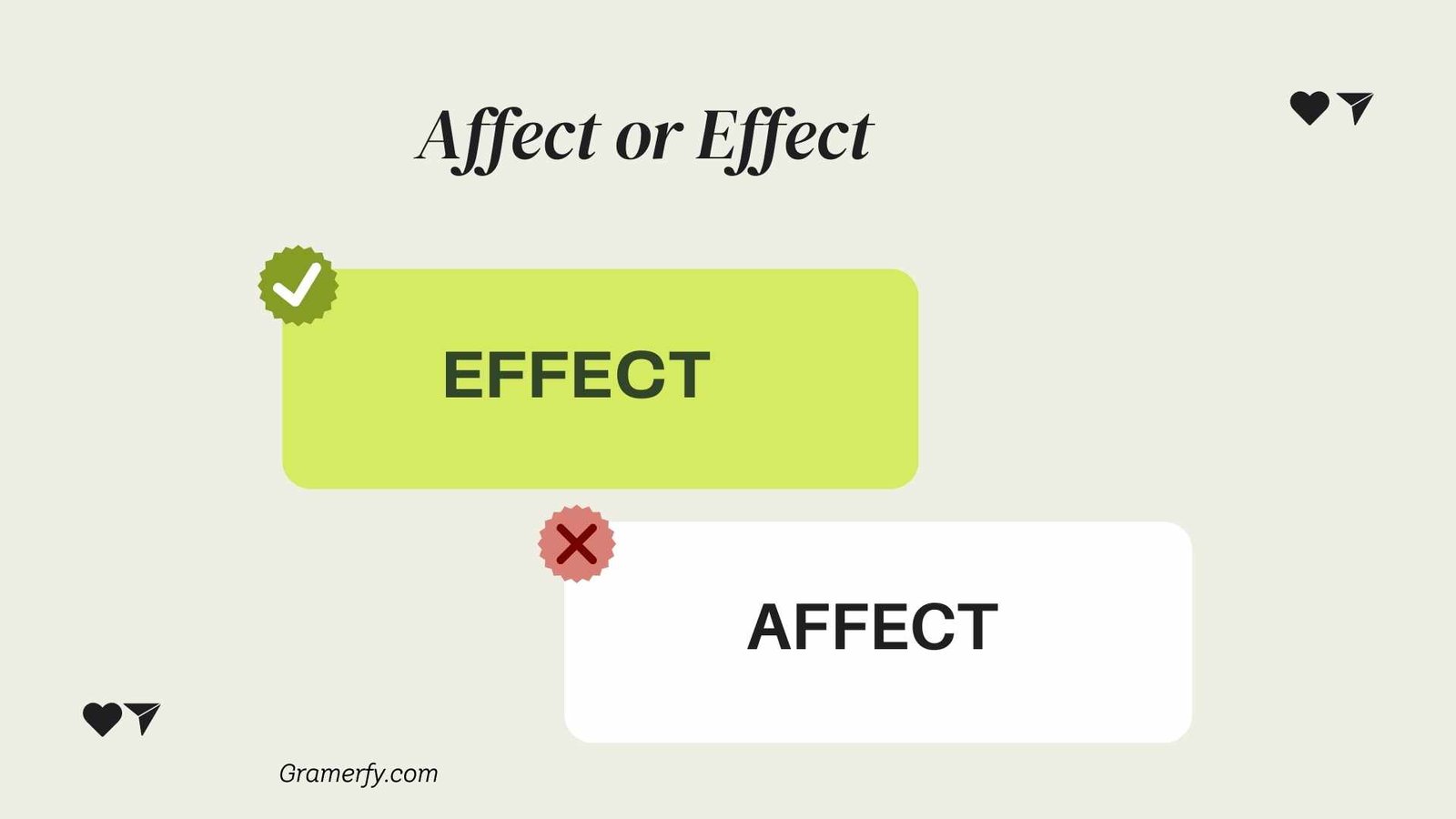
Confused between “Affect” and “Effect”? You’re not alone! These two words sneak into writing and conversation so often that even seasoned writers stumble over them.
Though they sound similar, their meanings and roles in a sentence are worlds apart one is usually a verb, the other a noun. Understanding the difference isn’t just about grammar; it’s about clarity, impact, and making your words truly resonate.
Imagine sending an important email, writing a blog post, or crafting a story, only to have your audience pause because a simple “affect” or “effect” threw them off. Learning this distinction can instantly elevate your writing, making it precise, professional, and persuasive.
What Does “Affect” Mean?
Affect is usually a verb, which means it shows an action, something that happens to someone or something.
- Meaning: To influence or make a change in something.
- Part of speech: Verb
- Pronunciation: /əˈfekt/
Examples of “Affect”
- The heavy rain affected the football match.
- Her speech deeply affected the audience.
- Stress can affect your sleep patterns.
- Smoking negatively affects your health.
✅ Tip: If you can replace the word with “influence”, then “affect” is likely correct.
What Does “Effect” Mean?
Effect is usually a noun, which means it is a thing, the result of a change.
- Meaning: A result or outcome of an action or event.
- Part of speech: Noun
- Pronunciation: /ɪˈfekt/
Examples of “Effect”
- The new law had a positive effect on the economy.
- The medicine had a strong effect on his headache.
- The speech created a lasting effect on the audience.
- Lack of sleep can have serious effects on your health.
✅ Tip: If you can replace the word with “result” or “outcome”, then “effect” is likely correct.
Affect vs Effect: Quick Comparison Table
| Feature | Affect | Effect |
| Part of speech | Verb | Noun |
| Meaning | To influence or change | The result of a change |
| Example sentence | His words affected me deeply. | His words had a strong effect on me. |
| Synonyms | Influence, change | Result, outcome |
| Common mistake | Using “effect” as a verb | Using “affect” as a noun |
When “Effect” is Used as a Verb
Although rare, effect can also be a verb, meaning to cause something to happen.
- Example: The new manager effected positive changes in the company.
- Tip: This usage is formal and uncommon in everyday conversation. Most learners only need to worry about “effect” as a noun.
Common Mistakes with Affect and Effect
- Incorrect: The medicine will affect my headache.
Correct: The medicine will have a positive effect on my headache. - Incorrect: Her words effected me deeply.
Correct: Her words affected me deeply. - Confusing spellings: Remember Affect = Action, Effect = End result.
Spelling Tips to Remember
- Affect starts with A, like Action → use as a verb.
- Effect starts with E, like End result → use as a noun.
These simple associations help prevent mistakes, especially in writing exams or professional documents.
Examples in Everyday Life
Affect
- The cold weather affected my mood.
- Loud music can affect your concentration.
- Bad habits affect your productivity.
Effect
- The new law had an immediate effect on traffic rules.
- Meditation can have a calming effect on your mind.
- The movie left a lasting effect on the audience.
FAQs (People Also Ask)
1. Can “effect” be a verb?
Yes, but it’s rare. As a verb, “effect” means to cause something to happen, usually in formal or professional contexts.
2. Is “affect” ever a noun?
Yes, but only in psychology, where it refers to emotion or mood, e.g., “The patient showed a flat affect.” This is advanced usage.
3. How can I remember the difference?
- Affect → Action (verb)
- Effect → End result (noun)
4. Are there any shortcuts for spelling?
- Affect starts with A → Action
- Effect starts with E → End result
5. Which is more common in writing?
- Affect is more common in everyday actions (verbs).
- Effect is more common when talking about results (nouns).
Conclusion
Understanding the difference between affect and effect is simpler than it seems. By practicing these rules and using the tips above, you’ll write confidently without mixing these words. Correct usage makes your English clearer, more professional, and easier to understand.
Next time you write a sentence, ask yourself: Am I talking about an action or a result? The answer will guide you to the correct word. With practice, the confusion between affect and effect will disappear, and your writing will shine!