Confused about when to use “Anyway” or “Anyways”? You’re not alone. These two tiny words might seem interchangeable, but choosing the right one can completely change the tone of your sentence.
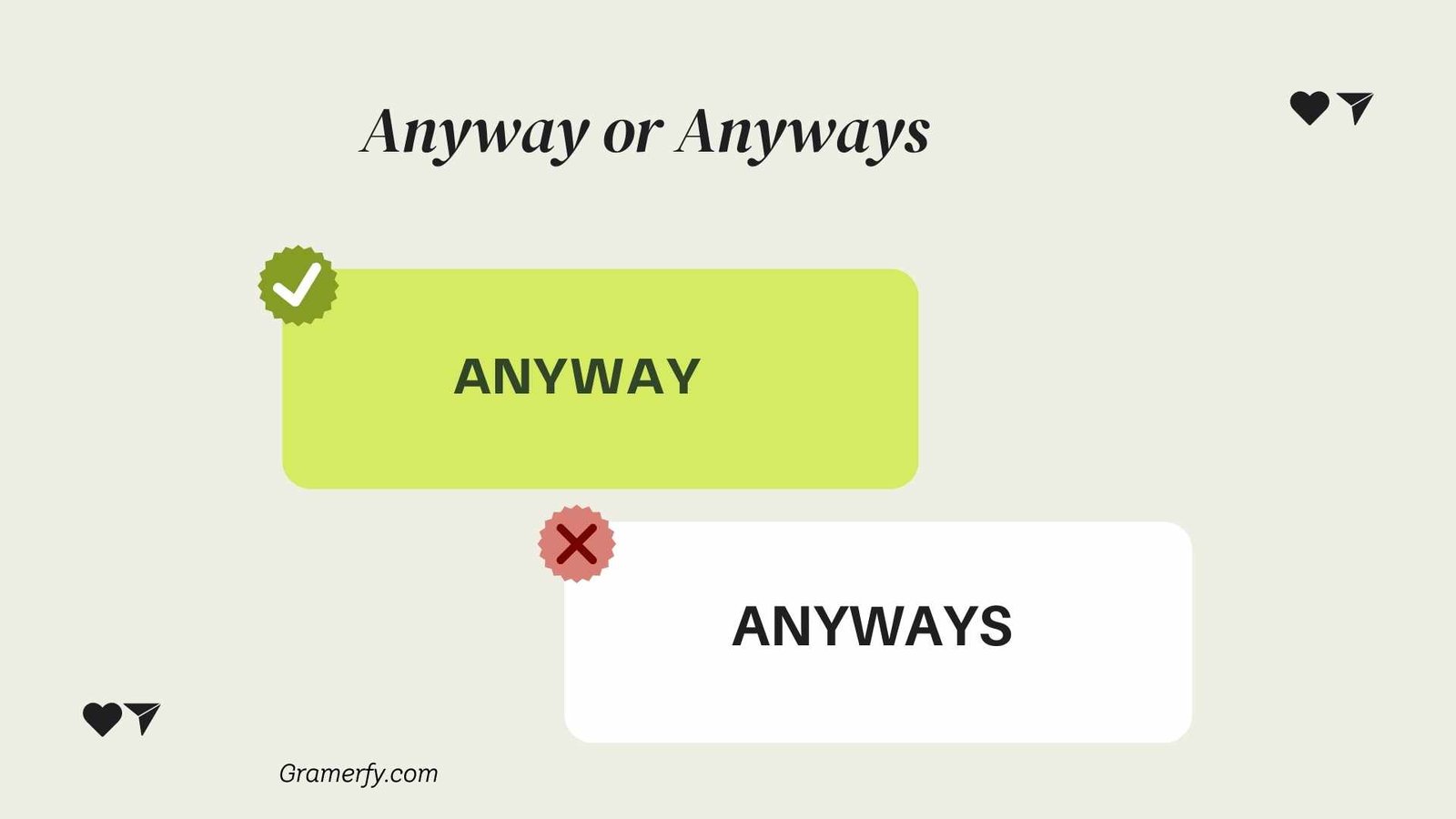
“Anyway” is crisp, professional, and universally accepted in both writing and speech, while “Anyways” has a casual, conversational flair perfect for texting or informal chats, but frowned upon in formal writing.
Many people mix them up, leaving sentences sounding awkward or unpolished. Imagine sending an important email and accidentally slipping in “anyways” it instantly shifts the vibe from confident to careless.
What Does “Anyway” Mean?
Anyway is an adverb commonly used in English. It has several meanings depending on the context:
- To continue a conversation or change a topic:
- Example: Anyway, let’s move on to the next topic.
- Example: Anyway, let’s move on to the next topic.
- To indicate a result or conclusion despite difficulties:
- Example: It was raining, but we went for a walk anyway.
- Example: It was raining, but we went for a walk anyway.
- To return to the main point:
- Example: Anyway, as I was saying earlier…
- Example: Anyway, as I was saying earlier…
- To show dismissal or indifference:
- Example: I don’t think it matters anyway.
- Example: I don’t think it matters anyway.
Key point: “Anyway” is standard English and widely accepted in both formal and informal contexts.
What Does “Anyways” Mean?
Anyways is considered a nonstandard variant of anyway, mostly used in casual spoken English.
- Example: Anyways, let’s finish this project.
While people do use it in conversations, anyways is generally not recommended in formal writing.
Fun fact: Linguists note that anyways is more common in some regions, especially in American English, but it is still considered informal or colloquial.
Comparison: Anyway vs Anyways
Here’s a quick comparison to understand the difference:
| Feature | Anyway | Anyways |
| Formality | Standard, formal and informal | Informal, casual |
| Usage | Writing and speaking | Mostly spoken English |
| Acceptable in writing | Yes, both formal and informal | Rarely; not recommended in formal writing |
| Meaning | To indicate continuation, result, or dismissal | Same as anyway, but informal |
| Grammar experts’ opinion | Preferred | Often considered incorrect in formal contexts |
Tip: If you are unsure, always use anyway. It is correct in all situations.
Common Mistakes with “Anyway” and “Anyways”
- Using “anyways” in formal writing:
- ❌ Wrong: Anyways, the results are final.
- ✅ Correct: Anyway, the results are final.
- ❌ Wrong: Anyways, the results are final.
- Misplacing “anyway” in sentences:
- ❌ Wrong: She went to the store anyway it was raining.
- ✅ Correct: She went to the store anyway, even though it was raining.
- ❌ Wrong: She went to the store anyway it was raining.
- Confusing meaning with “anyhow” or “in any case”:
- Anyway can sometimes be replaced with anyhow, but context matters.
- Anyway can sometimes be replaced with anyhow, but context matters.
- Overusing either word:
- Avoid starting every sentence with anyway/anyways—it can make writing sound repetitive.
- Avoid starting every sentence with anyway/anyways—it can make writing sound repetitive.
Tips for Correct Usage
- Always use anyway in formal writing, emails, reports, essays, and professional messages.
- Use anyways only in casual conversation or informal messages.
- Remember: anyway = standard; anyways = informal/colloquial
- Punctuate correctly: use a comma after “anyway” when starting a sentence.
Examples of Correct Usage
Using “Anyway”
- To continue a conversation:
- Anyway, I wanted to ask you about your plans for the weekend.
- Anyway, I wanted to ask you about your plans for the weekend.
- To show a result:
- He was tired, but he finished the assignment anyway.
- He was tired, but he finished the assignment anyway.
- To dismiss something:
- It’s too late to apologize, and it doesn’t matter anyway.
- It’s too late to apologize, and it doesn’t matter anyway.
- To return to a topic:
- Anyway, let’s get back to the main discussion.
- Anyway, let’s get back to the main discussion.
Using “Anyways” (Informal)
- Casual conversation:
- Anyways, what were you saying about the party?
- Anyways, what were you saying about the party?
- Text messages or chat:
- Anyways, I have to go now. Talk later!
- Anyways, I have to go now. Talk later!
- Regional speech patterns (common in American English):
- Anyways, he didn’t show up again.
- Anyways, he didn’t show up again.
FAQs: People Also Ask
1. Is “anyways” incorrect?
Answer: Technically, anyways is considered informal or nonstandard. It is widely used in speech, but in formal writing, anyway is preferred.
2. Can I use “anyway” and “anyways” interchangeably?
Answer: In casual speech, yes. In formal writing, stick to anyway.
3. Which is more correct in writing, anyway or anyways?
Answer: Anyway is always correct. Anyways should be avoided in essays, emails, or official documents.
4. What is the origin of “anyways”?
Answer: Anyways developed as a colloquial variant of anyway over time, mainly in North America. It is informal by nature.
5. Can “anyway” start a sentence?
Answer: Yes, especially when changing topics or returning to the main point. Always follow it with a comma.
Quick Spelling & Usage Tips
- Remember the spelling: anyway (1 “s”) is always correct in formal contexts.
- Avoid adding “s” unnecessarily: Many beginners write anyways thinking it’s plural—this is incorrect in standard English.
- Check the context: If you are speaking informally, anyways is fine. In formal situations, never use it.
Conclusion
In the end, both “anyway” and “anyways” appear in everyday language, but they aren’t exactly interchangeable. “Anyway” is the standard, widely accepted form, suitable for formal writing, professional emails, and proper grammar contexts. It works perfectly to show contrast, change topics, or continue a point.
“Anyways”, on the other hand, is informal, often used in casual speech or social media, giving a relaxed, conversational tone. To stay safe in writing and maintain credibility, stick with “anyway.” Use “anyways” sparingly, mostly when mimicking speech or creating a friendly, playful vibe. Understanding the difference ensures your sentences always feel polished and natural.