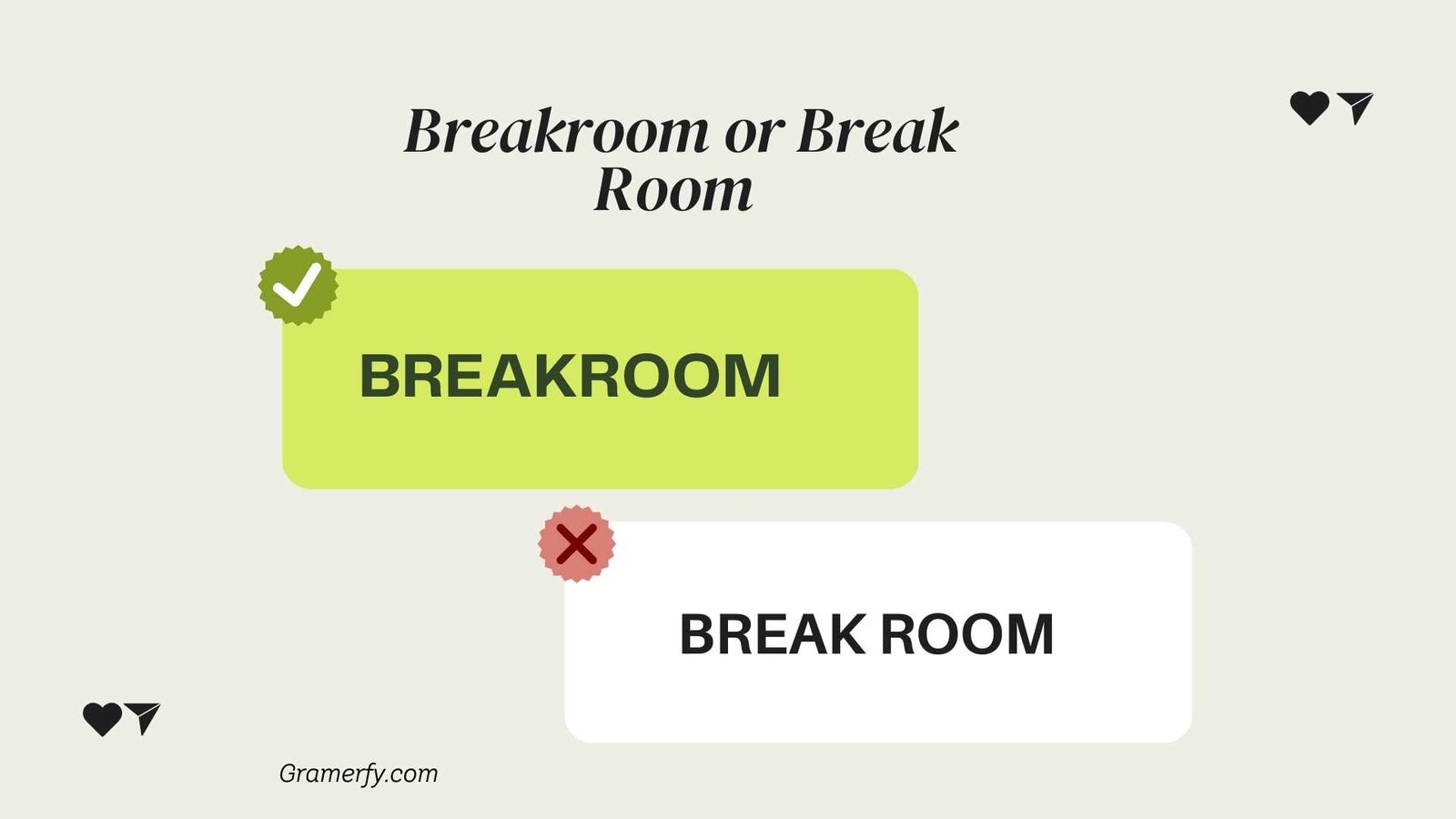
In every workplace, there’s one magical space that employees secretly look forward to: the breakroom, or as some call it, the break room.
More than just a place to grab a cup of coffee or heat up lunch, it’s the heartbeat of office culture a spot where ideas spark, laughter echoes, and bonds are strengthened.
It’s sharing a quick joke with a colleague, taking a moment to recharge, or finding inspiration for your next big project, the breakroom transforms ordinary workdays into memorable ones.
What Does “Break Room” Mean?
A break room is a room in a workplace or office where employees can take a rest, have snacks, or enjoy informal conversations. It’s a dedicated space for relaxation during work hours.
Key Points:
- Usually found in offices, hospitals, schools, and other workplaces.
- Equipped with chairs, tables, coffee machines, microwaves, or refrigerators.
- Helps employees recharge and improve productivity.
Example Sentences:
- I left my bag in the break room before heading to the meeting.
- The office break room has a new coffee machine.
What About “Breakroom”?
The term breakroom is a closed compound word that combines “break” and “room” into one word. This form is increasingly used, especially in American English, but it’s less common in formal writing.
Key Points:
- Often seen in casual communication or signage.
- Still refers to the same type of room for taking breaks.
- Can appear in emails, workplace announcements, or digital content.
Example Sentences:
- Please leave your lunch in the breakroom fridge.
- The company renovated the breakroom last month.
Breakroom vs Break Room: Comparison Table
| Feature | Break Room | Breakroom |
| Word Type | Two separate words | Closed compound word |
| Usage | Formal and standard | Informal or modern |
| Accepted in dictionaries | Yes | Sometimes, mostly in US English |
| Example | “She went to the break room for coffee.” | “Sign: Welcome to the breakroom!” |
| Recommendation | Preferred for formal writing | Acceptable in casual contexts |
Common Mistakes and Spelling Tips
Even simple words like these can trip up writers. Here are some tips:
- Don’t overcomplicate it – Stick to break room in formal writing.
- Avoid hyphenation – “break-room” is usually unnecessary.
- Be consistent – Choose one style and use it throughout a document.
- Check your audience – Casual notes or emails can use breakroom, while reports should use break room.
Incorrect Examples:
- I left my bag in the break-room. ✅ Avoid the hyphen.
- Let’s meet in the breakroom. ❌ Acceptable informally, not formally.
When to Use “Break Room”
- Formal documents, memos, or reports.
- Company handbooks or HR guidelines.
- Academic writing or articles about workplace culture.
Example Sentences:
- Employees are encouraged to take a short walk in the break room to refresh themselves.
- The break room policy is outlined in the employee handbook.
When “Breakroom” Is Acceptable
- Casual emails or messages to colleagues.
- Signage within offices or workplaces.
- Social media posts or internal newsletters.
Example Sentences:
- The new breakroom has free snacks and drinks.
- Check out our updated breakroom decorations!
Examples of Correct Usage in Context
- Formal Writing (Use “Break Room”)
- The company renovated the break room to make it more comfortable for employees.
- Employees must clean the break room after using it.
- The company renovated the break room to make it more comfortable for employees.
- Informal or Casual Writing (Use “Breakroom”)
- The breakroom now has a coffee machine and a mini fridge.
- I’ll meet you in the breakroom after the meeting.
- The breakroom now has a coffee machine and a mini fridge.
FAQs (People Also Ask)
1. Is “breakroom” a real word?
Yes, it is recognized in some dictionaries, mostly American English, but it is informal compared to break room.
2. Can I use “breakroom” in official documents?
It’s better to use break room in formal documents to avoid looking unprofessional.
3. Should I hyphenate it as “break-room”?
No. Hyphenation is unnecessary and uncommon. Stick to break room or breakroom depending on context.
4. Which is more common: break room or breakroom?
Break room is more widely accepted, especially in formal writing. Breakroom is increasingly common in informal contexts.
5. Does the spelling differ in British and American English?
Not significantly. Both forms exist in American English. In British English, break room is preferred.
Tips to Remember
- If in doubt, always choose “break room” for clarity and professionalism.
- Use breakroom only in casual or internal contexts.
- Avoid inconsistent usage in the same document.
- Think about your audience and tone before choosing a form.
Conclusion
Understanding the difference between break room and breakroom is simple once you know the rules. Use break room for formal contexts and breakroom for casual or modern usage. Both refer to the same concept: a place where employees take a break and recharge.
By applying these tips, you can write confidently and avoid common mistakes. Whether in emails, office signs, or workplace guides, the correct usage will make your writing look polished and professional.