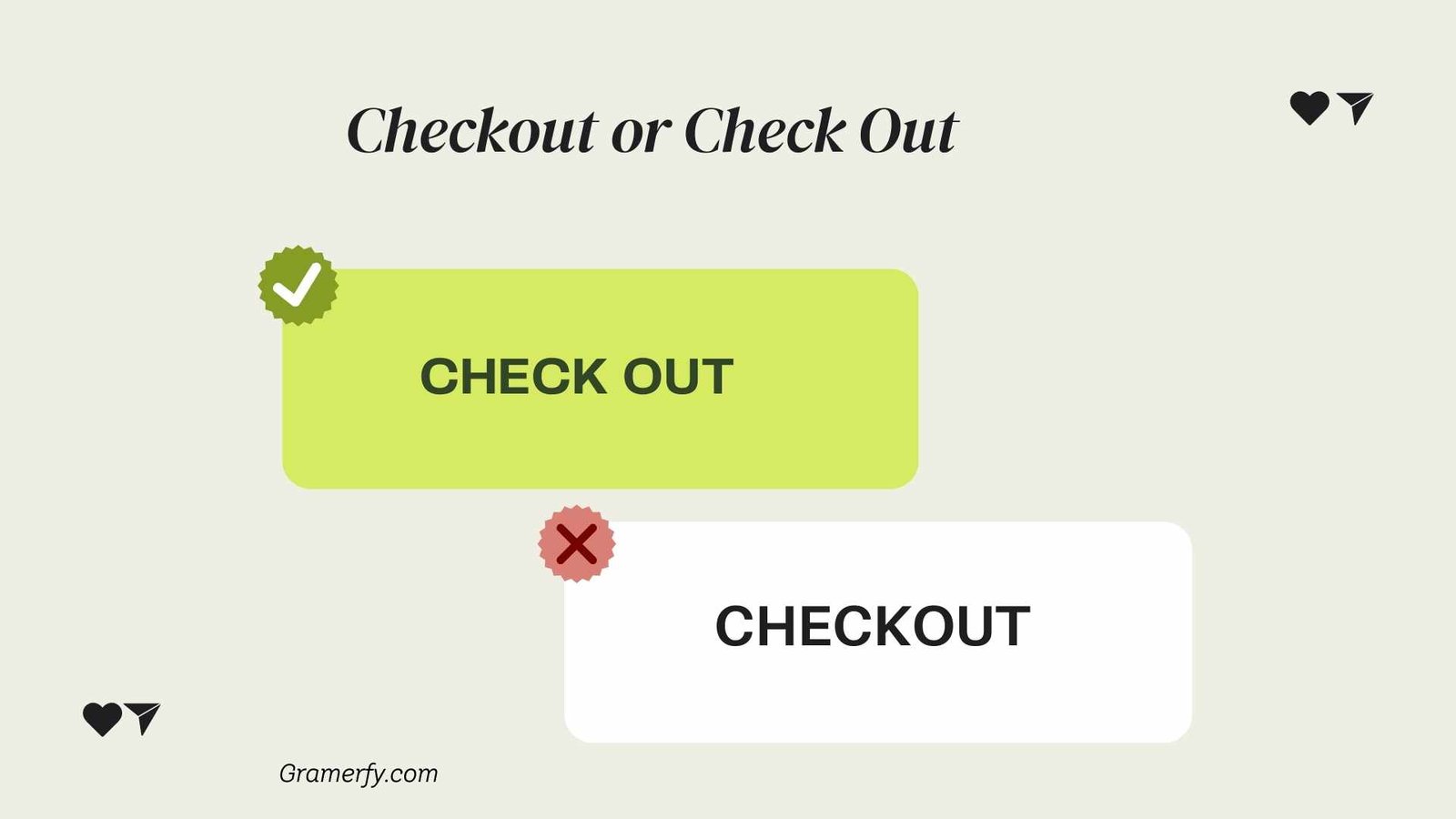
Are you often puzzled by whether to write “checkout” or “check out”? You’re not alone! Many stumble over this tiny yet powerful pair of words that can completely change the meaning of a sentence.
While they may sound identical, the difference is crucial one can refer to the action of leaving or verifying something, while the other is often a noun, describing a place or process.
Imagine sending the wrong version in your email, blog, or online store it could confuse your readers, customers, or even ruin your professional image!
What Does “Checkout” Mean?
Checkout is usually a noun or an adjective. It is one word.
As a Noun
When used as a noun, checkout refers to:
- A place where you pay for items in a store.
- The process of paying for items.
Examples:
- I went to the supermarket and waited at the checkout.
- The online checkout was quick and easy.
As an Adjective
Sometimes, checkout is used as an adjective before a noun to describe the payment area or process.
Examples:
- I used the checkout counter at the store.
- Please fill out the checkout form before leaving.
Quick Tip: If you can replace the word with “payment” and it still makes sense, it’s probably checkout.
What Does “Check Out” Mean?
Check out is a phrasal verb and always written as two words. It describes the action of:
- Examining or inspecting something.
- Leaving a hotel or completing a process.
Examples:
- Don’t forget to check out of the hotel before 11 a.m.
- You should check out the new restaurant in town.
- I will check out that book from the library.
Quick Tip: If you can replace it with “look at” or “inspect”, it’s likely check out.
Comparison Table: Checkout vs Check Out
| Feature | Checkout | Check Out |
| Part of speech | Noun / Adjective | Phrasal verb |
| Meaning | Payment area / process | Examine, inspect, leave |
| Number of words | One word | Two words |
| Example | The checkout was long. | Please check out this app. |
| Use in sentence | Usually with a thing (noun) | Usually with an action (verb) |
Common Mistakes with Checkout and Check Out
- Using “checkout” as a verb
- ❌ Wrong: I will checkout the new book.
- ✅ Correct: I will check out the new book.
- Using “check out” as a noun
- ❌ Wrong: I paid at the check out.
- ✅ Correct: I paid at the checkout.
- Confusing hotel check-out with checkout
- ❌ Wrong: I did the hotel checkout at noon.
- ✅ Correct: I did the hotel check-out at noon.
(Note: “check-out” can be hyphenated when used as a noun.)
- Spelling errors
- ❌ Wrong: chek out or checkot
- ✅ Correct: check out (phrasal verb) / checkout (noun)
Tips to Remember the Difference
- One word = noun/adjective → checkout
- Two words = action → check out
- Substitute test:
- Can you say “payment”? → checkout
- Can you say “look at”? → check out
- Can you say “payment”? → checkout
Examples in Real-Life Sentences
Using Checkout (noun/adjective)
- The checkout line was very long on Black Friday.
- I prefer the self-service checkout at the supermarket.
- The checkout page of the website was easy to navigate.
Using Check Out (phrasal verb)
- Make sure to check out of your hotel before noon.
- You should check out this tutorial online.
- I want to check out that new café downtown.
Mixed Example
- After completing the checkout, I decided to check out the store’s new arrivals.
Online Shopping Context
In e-commerce, this confusion happens a lot:
- Checkout (noun): The page where you pay for items in your cart.
- Go to the checkout to complete your purchase.
- Go to the checkout to complete your purchase.
- Check out (verb): To view or explore products or services.
- You should check out our latest collection online.
- You should check out our latest collection online.
Hotel and Travel Context
- Check-out (noun): The process of leaving the hotel.
- Hotel check-out is at 12 PM.
- Hotel check-out is at 12 PM.
- Check out (verb): To leave or inspect something.
- Please check out your room before leaving.
- Let’s check out the museum before it closes.
- Please check out your room before leaving.
Grammar Rules and Tips
- Checkout as Noun
- Can take articles: a checkout, the checkout
- Can take articles: a checkout, the checkout
- Checkout as Adjective
- Usually before a noun: checkout process, checkout counter
- Usually before a noun: checkout process, checkout counter
- Check Out as Verb
- Can take objects: check out the book, check out the offer
- Can take objects: check out the book, check out the offer
- Tense Usage
- Present: I check out the store.
- Past: I checked out the new app yesterday.
- Future: I will check out the hotel tomorrow.
- Present: I check out the store.
Common Expressions with “Check Out”
- Check out of: Leaving a place
- I will check out of the hotel at 10 a.m.
- I will check out of the hotel at 10 a.m.
- Check out for: Look for or inspect something
- Check out for discounts online.
- Check out for discounts online.
- Check somebody out: Examine or observe someone
- He was checking out the new employee’s work.
- He was checking out the new employee’s work.
Quick Quiz to Test Your Knowledge
Choose the correct option:
- I went to the _______ to pay for my groceries.
- a) check out
- b) checkout ✅
- a) check out
- Don’t forget to _______ of the hotel before 12 PM.
- a) checkout
- b) check out ✅
- a) checkout
- You should _______ this amazing article online.
- a) check out ✅
- b) checkout
- a) check out ✅
- The _______ counter was crowded during the sale.
- a) checkout ✅
- b) check out
- a) checkout ✅
FAQs (People Also Ask Style)
1. Can “checkout” be used as a verb?
No. “Checkout” is a noun or adjective. The verb form is always check out.
2. When should I use “check out” as two words?
Use “check out” when describing an action, like inspecting, leaving, or examining something.
3. Is “check-out” with a hyphen correct?
Yes. When used as a noun in formal writing, “check-out” with a hyphen is acceptable: Hotel check-out is at 12 PM.
4. Can I say “I checked out the checkout”?
Technically yes, but it’s rare. It means you examined the payment process: I checked out the online checkout page.
5. How do I remember the difference?
- One word = noun/adjective → checkout
- Two words = verb → check out
Conclusion
Understanding the difference between checkout and check out is easier than it seems. Remember:
Use the simple substitution tests, remember the context (shopping, hotel, online), and practice with real-life examples. Soon, using the correct form will become second nature.