In today’s fast-paced world, clutter and mess can quietly drain your energy and productivity. That’s where the power of a Cleanup or Clean Up comes in.
It’s tidying your home, organizing your workspace, or even doing a digital declutter, a proper cleanup transforms chaos into calm and stress into satisfaction. Imagine walking into a space that feels fresh, organized, and inviting every corner reflecting clarity and purpose.
A cleanup is more than just putting things in order; it’s about creating a sanctuary where your mind can breathe, focus sharpens, and creativity flourishes.
What Does “Clean Up” Mean?
“Clean up” as a Verb (Action Word)
Clean up is a phrasal verb.
It describes the action of making something clean, tidy, or organized.
If you can do it, it’s probably clean up.
Simple Definition
Clean up means to remove dirt, mess, or unwanted things from a place or object.
When to Use “Clean Up”
Use clean up when:
- Talking about an action
- Describing something someone does
- Referring to cleaning as a verb
Examples of “Clean Up” in Sentences
- Please clean up your room.
- She helped clean up after the party.
- We need to clean up the kitchen.
- He promised to clean up his mistakes.
- The workers will clean up the beach tomorrow.
👉 In all these examples, clean up shows an action.
What Does “Cleanup” Mean?
“Cleanup” as a Noun or Adjective
Cleanup is one word, and it is usually a noun.
Sometimes, it can also be used as an adjective.
Simple Definition
Cleanup refers to the process, event, or result of cleaning.
When to Use “Cleanup”
Use cleanup when:
- Referring to a thing, not an action
- Talking about a task, event, or operation
- Using it as a descriptive word
Examples of “Cleanup” in Sentences
- The cleanup took several hours.
- A beach cleanup event was organized.
- The oil spill cleanup was expensive.
- After the storm, the cleanup began.
- Volunteers joined the community cleanup.
👉 Here, cleanup is a noun-it names an activity or event.
Cleanup vs Clean Up: Key Differences Explained
Understanding the difference is easy when you remember this rule:
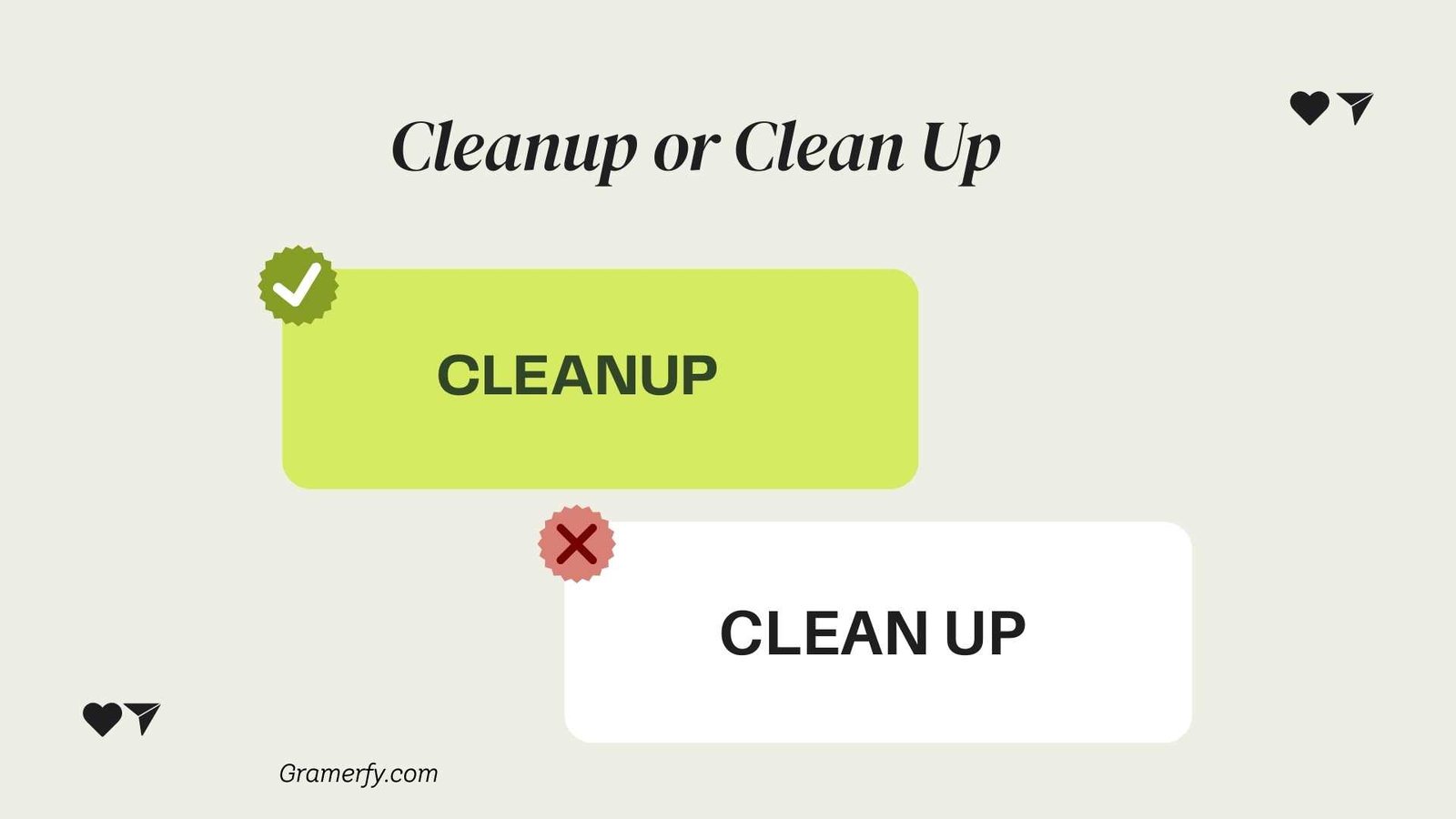
If it’s an action → clean up
If it’s a thing or event → cleanup
Comparison Table: Cleanup vs Clean Up
| Feature | Clean Up | Cleanup |
| Part of speech | Verb (phrasal verb) | Noun / Adjective |
| Number of words | Two words | One word |
| Usage | Action | Thing or event |
| Example | Please clean up | The cleanup was quick |
How to Decide Which One to Use (Easy Trick)
Ask yourself this question:
“Am I describing an action or naming a thing?”
- Action? → Use clean up
- Thing/Event? → Use cleanup
Example Test
- We need to ___ the house.
✔ clean up (action) - The ___ will take hours.
✔ cleanup (thing)
This simple test works every time.
“Clean Up” Used in Different Tenses
Because clean up is a verb, it can change tense.
Present Tense
- I clean up every morning.
- She cleans up her desk daily.
Past Tense
- They cleaned up the mess.
- He cleaned up after dinner.
Future Tense
- We will clean up later.
- She is going to clean up the garage.
“Cleanup” Used as a Noun
As a noun, cleanup stays the same and does not change form.
Examples
- The park cleanup starts at 9 AM.
- The office cleanup was successful.
- The post-festival cleanup took days.
“Cleanup” Used as an Adjective
Sometimes cleanup is used to describe another noun.
Examples
- Cleanup operation
- Cleanup campaign
- Cleanup crew
In these cases, cleanup acts like an adjective.
Common Mistakes to Avoid
Many writers make simple but serious mistakes with these words.
❌ Wrong: Using “cleanup” as a verb
- ❌ Please cleanup your room.
- ✔ Please clean up your room.
❌ Wrong: Using “clean up” as a noun
- ❌ The clean up took hours.
- ✔ The cleanup took hours.
Spelling Tips to Remember
Here are easy spelling tips you can remember forever:
- Two words = action → clean up
- One word = name of task → cleanup
Memory Trick
If you can put “to” before it, use clean up
Example: to clean up the room
If you can put “the” before it, use cleanup
Example: the cleanup was quick
Cleanup or Clean Up in American vs British English
Good news! 😊
There is no difference between American and British English here.
- Americans use cleanup and clean up
- British English uses cleanup and clean up
The rules are the same everywhere.
Cleanup or Clean Up in Formal Writing
Formal Writing Tips
- Use cleanup in reports, news articles, and official documents
- Use clean up in instructions and action-based sentences
Examples
- The environmental cleanup was approved. (formal)
- Workers must clean up the area. (instruction)
Real-Life Examples in Context
Home
- Please clean up your bedroom.
- The weekend cleanup is planned.
Office
- Employees must clean up their desks.
- The office cleanup happens monthly.
Environment
- Volunteers clean up beaches.
- A beach cleanup saves wildlife.
Frequently Asked Questions (FAQs)
Is it “cleanup” or “clean up”?
Both are correct.
Use clean up as a verb and cleanup as a noun.
Can “cleanup” be used as a verb?
No.
Cleanup is not a verb.
Use clean up for actions.
Is “clean-up” with a hyphen correct?
Sometimes.
Hyphenated clean-up is acceptable in older or British-style writing, but cleanup is more common today.
Which one is more common?
- Clean up is more common in speech.
- Cleanup is more common in writing.
Can I use both in one sentence?
Yes!
- We need to clean up before the cleanup inspection.
Final Thoughts:
In conclusion, understanding the difference between “cleanup” and “clean up” is essential for clear and accurate communication. “Cleanup” is a noun, referring to the act or process of cleaning, like “The park needs a cleanup.” On the other hand, “clean up” is a verb phrase, describing the action itself, as in “Please clean up your room.”
Mixing them up can confuse readers and weaken your writing. By remembering their specific roles in a sentence, you can write with precision and confidence. Mastering this simple distinction elevates your English, making your messages polished and professional.