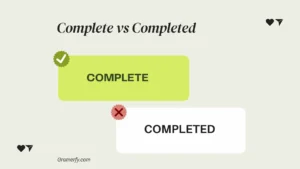
Have you ever stopped while writing and wondered whether you should use “complete” or “completed”? You’re not alone.
Many English learners and even fluent writers often pause at this small but confusing choice. At first glance, the two words look almost identical. However, their usage can change the meaning and structure of a sentence.
Think of it this way: one word often describes something that is whole or finished, while the other usually talks about an action that has already been finished. That small difference can make your sentence clearer or completely confusing.
What Does “Complete” Mean?
The word “complete” can function as an adjective or a verb.
As an Adjective
When used as an adjective, “complete” describes something that has all necessary parts or is whole.
Examples:
- I have a complete set of stamps.
- She gave a complete explanation of the problem.
- This puzzle is complete.
As a Verb
As a verb, “complete” means to finish something or make it whole.
Examples:
- I need to complete my homework before dinner.
- They will complete the project next week.
- Please complete the form carefully.
What Does “Completed” Mean?
“Completed” is the past tense and past participle form of the verb “complete.” It indicates that an action has already been finished.
Examples:**
- She completed the assignment yesterday.
- The construction of the building was completed in 2020.
- I have completed my online registration.
Notice that “completed” always refers to an action that is already done, unlike “complete,” which can describe something ongoing or whole.
Key Differences Between Complete and Completed
Here’s a quick table to clarify the differences:
| Aspect | Complete | Completed |
| Part of Speech | Adjective / Verb | Verb (past tense/past participle) |
| Meaning | Whole, finished, or perfect | Finished action in the past |
| Usage Example | This is a complete guide. | I have completed my homework. |
| Time Reference | Present or general state | Past or finished actions |
| Common Confusion | Can be used in place of “completed” | Cannot be used as an adjective |
How to Use “Complete” Correctly
Tips:
- Use complete when describing something that is whole or finished.
- It works well in general statements or as instructions.
Examples:
- I need a complete list of all participants.
- She wants to complete her degree next year.
- He made a complete recovery after the surgery.
How to Use “Completed” Correctly
Tips:
- Use completed for past actions that are finished.
- Often used in formal writing, reports, and past events.
Examples:
- They completed the report before the deadline.
- I have completed all my chores.
- The marathon was completed in record time.
Common Mistakes and Spelling Tips
- Using complete instead of completed for past actions:
❌ I have complete my homework.
✅ I have completed my homework. - Using completed as an adjective:
❌ This is a completed guide.
✅ This is a complete guide. - Spelling tip:
- Remember complete is the base word.
- Add -ed only when referring to something already finished.
- Remember complete is the base word.
Multiple Examples in Context
Using Complete
- This book is a complete resource for beginners.
- Make sure your profile is complete before submitting it.
- I want a complete answer, not just a part.
Using Completed
- I completed the test an hour ago.
- The renovations were completed last month.
- She has completed three online courses.
Mixed Examples
- After I completed my assignments, I felt a complete sense of satisfaction.
- The teacher checked all completed exercises to ensure they were complete.
FAQs (People Also Ask)
1. Can I use “complete” and “completed” interchangeably?
No. Complete can be an adjective or verb, while completed is only past tense/past participle. Using them interchangeably can cause grammatical errors.
2. Which is correct: “I complete my homework” or “I completed my homework”?
- I complete my homework → Present tense; implies a habit.
- I completed my homework → Past tense; indicates the task is already done.
3. Can “completed” describe something as whole?
No. Use complete to describe something as whole or finished.
4. Is “completely” related to “complete”?
Yes. Completely is an adverb that modifies verbs, adjectives, or other adverbs.
Example: She completely understands the topic.
5. How do I remember the difference?
Think of complete = whole/finish (general)
Completed = already done (past action)
Conclusion
Understanding the difference between complete and completed is essential for clear English. Use complete for wholeness or instructions and completed for actions already finished.
By practicing with examples and keeping these simple rules in mind, you can avoid common mistakes and improve your writing instantly.