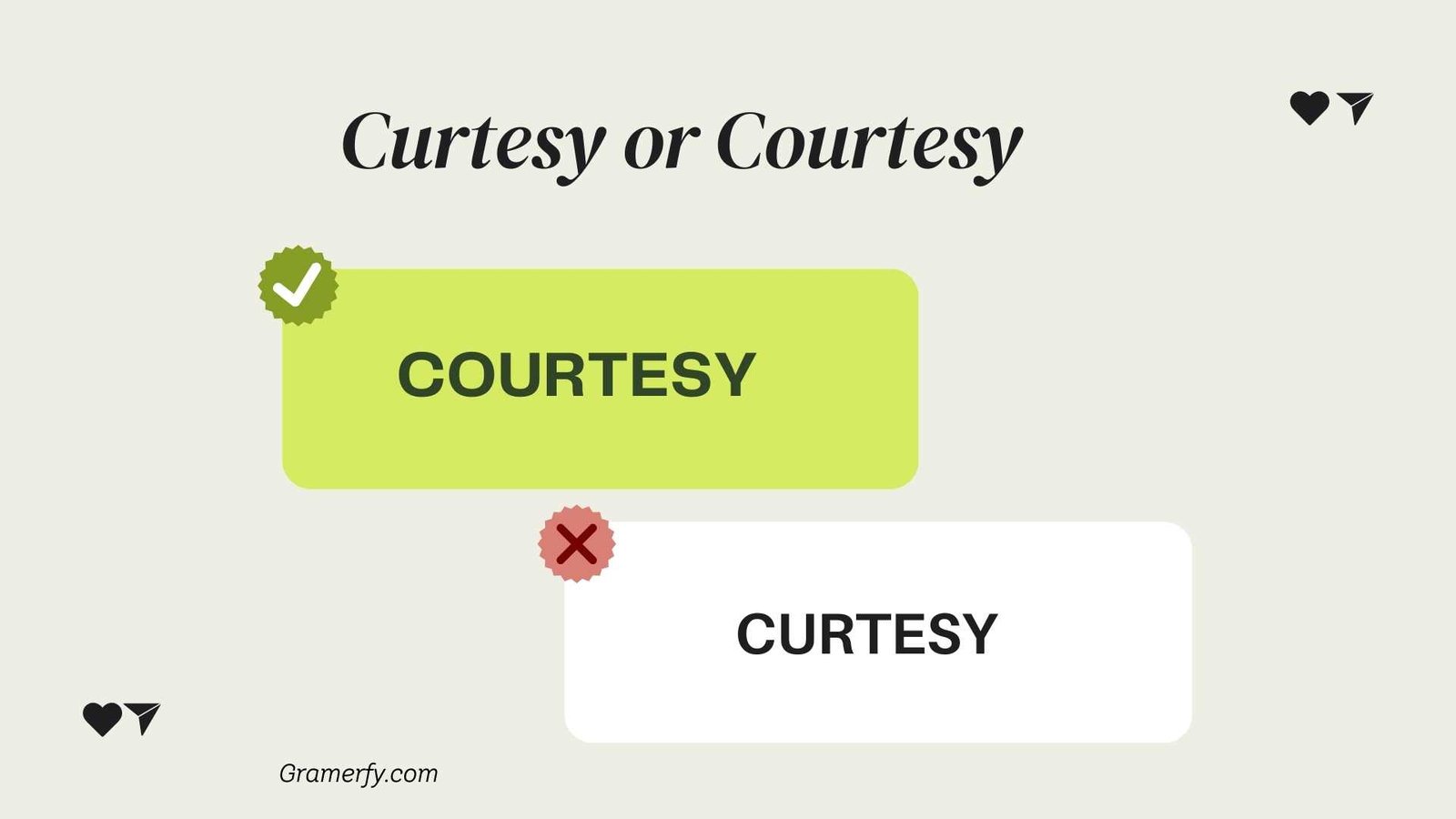
Words shape how we’re perceived. One small spelling choice can quietly define whether your message feels polished or careless. That’s exactly why people often search for “Curtesy or Courtesy” because a single letter can change everything.
You may have seen both versions online, in emails, or even in professional documents, and wondered which one is correct. The confusion is common, but the answer is simple once you understand it.
In this guide, you’ll discover the real meaning behind courtesy, why curtesy exists as a different word, and how to use each one properly without second-guessing yourself.
What Does “Courtesy” Mean?
Courtesy is the word you will encounter most often in English. It refers to polite behavior, respect, or a kind gesture towards others. Courtesy is all about showing good manners and consideration.
Key Points About Courtesy
- Part of speech: Noun
- Meaning: Polite behavior or a considerate act
- Usage: Social manners, formal communication, everyday interactions
Examples of Courtesy in Sentences
- It is common courtesy to greet your neighbors.
- She showed courtesy by holding the door for the older people man.
- Please return the book as a courtesy to the library.
- Courtesy of Mr. Smith, we were allowed to visit the garden.
Tips for Remembering
Think of courtesy as “courteous behavior.” If it involves politeness or kindness, courtesy is the correct word.
What Does “Curtesy” Mean?
Curtesy is much less common than courtesy. It is a legal term from older English law. Curtesy refers to a husband’s legal right to a portion of his deceased wife’s property if they had children. This meaning is very specific and rarely used in modern conversation.
Key Points About Curtesy
- Part of speech: Noun
- Meaning: A legal right of a husband to his deceased wife’s estate
- Usage: Legal documents, historical contexts
Examples of Curtesy in Sentences
- Under the old law, the man inherited the land by curtesy.
- The lawyer explained the property rights based on curtesy.
- Curtesy is rarely applied in modern legal systems.
Tips for Remembering
- Curtesy = legal, historical context
- Courtesy = politeness, manners
A simple trick: If it is about being polite, it is courtesy. If it is about legal inheritance, it is curtesy.
Curtesy vs Courtesy: Comparison Table
| Feature | Courtesy | Curtesy |
| Part of Speech | Noun | Noun |
| Meaning | Polite behavior or kindness | Husband’s legal right to wife’s property |
| Usage | Everyday conversation, writing | Legal documents, historical references |
| Common Confusion | Often misspelled as curtesy | Rarely confused but often unknown |
| Examples | Holding the door, saying “thanks” | Inheriting land or property |
Common Mistakes and Spelling Tips
Mistakes to Avoid
- Using “curtesy” instead of “courtesy”
❌ Incorrect: Please show curtesy to your guests.
✅ Correct: Please show courtesy to your guests. - Mixing meanings in formal writing
Using courtesy in legal context is usually wrong unless quoting historical laws. - Spelling errors
People often drop the “o” and write “curtesy” by mistake when they mean “courtesy.”
Spelling Tips
- Courtesy: Remember “court” in the word – polite behavior is “courtly.”
- Curtesy: No “o” – think of legal terms from older English.
Examples of Correct Usage
Here are more examples for each word:
Courtesy
- Always treat strangers with courtesy.
- She spoke with courtesy, even when she disagreed.
- Courtesy of the manager, we got extra time to finish our work.
Curtesy
- The property passed to him by curtesy after his wife’s death.
- Curtesy was more common in medieval England than today.
- Laws about curtesy have largely been replaced by modern inheritance rules.
FAQs About Curtesy vs Courtesy
1. Can I use curtesy instead of courtesy?
No. Curtesy and courtesy have completely different meanings. Using curtesy to mean polite behavior is incorrect.
2. Is courtesy only for formal situations?
No. Courtesy applies to everyday actions, like saying “please” and “thank you,” and formal events.
3. Is curtesy still used today?
Very rarely. Modern legal systems have mostly replaced curtesy with other inheritance laws.
4. How do I remember the difference?
- Courtesy = polite, considerate behavior
- Curtesy = legal right to property
5. Can courtesy be used in writing emails?
Absolutely! Phrases like “as a courtesy” or “courtesy copy” are common in professional emails.
Conclusion
In English, courtesy and curtesy are often confused, but their meanings are very different. Courtesy is everyday politeness and good manners, while curtesy is an old legal term about a husband’s rights to his deceased wife’s property.
Understanding this difference will make your writing clear, professional, and accurate. Remember, most of the time, if you are talking about being kind, helpful, or polite, courtesy is the word you need.