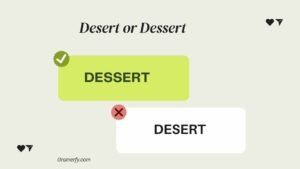
Have you ever ordered a desert when you were actually craving something sweet? Or written dessert when you meant a dry, sandy place?
Don’t worry you’re not alone. The confusion between “Desert or Dessert” trips up thousands of English learners every day. These two words look almost identical. However, their meanings couldn’t be more different.
One refers to vast, dry lands like the Sahara. The other brings to mind cakes, ice cream, and chocolate brownies. Just one extra “s” can completely change your sentence — and sometimes your message.
What Does “Desert” Mean?
The word desert can be a noun or a verb, and its pronunciation changes depending on how it is used.
As a Noun
When pronounced /ˈdez.ərt/, desert refers to a dry, sandy area with little or no vegetation. Examples:
- The Sahara is the largest desert in the world.
- Camels are well-suited to life in the desert.
As a Verb
When pronounced /dɪˈzɜːrt/, desert means to abandon someone or something. Examples:
- He felt betrayed when his friends deserted him.
- Soldiers must not desert their posts during duty.
Tip: Pay attention to pronunciation. The stress moves to the first syllable for the noun and the second syllable for the verb.
What Does “Dessert” Mean?
The word dessert is always a noun and pronounced /dɪˈzɜːrt/. It refers to a sweet course served at the end of a meal, like cake, ice cream, or pie.
Examples:
- Chocolate cake is my favorite dessert.
- After dinner, we had fruit dessert.
- Ice cream is a popular dessert around the world.
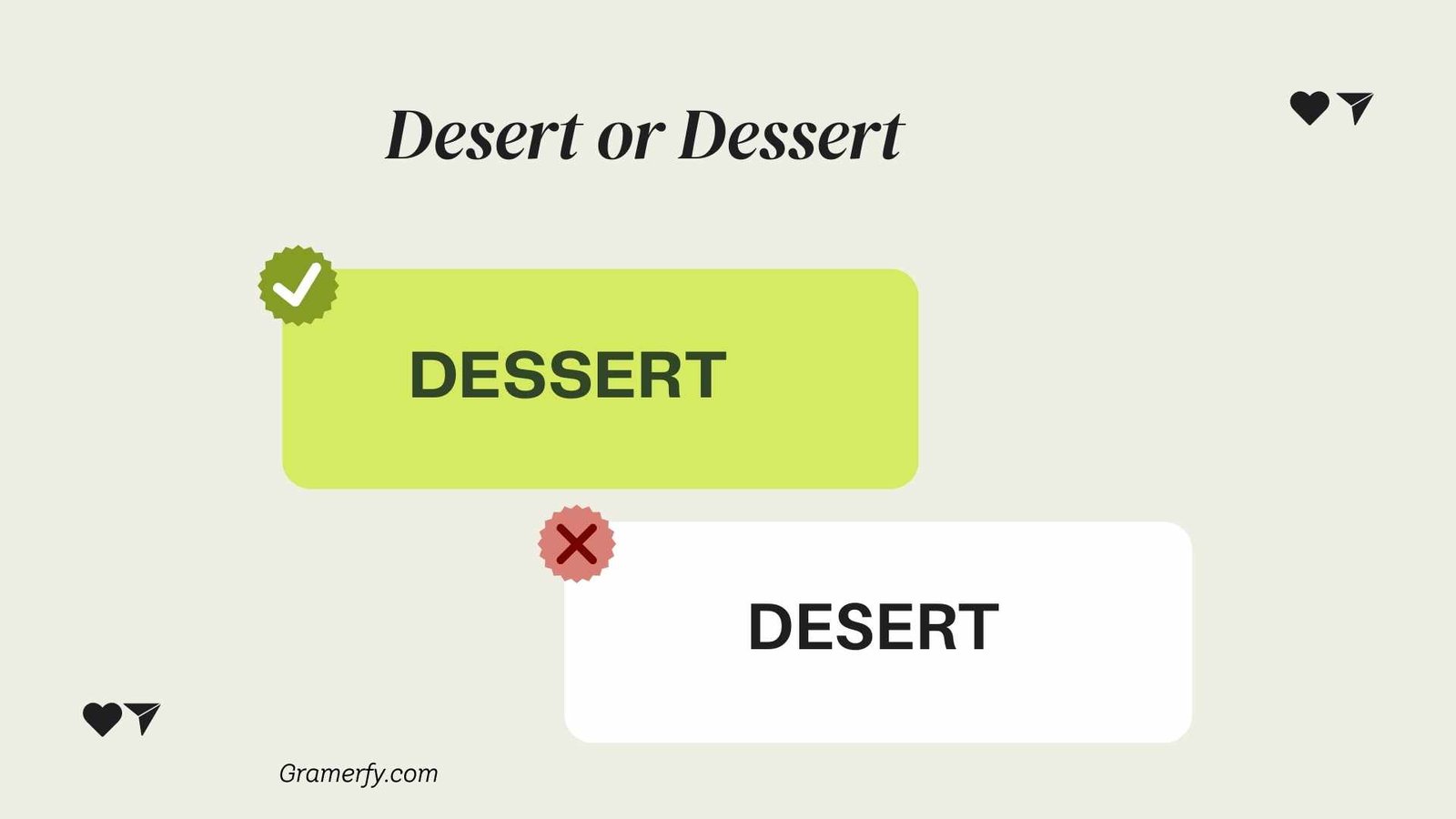
Tip: Remember: dessert has two S’s, which can remind you it’s “sweet” and “satisfying.”
Desert vs Dessert: Key Differences
Here’s a simple comparison table to help you remember:
| Feature | Desert | Dessert |
| Part of Speech | Noun / Verb | Noun |
| Pronunciation | /ˈdez.ərt/ (noun), /dɪˈzɜːrt/ (verb) | /dɪˈzɜːrt/ |
| Meaning | Dry, sandy area / Abandon | Sweet treat after a meal |
| Spelling Tip | One “s” – think of sand | Two “s” – think of sweets |
| Example (Noun) | The Gobi is a cold desert | I love ice cream for dessert |
| Example (Verb) | Don’t desert your friends | N/A |
Common Mistakes and How to Avoid Them
Many learners confuse desert and dessert because they sound similar. Here are common mistakes:
- Using “desert” when you mean a sweet treat
❌ I had a chocolate desert.
✅ I had a chocolate dessert. - Spelling errors
- Remember: dessert has two “s” like “sugar” or “sweet.”
- Desert has one “s,” like “sand.”
- Remember: dessert has two “s” like “sugar” or “sweet.”
- Verb confusion
- Some learners forget desert can be a verb.
❌ He deserted the desert. (Confusing!)
✅ He deserted his team.
- Some learners forget desert can be a verb.
Quick Tip: Associate “dessert” with the extra sweetness, so it needs an extra “s.”
Helpful Mnemonics
- Dessert = double S = double sweetness
- Desert = one S = sparse, like sand
Examples of Correct Usage
Desert (Noun)
- The Arabian desert is famous for its dunes.
- Many animals have adapted to live in harsh deserts.
Desert (Verb)
- Don’t desert your friends when they need you.
- He promised never to desert his responsibilities.
Dessert (Noun)
- Strawberry dessert is perfect for a summer evening.
- After Thanksgiving dinner, pumpkin pie is the favorite dessert.
Fun Fact
Did you know the word dessert comes from the French word desservir, which means “to clear the table”? That’s why it’s served after the main meal!
Tips to Remember the Difference
- Visualize the words
- Imagine dessert as a plate full of sweets (more “s”).
- Imagine desert as a dry, empty land (single “s”).
- Imagine dessert as a plate full of sweets (more “s”).
- Use them in sentences
- Practice writing simple sentences like:
- “The desert is hot.”
- “I want dessert.”
- “The desert is hot.”
- Practice writing simple sentences like:
- Listen and repeat
- Pronunciation matters: desert (noun) vs desert (verb) vs dessert.
- Pronunciation matters: desert (noun) vs desert (verb) vs dessert.
FAQs (People Also Ask)
1. How do I remember the difference between desert and dessert?
Use the spelling tip: dessert has two S’s for sweet, and desert has one S for sand.
2. Can desert be a verb?
Yes! Desert can mean to abandon someone or something. Example: “He deserted his post.”
3. Is dessert always sweet?
Yes, dessert refers to sweet foods served after meals.
4. Why do these words sound similar?
Both come from French roots, but their meanings and spellings evolved differently.
5. What’s a good trick to avoid mistakes in writing?
Think: Dessert = double S = extra sweet, Desert = one S = dry sand.
Advanced Examples
- The desert stretched for miles, with nothing but sand and rocks.
- She promised never to desert her family, no matter what.
- Chocolate mousse is my favorite dessert after dinner.
- The soldiers did not desert their camp despite the storm.
Quick Recap
- Desert = dry land or to abandon (one “s”)
- Dessert = sweet treat after a meal (double “s”)
- Pay attention to pronunciation and spelling.
- Use mnemonics and examples to remember the difference.
With practice, you’ll never mix up these words again. Next time you enjoy a piece of cake, you can confidently say, “I love dessert,” without worrying about sand!
Conclusion
Mixing up desert and dessert is easy, but the difference is simple once you remember it. A desert is a dry, sandy place like the Sahara, while dessert is the sweet treat you enjoy after a meal. One extra “s” makes all the difference. Think of it this way: you always want more sweets, so dessert gets two “s” letters.
Small spelling details can completely change meaning, especially in writing. By understanding this distinction, you’ll avoid confusion and communicate more clearly. Now that you know the difference, you can use both words confidently in conversations, texts, and everyday writing.