When you hear the words “dwarfs” or “dwarves,” what comes to mind? Tiny yet mighty figures straight out of myths, legends, and epic tales that have fascinated generations.
From the enchanted mines of folklore to the pages of fantasy novels, these beings embody strength, cunning, and resilience, proving that size is no measure of power.
But there’s more than just their legendary feats language itself sparks debate. Should we say “dwarfs” in modern English or embrace “dwarves” as the Tolkien-inspired variant?
What Does “Dwarf” Mean?
A dwarf is a noun used to describe:
- A person of unusually short stature due to a medical condition (medical or scientific context).
- A small creature in folklore or mythology.
- Something very small compared to normal size (used metaphorically).
Examples:
- The scientist studied the dwarf population in the village.
- In fairy tales, a dwarf often lives in a magical forest.
- The new phone’s battery life is dwarfed by the older model.
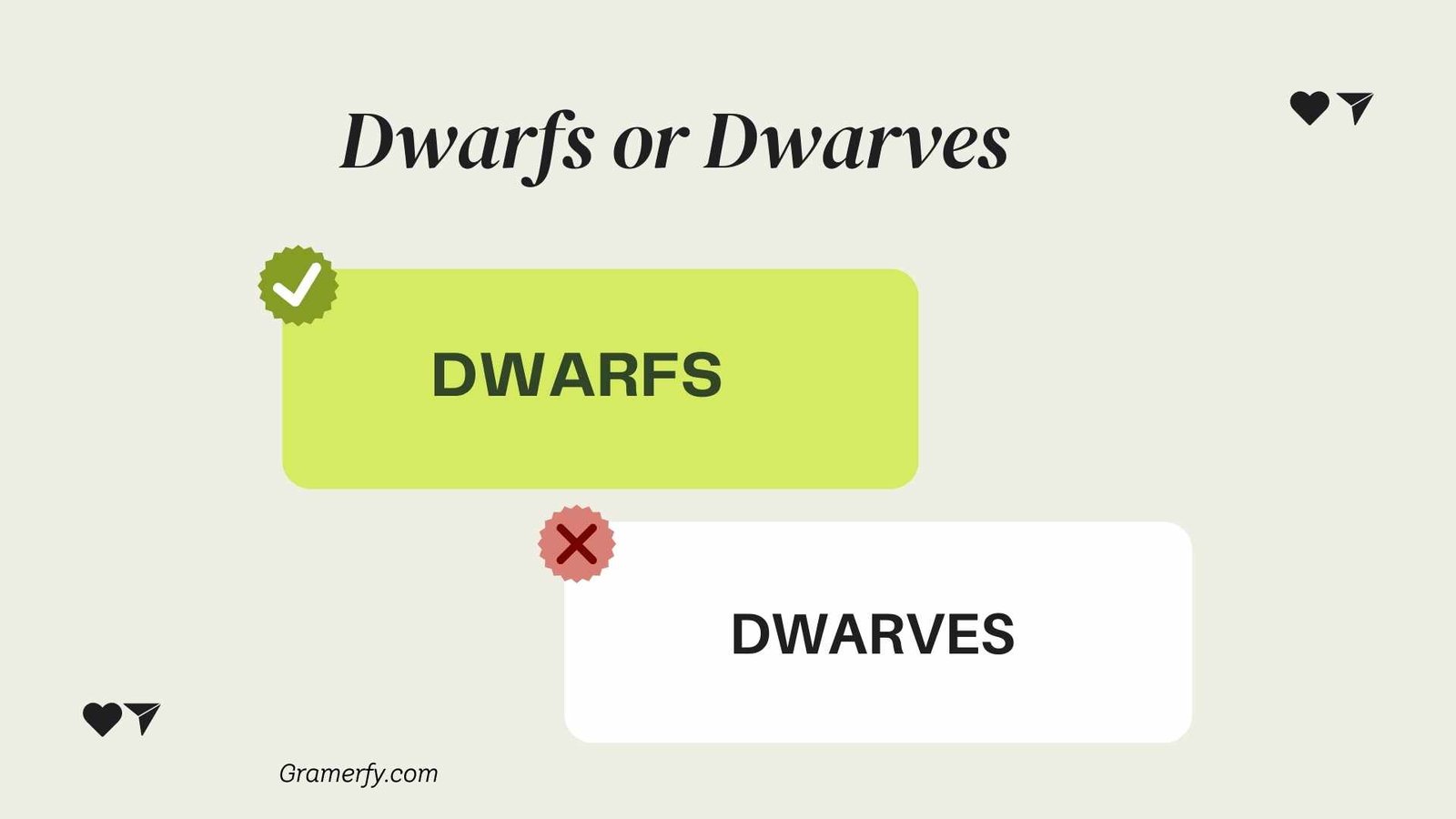
Key point: The plural of dwarf can be dwarfs in standard English.
What Does “Dwarves” Mean?
Dwarves is another plural form of dwarf, mostly used in fantasy literature.
- Popularized by J.R.R. Tolkien in The Hobbit and The Lord of the Rings, dwarves refers specifically to magical or mythical small humanoid beings.
- Outside of literature or fantasy, using dwarves is uncommon in scientific or everyday contexts.
Examples:
- Tolkien’s book describes thirteen dwarves traveling to the Lonely Mountain.
- In fantasy games, players often encounter armies of dwarves in mines and castles.
Key point: Use dwarves in fantasy or mythological contexts.
Dwarfs vs Dwarves: The Main Difference
| Aspect | Dwarfs | Dwarves |
| Context | Real-life people of short stature, scientific or general use | Fantasy, folklore, mythological creatures |
| Plural form | Standard plural in dictionaries | Mostly literary/plural in fiction works |
| Examples | “The circus had several dwarfs in the show.” | “Bilbo Baggins traveled with thirteen dwarves.” |
| Tone | Neutral, factual | Imaginative, literary |
| Common usage today | Everyday English, news, medicine | Literature, fantasy novels, games |
When to Use “Dwarfs” vs “Dwarves”
- Use “dwarfs” for real-life contexts or general English.
- Example: The garden was full of dwarfs in the fairy statue collection.
- Example: Some people are born with conditions that make them dwarfs.
- Example: The garden was full of dwarfs in the fairy statue collection.
- Use “dwarves” in fantasy, mythology, or storytelling.
- Example: The castle was guarded by several brave dwarves.
- Example: In the novel, dwarves mined precious gems deep underground.
- Example: The castle was guarded by several brave dwarves.
Tip: If you are unsure, dwarfs is always correct. Only use dwarves if you are writing fiction or referencing fantasy worlds.
Common Mistakes with Dwarfs and Dwarves
- Mistake 1: Using dwarves for real people.
❌ Wrong: The village had many dwarves.
✅ Correct: The village had many dwarfs. - Mistake 2: Using dwarfs in Tolkien-style fantasy.
❌ Wrong: Bilbo traveled with thirteen dwarfs.
✅ Correct: Bilbo traveled with thirteen dwarves. - Mistake 3: Spelling variations in older texts
Older English sometimes used dwarfs and dwarves interchangeably, but modern usage favors the rules above.
Spelling Tips
- Remember the context: Fantasy = dwarves, reality = dwarfs.
- Pronunciation: Both are pronounced the same – /dwɔːrfz/.
- Plural confusion: Always double-check if writing for a general audience (stick with dwarfs).
Examples in Sentences
Using Dwarfs
- The circus featured talented dwarfs who amazed the audience.
- Scientists measured the growth of dwarfs in the research study.
- The tree in my backyard is tiny, almost a dwarf compared to the others.
Using Dwarves
- The story describes how dwarves forged magical swords in secret.
- Video games often include dwarves as strong, brave characters.
- In mythology, dwarves live underground and guard treasures.
FAQs (People Also Ask)
1. Can you use “dwarves” for real people?
No, dwarves is reserved for fantasy or mythological contexts. Use dwarfs for real people.
2. Which is the correct plural of dwarf?
Both are technically correct, but dwarfs is standard for real-life situations. Dwarves is used in literature or fantasy.
3. How did “dwarves” become popular?
J.R.R. Tolkien popularized dwarves in his novels, making it the standard plural in fantasy works.
4. Is “dwarfs” outdated?
Not at all! Dwarfs is still the correct plural in science, journalism, and everyday English.
5. Can I mix “dwarfs” and “dwarves” in the same text?
It’s best not to. Stick to dwarfs for real-world references and dwarves for fantasy to avoid confusing your readers.
Conclusion
By keeping this rule in mind, you can write confidently and correctly. Using the right form also shows your readers that you know the difference between reality and fantasy contexts.
So next time you write about a tiny person or a magical creature, you’ll know exactly which word to use!