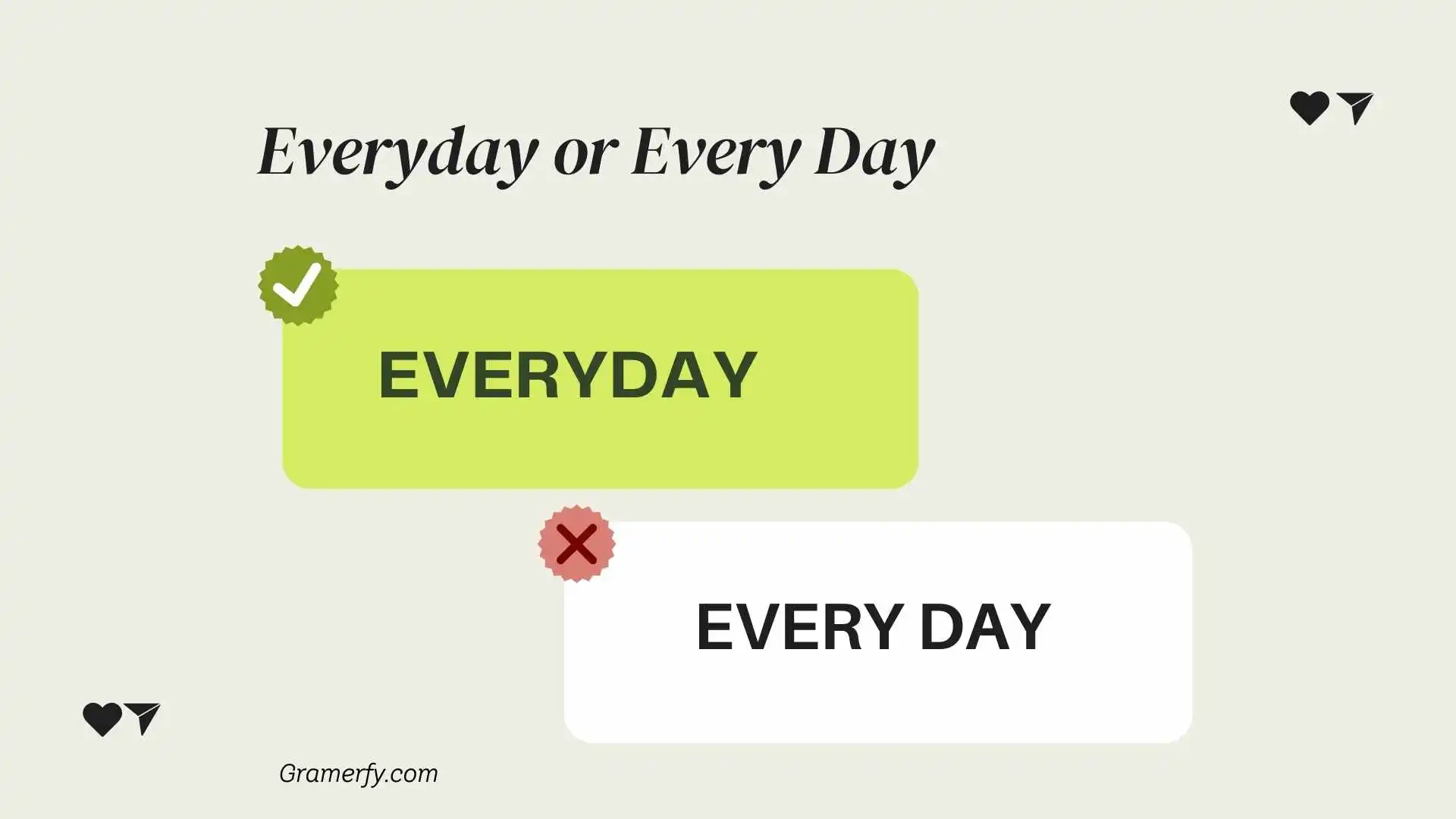
Confused about whether to write “everyday” or “every day”? You’re not alone! This tiny difference in spacing creates one of the most common mistakes in English writing.
While the two terms look almost identical, they carry completely different meanings and uses. One describes something ordinary or routine, while the other simply refers to something that happens daily.
Using the wrong one can change the meaning of your sentence and make even well-written content look unpolished. Imagine writing an email, blog post, or assignment and mixing up these two your readers might notice immediately.
What Does “Everyday” Mean?
“Everyday” is an adjective, which means it describes a noun. It refers to something ordinary, common, or routine.
Key points about “everyday”:
- Always one word.
- Used before nouns.
- Describes things that are normal, typical, or seen often.
Examples:
- These are my everyday shoes. (Shoes I wear regularly)
- Drinking coffee has become an everyday habit.
- Traffic jams are an everyday problem in big cities.
💡 Tip: If you can replace “everyday” with “ordinary” or “common” and the sentence still makes sense, then “everyday” is correct.
What Does “Every Day” Mean?
“Every day” is a phrase made of two words: every + day. It refers to each day or daily occurrences.
Key points about “every day”:
- Two words.
- Focuses on the frequency of an action.
- Answers questions like: How often? When?
Examples:
- I drink coffee every day. (Daily habit)
- She goes for a walk every day.
- We check our emails every day.
💡 Tip: If you can replace “every day” with “each day” and the sentence still makes sense, then “every day” is correct.
Everyday vs Every Day: Quick Comparison
| Feature | Everyday | Every Day |
| Part of Speech | Adjective | Phrase (adjective + noun) |
| Meaning | Ordinary, normal, routine | Each day, daily |
| Usage | Before a noun | Can be anywhere in the sentence |
| Test | Replace with “ordinary” | Replace with “each day” |
| Examples | everyday clothes, everyday tasks | I exercise every day, She smiles every day |
Common Mistakes with “Everyday” and “Every Day”
Many learners confuse these two because they sound the same. Here are common mistakes to watch out for:
- Incorrect: I wear my everyday to school.
Correct: I wear my everyday clothes to school. - Incorrect: I go to the gym everyday.
Correct: I go to the gym every day. - Incorrect: He faces every day problems at work.
Correct: He faces everyday problems at work. - Incorrect: She drinks tea everyday.
Correct: She drinks tea every day.
Spelling tips:
- Everyday = one word, always an adjective.
- Every day = two words, focusing on time/frequency.
How to Remember the Difference
Here’s a simple trick to avoid confusion:
- If you can replace it with “ordinary” → everyday.
- If you can replace it with “each day” → every day.
Examples using the trick:
- Ordinary shoes → everyday shoes ✅
- Each day I study → I study every day ✅
More Examples of Everyday and Every Day
Everyday (adjective):
- She wears everyday outfits to work.
- Checking messages is an everyday activity for him.
- These dishes are part of my everyday meals.
Every Day (phrase):
- I read a book every day.
- He practices the guitar every day.
- We clean the house every day.
Everyday or Every Day in Questions
Sometimes it’s confusing in questions. Here’s how to use them:
Everyday:
- What are your everyday routines?
- Which everyday tasks do you enjoy?
Every Day:
- Do you go for a walk every day?
- How many emails do you check every day?
FAQs (People Also Ask)
Q1: Can “everyday” and “every day” be used interchangeably?
A1: No. Everyday describes something ordinary, while every day refers to daily frequency.
Q2: Is “everyday” always written as one word?
A2: Yes. “Everyday” is always a single word when used as an adjective.
Q3: Can I use “every day” in the middle of a sentence?
A3: Yes. For example: “I drink water every day, even on weekends.”
Q4: How can I remember the difference easily?
A4: Replace everyday with “ordinary” and every day with “each day.” If the sentence still makes sense, you have the correct form.
Q5: Are there similar confusing words in English?
A5: Yes. Words like anyone vs. any one, alot vs. a lot, and all together vs. altogether follow similar patterns.
Tips for Using Everyday and Every Day Correctly
- Focus on context: Is it about frequency or ordinariness?
- Check the noun: If it comes before a noun, it’s likely everyday.
- Think about substitution: Ordinary = everyday; Each day = every day.
- Practice writing sentences: Writing examples daily improves accuracy.
- Read English content: Newspapers and blogs show correct usage naturally.
Everyday or Every Day in Common Phrases
- Everyday life – normal daily experiences
- Everyday use – regular usage, not special
- Everyday routine – usual daily tasks
- Every day at school – occurs daily at school
- Every day after work – happens daily after work
Conclusion
Mastering everyday and every day may seem small, but it improves your clarity and grammar instantly. Remember, everyday describes something ordinary, while every day shows frequency. Use substitution tricks ordinary for everyday, each day for every day to avoid mistakes.
Practice writing sentences, reading articles, and paying attention to context. Soon, choosing the correct form will become second nature. Clear usage not only makes your English stronger but also impresses teachers, colleagues, and readers.