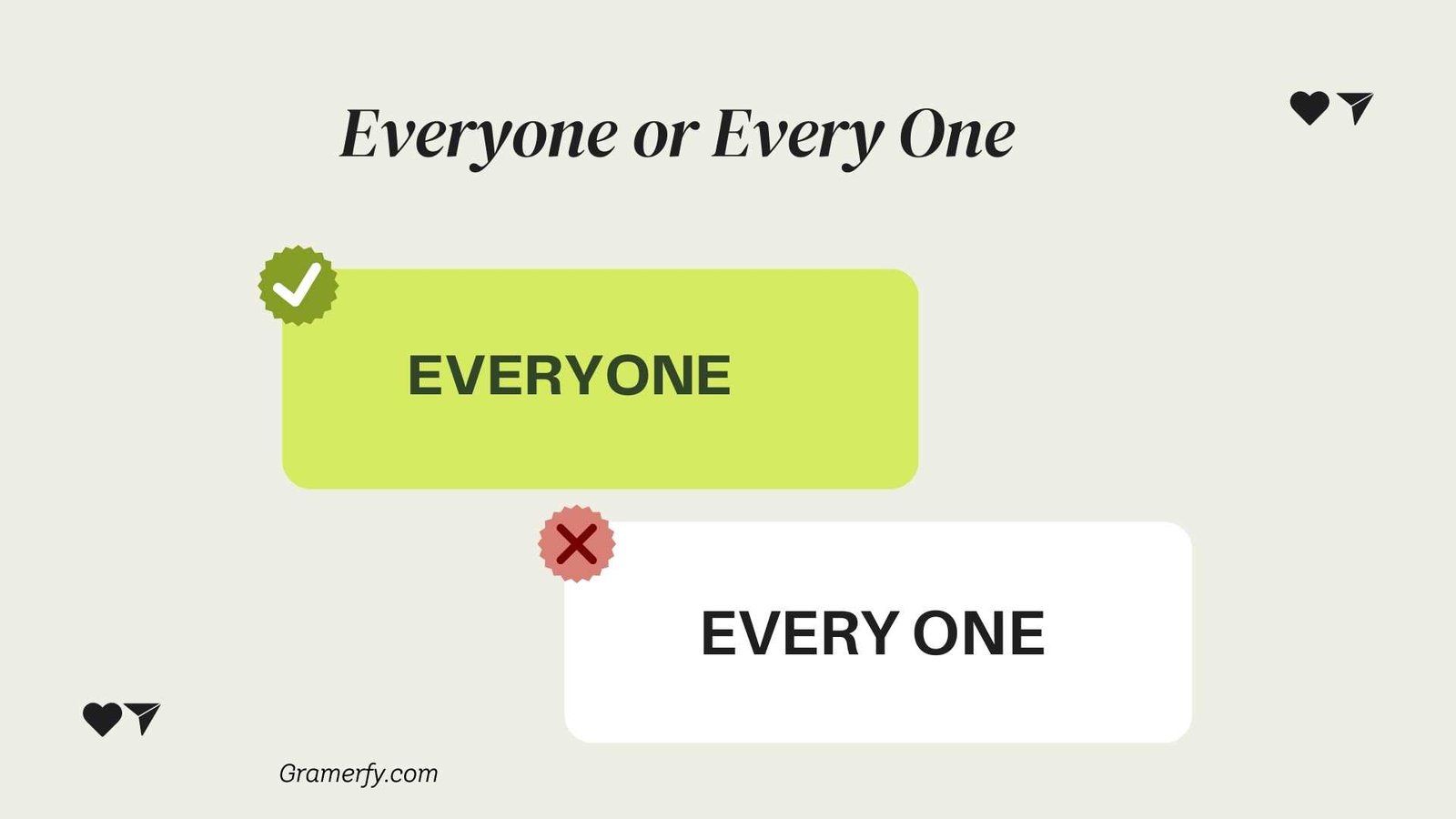
Everyone or Every One these two tiny phrases look almost identical, yet they often leave writers scratching their heads. You may have typed a sentence, paused, and wondered, “Which one is actually correct here?” You’re not alone.
From casual texting to professional writing, choosing between everyone and every one can feel surprisingly tricky. One small space can completely change the meaning of your sentence, and that difference matters more than you think.
Understanding how and when to use each form can instantly sharpen your grammar and boost your confidence. In this guide, you’ll uncover the simple rule that separates everyone from every one, along with clear examples that make everything click.
Meaning and Usage of “Everyone”
What Does “Everyone” Mean?
“Everyone” is a pronoun that refers to all people in a group. It is singular in form but refers to multiple people collectively.
- Meaning: All people, every person.
- Grammar: Always singular in form (use singular verbs).
Examples:
- Everyone is invited to the party.
- Everyone loves a good story.
- She waved at everyone in the room.
Notice how everyone cannot be separated into two words—it always stays together.
Key Points About “Everyone”
- It is used for people only.
- Always singular: “Everyone is happy,” not “Everyone are happy.”
- Can be replaced with “all people” in many cases:
- Everyone enjoyed the movie → All people enjoyed the movie.
- Everyone enjoyed the movie → All people enjoyed the movie.
Meaning and Usage of “Every One”
What Does “Every One” Mean?
“Every one” is two words. Here, “every” is an adjective describing “one,” which means a single item or person.
- Meaning: Each single person or thing in a group, considered individually.
- Grammar: Can refer to people, objects, or abstract things.
Examples:
- Every one of the cookies was eaten.
- Every one of my friends called me today.
- She checked every one of the documents carefully.
Notice that “every one” is often followed by “of” + a noun to specify the group.
Key Points About “Every One”
- Refers to individual items or people.
- Can be replaced with “each one”:
- Every one of the books is old → Each one of the books is old.
- Every one of the books is old → Each one of the books is old.
- It emphasizes individuality, not the group as a whole.
Everyone vs Every One: Comparison Table
| Feature | Everyone | Every One |
| Form | Single word | Two words |
| Meaning | All people collectively | Each individual person or thing |
| Usage | Refers only to people | Refers to people or things |
| Verb Agreement | Singular | Singular or plural depending on context |
| Example | Everyone is ready for the trip. | Every one of the shoes is new. |
Common Mistakes and How to Avoid Them
1. Confusing the Two Forms
- ❌ Incorrect: Every one is going to the park.
- ✅ Correct: Everyone is going to the park.
- ❌ Incorrect: Everyone of the students finished their homework.
- ✅ Correct: Every one of the students finished their homework.
2. Wrong Verb Agreement
Remember:
- Everyone → singular verb
- Every one → singular verb for each item, but can sound plural in context
- ❌ Everyone are happy.
- ✅ Everyone is happy.
- ❌ Every one of the apples are rotten.
- ✅ Every one of the apples is rotten.
3. Using “Everyone” for Objects
- ❌ Everyone of the books is old.
- ✅ Every one of the books is old.
Tip: If you can replace it with “all people,” use everyone. If you can replace it with “each one,” use every one.
Usage Tips
- Everyone is simpler; think of it as “all people together.”
- Every one is precise; think of it as “each single person or thing.”
- Look at the noun after the phrase. If it refers to things or is specific, you probably need every one.
Multiple Examples in Sentences
Using “Everyone”
- Everyone agreed to help with the project.
- I hope everyone enjoys the picnic.
- Everyone in the class passed the exam.
Using “Every One”
- Every one of the students received a certificate.
- I checked every one of the boxes for damage.
- She answered every one of the questions correctly.
Mixed Practice
- ✅ Everyone is excited about the trip.
- ✅ Every one of the team members contributed ideas.
- ❌ Everyone of the participants got a medal. → Wrong, should be Every one of the participants…
- ❌ Every one is here. → Wrong, should be Everyone is here.
FAQs (People Also Ask)
Q1: Can I use “everyone” and “every one” interchangeably?
A: No. “Everyone” refers to all people collectively, while “every one” refers to each individual person or item.
Q2: Is “everyone” singular or plural?
A: Grammatically singular, even though it refers to multiple people. Always use singular verbs.
Q3: Can “every one” be used for objects?
A: Yes. “Every one” can refer to people, objects, or abstract things.
Q4: How can I remember the difference?
A: Think:
- Everyone = all people together
- Every one = each single item or person
Q5: What’s the common mistake learners make?
A: Using “everyone” for objects or forgetting singular verb agreement. Example: “Everyone of the books” is wrong; it should be “Every one of the books.”
Conclusion
Understanding the difference between everyone and every one is simple once you know the rules.
With practice, choosing the right word will become natural, helping your English sound more fluent and professional.