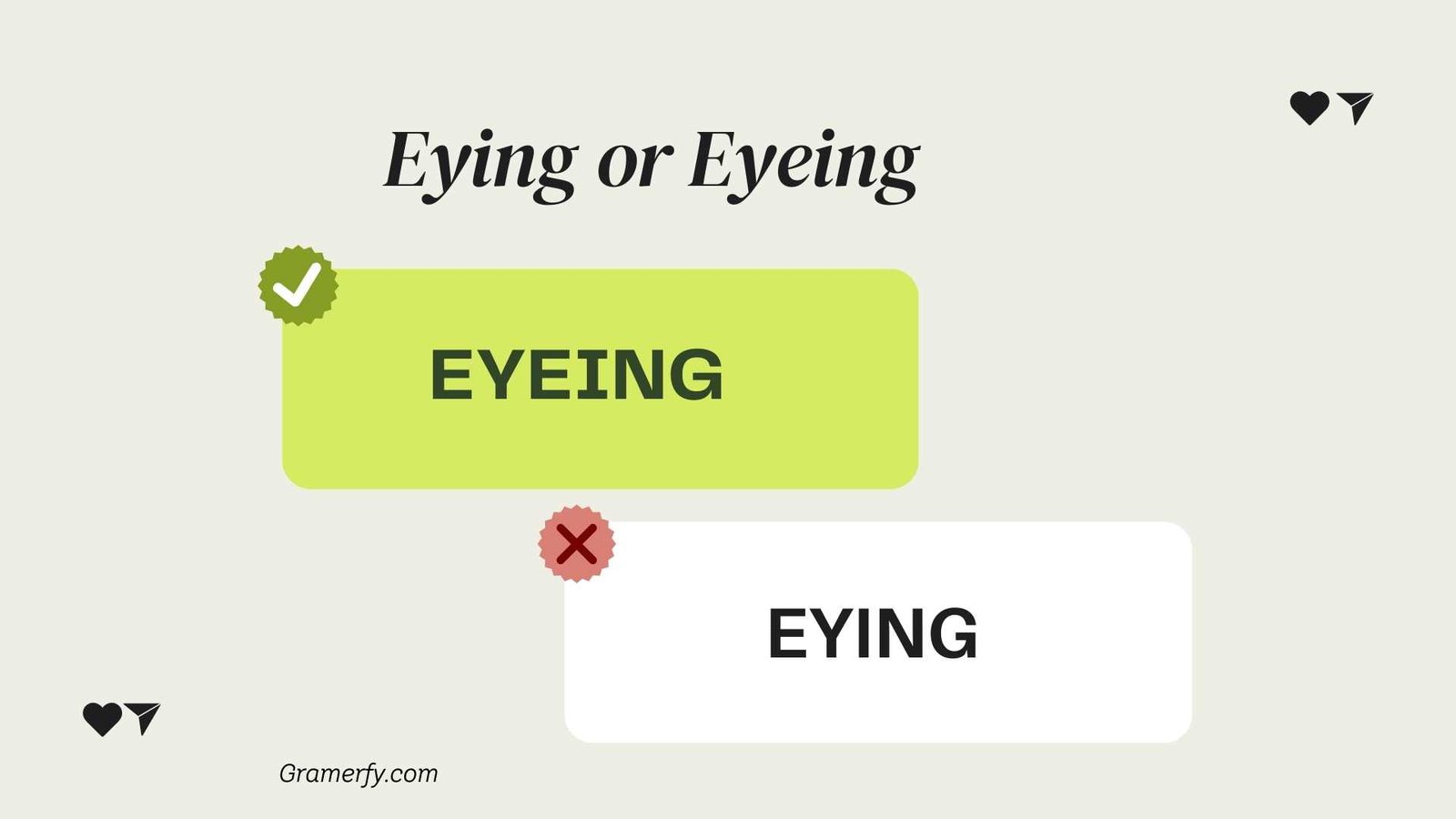
Choosing the right word between eying and eyeing can leave many scratching their heads. Both words sound the same and are often used interchangeably, but understanding their subtle differences can make your writing sharper and more precise.
This guide explores their meanings, correct usage, and common mistakes so you can confidently pick the right option every time.
By the end, you’ll not only spot the difference but also feel more confident weaving these words naturally into your sentences, making your communication polished and effective.
Meaning of “Eying” and “Eyeing”
1. Eying
Eying is the present participle form of the verb “eye”, meaning to look at something carefully or with interest.
- Example: She was eying the last piece of cake on the table.
In some cases, eying can also mean glancing or watching someone or something with suspicion or desire.
2. Eyeing
Eyeing is simply an alternative spelling of eying, especially in American English. Both words are pronounced the same way: /ˈaɪɪŋ/.
- Example (American English): He is eyeing a new car for his birthday.
Essentially, “eying” is the traditional spelling, while “eyeing” is now more common in modern usage, particularly in the United States.
Correct Usage of Eying and Eyeing
Both forms are correct, but your choice may depend on the style guide, country, or personal preference.
| Word | Usage Area | Example Sentence | Notes |
| Eying | British English | She was eying the painting in the gallery. | Traditional spelling |
| Eyeing | American English | He is eyeing the new smartphone. | Modern and widely accepted in the U.S. |
Tip: If you’re writing for a global audience, eyeing is safer as it is widely recognized.
Common Mistakes
Many beginners make these errors when using eying/eyeing:
- Spelling Confusion – Writing “aying” or “iying” by mistake.
- ❌ Wrong: She was iying the gift.
- ✅ Correct: She was eyeing the gift.
- ❌ Wrong: She was iying the gift.
- Using the Wrong Form – Forgetting that eying/eyeing is a verb, not a noun.
- ❌ Wrong: His eying was beautiful.
- ✅ Correct: He was eyeing the beautiful sunset.
- ❌ Wrong: His eying was beautiful.
- Overcomplicating the Meaning – Some confuse eying with “seeing” or “staring.”
- “Eying” implies interest or focus, not just noticing.
- “Eying” implies interest or focus, not just noticing.
Examples of Eying and Eyeing
Here are multiple examples to clarify usage:
Daily Life Examples
- She was eying the cupcakes at the bakery.
- He is eyeing a promotion at work.
- I noticed him eying the latest shoes in the shop window.
Formal and Informal Contexts
- Formal: The committee is eyeing the new policy changes carefully.
- Informal: I’ve been eying that pizza all day!
Idiomatic Usage
- Eying someone’s success – watching with admiration or envy.
- Example: She was eyeing her colleague’s success with curiosity.
- Example: She was eyeing her colleague’s success with curiosity.
- Eyeing opportunities – looking for chances or advantages.
- Example: He’s eyeing opportunities to expand his business.
- Example: He’s eyeing opportunities to expand his business.
Spelling Tips
- Remember: Both eying and eyeing are correct.
- Use eyeing for American English or online content—it’s more widely recognized.
- Use eying for traditional or British English writing.
- Pronunciation remains the same: /ˈaɪɪŋ/.
Eying vs Eyeing: Quick Comparison
| Feature | Eying | Eyeing |
| Pronunciation | /ˈaɪɪŋ/ | /ˈaɪɪŋ/ |
| Spelling Tradition | British English | American English |
| Common Usage | Less frequent | More frequent globally |
| Example | She was eying the dessert. | He is eyeing a new phone. |
FAQs (People Also Ask)
1. Is it eying or eyeing?
Both are correct. Eying is traditional/British English, and eyeing is American English.
2. Can I use eyeing in formal writing?
Yes! Modern usage accepts eyeing in formal and informal contexts.
3. What does “eyeing” mean in slang?
In informal slang, eyeing can mean checking someone out, like: He was eyeing her at the party.
4. Is eying a noun or verb?
It is a verb (present participle of “eye”). It should never be used as a noun.
5. How do you pronounce eying/eyeing?
Both are pronounced the same: /ˈaɪɪŋ/.
Conclusion
The English words eying and eyeing may look tricky, but they are simple once you understand their meaning and context. Both words refer to looking at something with interest, desire, or focus.
By remembering the correct pronunciation, context, and usage, you can confidently choose the right form in your writing. Whether you are drafting emails, social media posts, or formal essays, this guide ensures you never mix up eying and eyeing again.