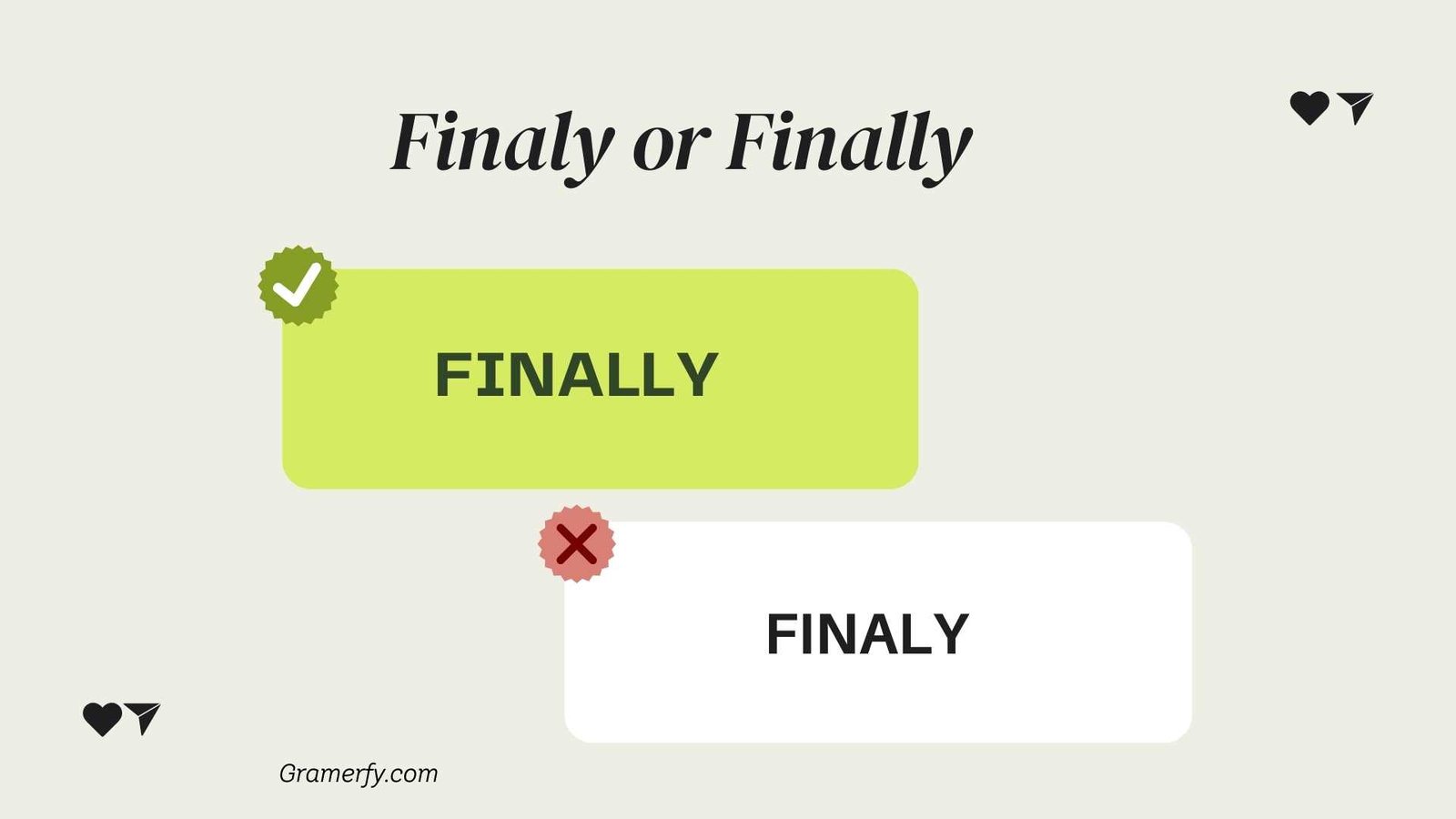
Confusing “Finaly or Finally” is one of those small spelling mistakes that can quietly weaken your writing whether you’re sending a text, posting on social media, or working on a professional document.
You may have seen both versions used online, and that’s exactly why so many people wonder which one is actually correct. One extra letter might not seem like a big deal, but in English, tiny details can completely change how polished and trustworthy your message appears.
If you’ve ever paused mid-sentence, second-guessing yourself before hitting send, you’re not alone. Thousands of writers, students, and professionals search this same question every day, hoping for a clear and simple answer.
Meaning and Correct Usage
1. Finally
Finally is the correct word. It is an adverb that means:
- “At the end of a process”
- “After a long time”
- “Eventually”
Examples:
- After hours of waiting, she finally arrived at the party.
- I have finally completed my assignment.
- The team finally won the championship.
Usage Notes:
- Use finally when you want to indicate the last step in a sequence or the conclusion of something.
- It can also show relief, accomplishment, or a long-awaited event.
2. Finaly
Finaly is incorrect. It is a common spelling mistake, often due to skipping the second “l” in finally.
Incorrect Examples:
- I have finaly finished my homework. ❌
- She finaly called me after two weeks. ❌
Tip: Always double-check for the double “l” in finally.
Comparison: Finaly vs Finally
Here’s a simple table to make it clear:
| Word | Correct Usage | Meaning | Example |
| finally | ✅ Correct | At last, eventually, in conclusion | I finally understood the lesson. |
| finaly | ❌ Incorrect | N/A | She finaly went home. ❌ |
Quick Memory Trick: “Finally” has two L’s—think of it as lasting long (double L) until the end.
Common Mistakes & Spelling Tips
English learners make several common mistakes with finally. Let’s look at them:
1. Dropping one L
- Wrong: I finaly finished reading the book. ❌
- Correct: I finally finished reading the book. ✅
Tip: Remember the double L.
2. Confusing with “final”
- Wrong: I final left the office. ❌
- Correct: I finally left the office. ✅
Tip: “Final” is an adjective meaning last or ultimate, while finally is an adverb.
Example:
- Final (adjective): This is the final chapter of the book.
- Finally (adverb): I finally finished reading the book.
3. Using in the wrong context
- Wrong: He is finally tall. ❌ (doesn’t fit sequence or conclusion)
- Correct: After growing for years, he finally became tall. ✅
Detailed Examples of “Finally”
Here are multiple examples in different contexts:
1. Everyday Life
- I finally woke up on time today.
- She finally learned how to ride a bicycle.
2. Academic / Work
- After months of research, we finally found the solution.
- He finally submitted the project before the deadline.
3. Emotional / Relief
- I finally got a call from my dream university.
- After waiting for two hours, we finally got a table at the restaurant.
4. Sequence / Events
- First, we packed our bags. Then, we booked the tickets. And finally, we left for the airport.
Tips to Remember the Correct Spelling
- Double L Rule: Remember, finally always has two L’s.
- Check if it’s an adverb: If the word is showing “eventually” or “at last,” it’s finally.
- Avoid shortcuts: Don’t type quickly—typing “finaly” is a common habit.
Mnemonic: F + I + N + A + L + L + Y → Finally, think of “long wait (double L)” ending.
FAQs (People Also Ask Style)
1. Is “finaly” correct English?
No, finaly is not correct. The correct word is finally with two L’s.
2. Can I use “final” instead of “finally”?
No, final is an adjective (last), while finally is an adverb (eventually). They are not interchangeable.
3. How do I remember to spell “finally” correctly?
Remember double L, and associate it with “long wait” or “end of a sequence.”
4. Can “finally” be used at the start of a sentence?
Yes, it can start a sentence to indicate the last point in a series:
- Finally, I want to thank everyone who helped me.
5. Is “finally” formal or informal?
It works in both formal and informal English. You can use it in emails, essays, speeches, or casual conversation.
Common Expressions with Finally
- Finally and fortunately: “Finally and fortunately, we avoided the traffic.”
- Finally done: “I am finally done with my exams.”
- Finally ready: “The cake is finally ready.”
Step-by-Step: Correcting “Finaly” Mistakes
- Spot the word finaly in your text.
- Ask: “Am I using this as ‘at last’ or ‘eventually’?”
- Replace finaly with finally.
- Proofread to ensure the sentence sounds correct.
Comparison With Synonyms
Sometimes finally can be replaced with other words, but not “finaly.”
| Synonym | Meaning | Example |
| eventually | after a long time | He eventually solved the problem. |
| at last | after waiting | At last, she arrived home. |
| in the end | after everything | In the end, we all agreed. |
| ultimately | finally, in conclusion | He ultimately succeeded in his career. |
Writing Tips
- Use finally to emphasize the conclusion or end of a process.
- Avoid typing finaly—spell check can catch this, but mental habit helps more.
- Pair with other sequence words like first, next, then for clarity.
Example of sequence:
- First, I cleaned my room. Next, I organized my desk. Then, I packed my bag. Finally, I left for school.
Conclusion
To sum up, the confusion between finaly and finally is a common one, but it’s easy to overcome. With careful spelling and understanding, you can confidently write finally in emails, essays, social media posts, or any written content. Practice, and soon it will feel natural.
Correct usage of words like finally may seem small, but they make a big difference in how polished and professional your English looks.