When it comes to joining materials, the terms gluing and glueing often cause confusion. People frequently wonder which spelling is correct and how it affects writing or DIY projects.
Understanding the difference is not only useful for proper grammar but also for clear communication in crafting, woodworking, or any adhesive-related task.
While both forms appear in various texts, one is considered standard in modern English, and knowing this can save you from small but noticeable mistakes.
What Does “Glue” Mean?
Before we compare spellings, let’s understand the base word.
Meaning of “Glue”
Glue is both a noun and a verb.
As a noun:
Glue is a sticky substance used to join things together.
Example:
- Use strong glue to fix the broken chair.
As a verb:
To glue means to stick or join objects together using glue.
Example:
- She will glue the paper pieces together.
What Is “Gluing”?
Meaning of “Gluing”
Gluing is the present participle and gerund form of the verb glue.
It means:
- The act of sticking things together
- Something happening right now
- An ongoing action
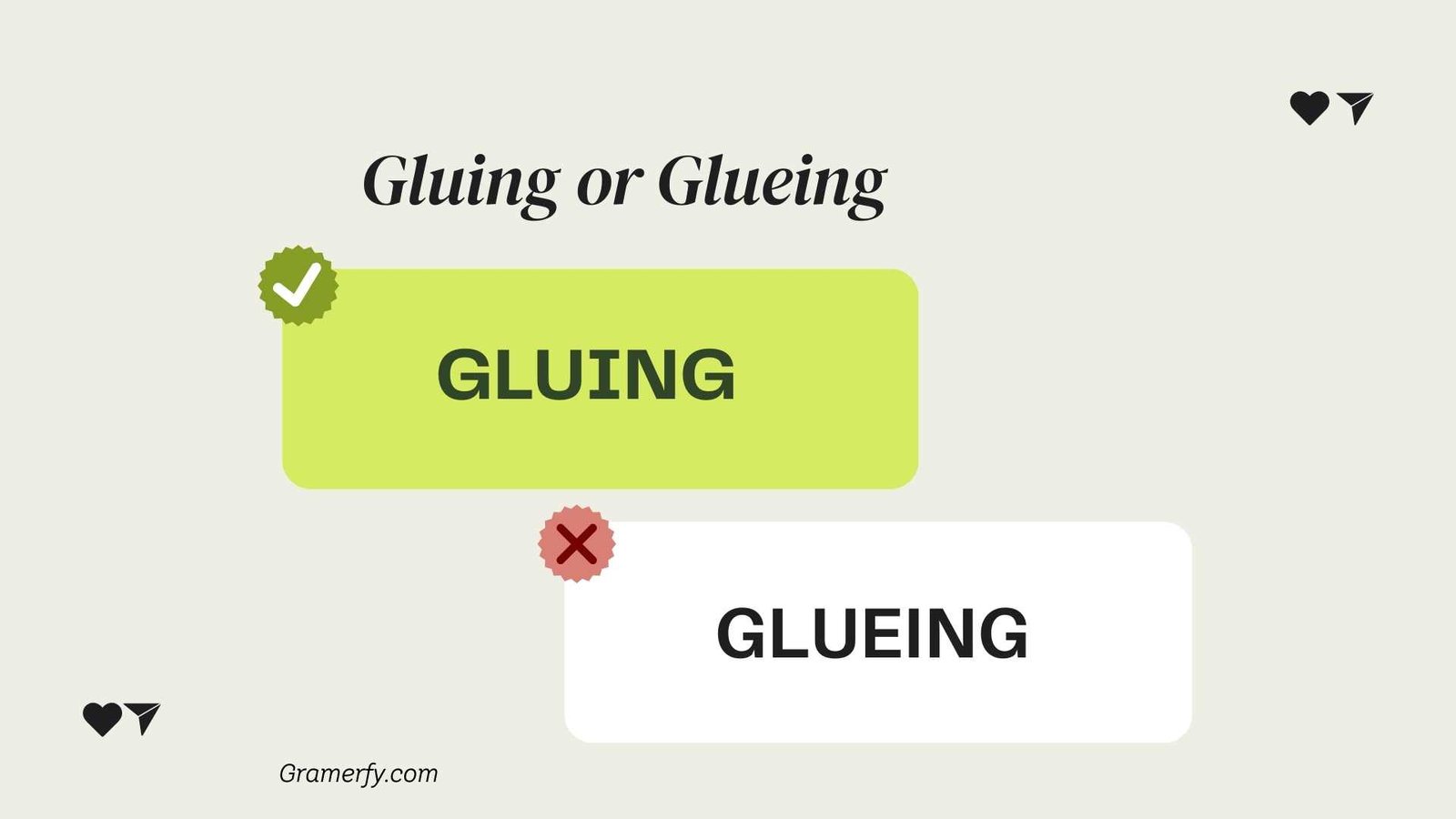
Correct Spelling: ✅ Gluing
✔ Gluing is the correct and standard spelling in modern English.
Examples:
- He is gluing the tiles carefully.
- Gluing the model took two hours.
- I’m gluing photos into my scrapbook.
What Is “Glueing”?
Is “Glueing” a Real Word?
❌ Glueing is considered incorrect in standard English.
Although it looks logical, “glueing” is not the accepted spelling in dictionaries, academic writing, or professional English.
Why Do People Write “Glueing”?
People often think:
- Glue → glue + ing = glueing
This seems logical, but English spelling rules work differently.
Why Is “Gluing” Correct and “Glueing” Wrong?
The English Spelling Rule Explained
In English, when a verb ends in silent “e”, we usually drop the “e” before adding “-ing”.
Examples of the Rule
| Base Verb | Incorrect | Correct |
| make | makeing ❌ | making ✅ |
| write | writeing ❌ | writing ✅ |
| glue | glueing ❌ | gluing ✅ |
| take | takeing ❌ | taking ✅ |
| dance | danceing ❌ | dancing ✅ |
📌 Rule:
If a verb ends in a silent e, drop the e before adding -ing.
Comparison: Gluing vs Glueing
Side-by-Side Comparison Table
| Feature | Gluing | Glueing |
| Correct spelling | ✅ Yes | ❌ No |
| Used in dictionaries | ✅ Yes | ❌ No |
| Accepted in exams | ✅ Yes | ❌ No |
| Used in professional writing | ✅ Yes | ❌ No |
| Grammar rule compliant | ✅ Yes | ❌ No |
| SEO & AdSense friendly | ✅ Yes | ❌ No |
✔ Winner: Gluing
Is “Gluing” Used in British and American English?
Yes.
✔ Gluing is correct in both:
- American English
- British English
- Australian English
- Canadian English
❌ Glueing is incorrect in all standard English varieties.
Common Mistakes Learners Make
Mistake 1: Adding “-ing” Without Dropping “e”
❌ glueing
✔ gluing
Mistake 2: Trusting Spellcheck Suggestions
Some older tools or user-generated content may show glueing, but modern dictionaries do not accept it.
Mistake 3: Copying Informal Online Usage
Blogs, forums, and comments sometimes use incorrect spellings. Always rely on grammar rules and trusted sources.
Easy Spelling Tip to Remember
Simple Trick 🧠
If the verb ends in silent “e”, drop the “e” before adding “-ing”.
Glue → gluing
Make → making
Bake → baking
📌 No exceptions for glue.
Examples of “Gluing” in Sentences
Beginner-Level Examples
- She is gluing the papers together.
- I am gluing the broken toy.
- Gluing photos is my hobby.
Daily Conversation Examples
- He spent all evening gluing the shelf.
- Stop moving while I’m gluing this.
- Gluing decorations takes patience.
Academic / Professional Examples
- The technician is gluing the components.
- Gluing materials require precision.
- Safety gloves are recommended while gluing.
“Gluing” as a Gerund (Noun)
“Gluing” can act as a noun.
Examples:
- Gluing requires steady hands.
- Gluing is better than taping.
- Proper gluing improves durability.
“Gluing” in Continuous Tenses
Present Continuous
- She is gluing the pieces.
Past Continuous
- He was gluing the frame.
Future Continuous
- They will be gluing the parts tomorrow.
Related Word Forms of “Glue”
| Form | Example |
| Glue (verb) | Please glue this. |
| Glue (noun) | Use strong glue. |
| Glued | The paper is glued. |
| Gluing | He is gluing it. |
Frequently Asked Questions (FAQs)
Is glueing ever correct?
No. Glueing is not correct in standard English. The correct spelling is gluing.
Why doesn’t glue keep the “e”?
Because English grammar rules say to drop the silent “e” before adding “-ing”.
Is gluing used in exams?
Yes. Gluing is the only accepted spelling in:
- School exams
- IELTS
- TOEFL
- Academic writing
Can I use glueing in informal writing?
It’s not recommended. Even in informal writing, gluing is preferred and correct.
Is glueing used in old English?
Some very old or non-standard texts may show glueing, but modern English does not accept it.
What do dictionaries say?
All major dictionaries (Oxford, Cambridge, Merriam-Webster) list gluing as correct.
Final Verdict:
The Correct Answer
✅ GLUING is correct
❌ GLUEING is incorrect
Remember This Rule Forever
Drop the silent e before adding -ing.
Conclusion
English spelling may feel tricky, but rules make it easier. The confusion between gluing and glueing disappears once you understand the silent “e” rule. While glueing may look right, it breaks standard grammar rules.
Gluing is the only correct, accepted, and professional spelling. Whether you’re writing an exam answer, blog post, or daily message, always choose gluing for clear, correct English.