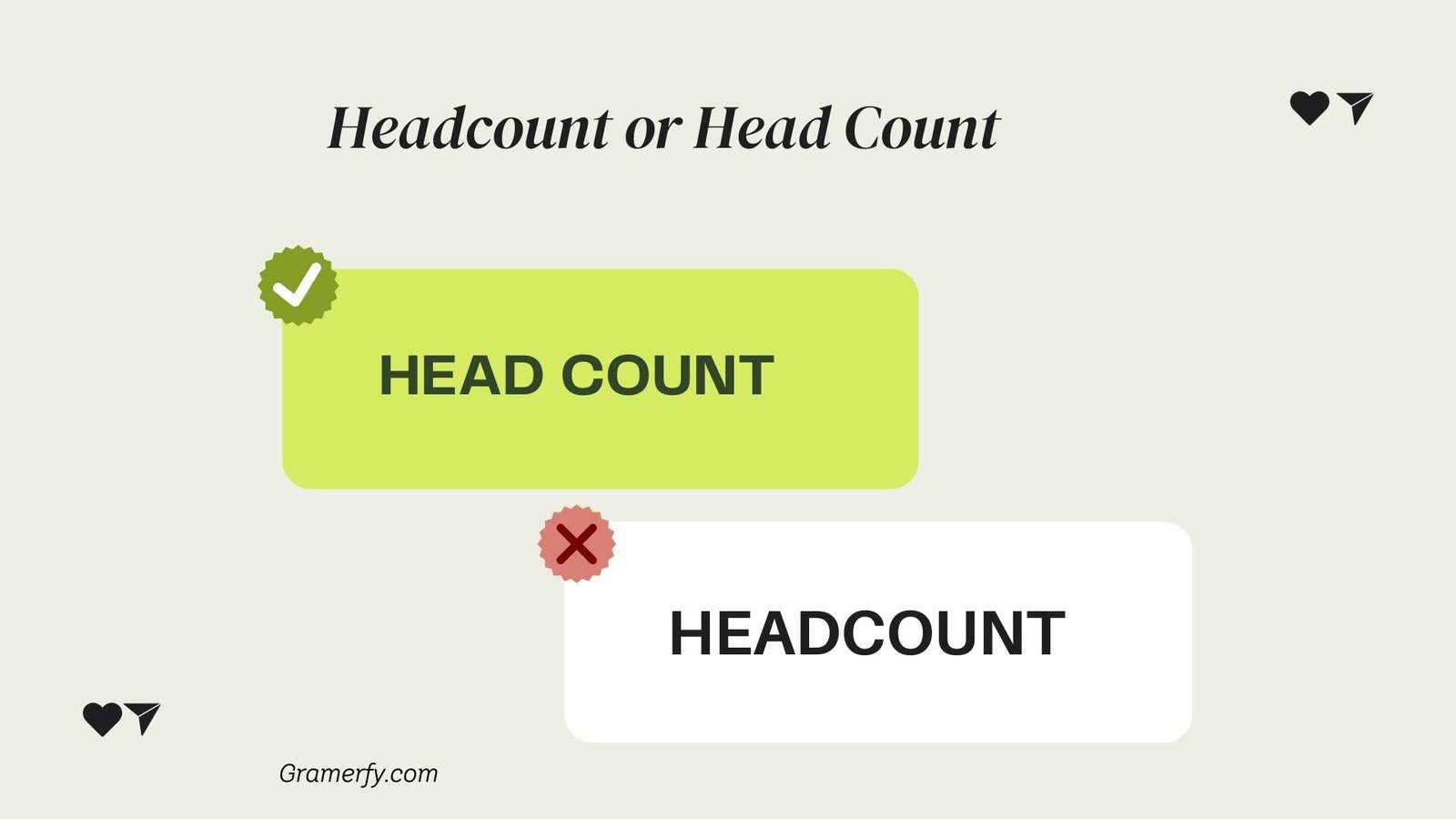
In today’s fast-paced business world, the terms Headcount and Head Count have become more than just HR jargon they are crucial indicators of a company’s growth, efficiency, and strategic planning.
You’re a startup founder trying to balance your team size or an HR professional aiming to optimize workforce management, understanding the subtle differences and implications of headcount can transform the way you make decisions.
Many people confuse “headcount” with “head count,” but this small variation can influence reporting, budgeting, and even recruitment strategies.
Meaning of “Headcount”
Definition
Headcount (one word) is a noun that refers to the total number of people in a group. It is often used in workplaces, schools, events, or organizations to indicate the number of people present.
Examples:
- The company’s headcount has increased to 150 employees.
- During the meeting, the manager took a quick headcount.
- The school keeps track of student headcount every semester.
Key Points About “Headcount”
- Always written as one word when referring to the number of people in a group.
- Commonly used in business, HR, education, and event management.
- Can also be used as a verb in informal contexts: “We need to headcount the team before starting.”
Meaning of “Head Count”
Definition
Head count (two words) is simply the literal act of counting heads, meaning counting each person individually. It emphasizes the process rather than the total number.
Examples:
- Let’s do a head count before leaving the office.
- The teacher performed a head count to make sure no students were missing.
- A quick head count showed that 10 guests had arrived.
Key Points About “Head Count”
- Written as two words when referring to the action of counting people.
- Focuses on the process, not the total number.
- Often used in formal or casual situations to check attendance.
Headcount vs Head Count: Main Differences
| Feature | Headcount (one word) | Head Count (two words) |
| Meaning | Total number of people | The act of counting people |
| Usage | Noun (number) | Noun (action) |
| Example | The company’s headcount is 200. | Let’s do a head count before lunch. |
| Formality | Business, HR, official records | General, casual, or procedural |
| Verb Form | Can be used informally as a verb | Not typically used as a verb |
Correct Usage of “Headcount”
Best In Business
- Our headcount has grown by 20% this year.
- The HR department tracks employee headcount every month.
In Schools
- The headcount of students increased to 1,200 this semester.
In Events
- The event’s headcount reached 500 attendees.
As a Verb (Informal)
- We need to headcount everyone before boarding the bus.
Correct Usage of “Head Count”
Checking Attendance
- The teacher did a head count to ensure no one was missing.
- Before the meeting started, we did a head count.
Informal Situations
- Let’s do a quick head count of who’s coming to the party.
Common Mistakes
- Mixing the two forms
- ❌ Incorrect: The manager performed a headcount to see who arrived.
- ✅ Correct: The manager performed a head count to see who arrived.
- ❌ Incorrect: The manager performed a headcount to see who arrived.
- Using “head count” when referring to the total number
- ❌ Incorrect: Our company’s head count is 200 employees.
- ✅ Correct: Our company’s headcount is 200 employees.
- ❌ Incorrect: Our company’s head count is 200 employees.
- Using “headcount” as a verb in formal writing
- ❌ Incorrect: Please headcount all participants.
- ✅ Correct (formal): Please conduct a head count of all participants.
- ❌ Incorrect: Please headcount all participants.
Tips to Remember
- Use headcount (one word) when talking about the total number of people.
- Use head count (two words) when talking about the action of counting people.
- If unsure, think: Are you talking about a number or a process?
Examples in Sentences
Using Headcount
- The company’s headcount increased after the new hires joined.
- We need an accurate headcount for budget planning.
- HR monitors headcount monthly to track growth.
Using Head Count
- The teacher did a head count before starting the field trip.
- Before leaving the office, we should do a head count.
- A head count revealed that five guests had not yet arrived.
FAQs (People Also Ask)
1. Is “headcount” one word or two?
Answer: Both are correct, but usage depends on context. Headcount (one word) refers to the total number of people, while head count (two words) refers to the act of counting people.
2. Can I use “headcount” as a verb?
Answer: Informally, yes. For example, “We need to headcount the employees.” In formal writing, use head count as a noun.
3. Which is more common in business writing?
Answer: Headcount (one word) is more common in HR and business documents because it refers to total numbers.
4. Can I say “do a headcount”?
Answer: Yes, this is commonly used in informal contexts to mean “check how many people are present.”
5. Is “head count” outdated?
Answer: No, it is still widely used, especially when emphasizing the action of counting.
Spelling Tips
- Always remember: headcount = one word for total numbers.
- Always remember: head count = two words for the action.
- Avoid using “headcount” as a verb in formal documents.
- Check context: Are you talking about the number or the counting process?
Conclusion
Understanding the difference between headcount and head count is simple if you remember one key idea: total number vs action of counting. Use headcount when referring to totals, especially in business, schools, or events. Use head count when you are actually counting people in real-time.
Correct usage will make your writing clear, professional, and error-free. Next time you write about employees, students, or attendees, you will know exactly which form to use.