Ever paused while writing and wondered, “Is it in tact or intact?” You’re not alone. These two words look almost identical, yet only one is correct in modern English. A tiny space can completely change your sentence and your credibility.
You’re drafting an email, posting on social media, or working on an important document, using the right word matters more than you think. After all, clear communication builds trust.
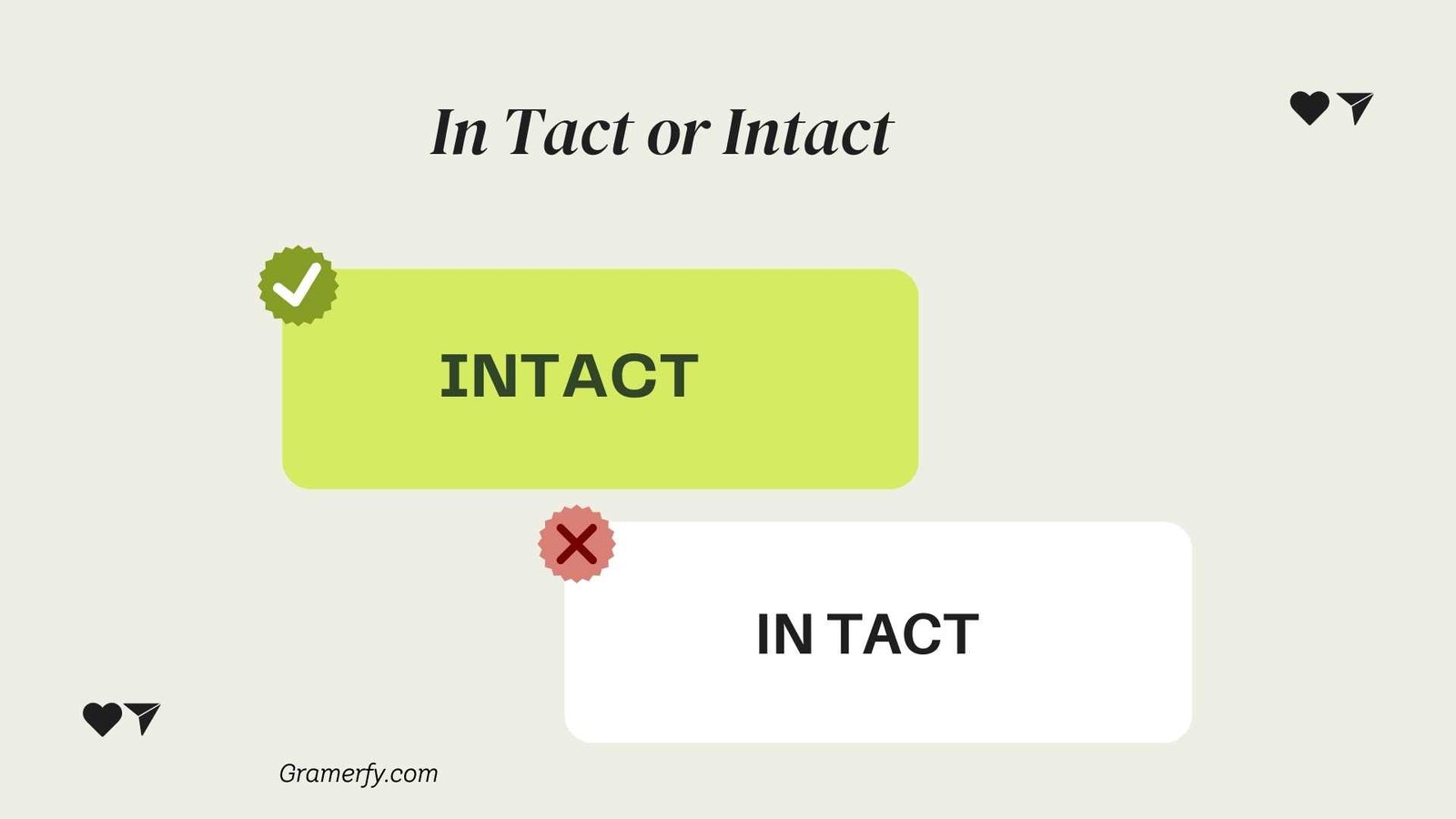
Here’s the truth: “intact” is the correct word, and it means something remains whole, undamaged, or complete. On the other hand, “in tact” is almost always a mistake. One small spacing error can slip in unnoticed, but sharp readers will catch it instantly.
What Does “Intact” Mean?
Meaning of Intact
Intact is an adjective that means:
- Complete
- Whole
- Not damaged
- Not altered
- In its original condition
When something is intact, nothing is missing, broken, or harmed.
Simple Definition
👉 Intact = not broken or damaged
Origin of the Word “Intact”
The word intact comes from the Latin word intactus, which means untouched. Over time, it entered English as a single word with a clear meaning related to wholeness and completeness.
Correct Usage of Intact
Intact is always written as one word.
✅ Correct
❌ Incorrect
Examples of Intact in Sentences
- The phone survived the fall and is still intact.
- Luckily, all the documents were intact after the fire.
- The ancient vase was found intact.
- Her reputation remained intact despite the rumors.
- The package arrived intact and undamaged.
What Does “In Tact” Mean?
Is “In Tact” a Real Phrase?
Here’s where the confusion begins.
- Tact is a real English word.
- In tact, however, is almost always incorrect in modern English.
Meaning of “Tact”
Tact means:
- Sensitivity in dealing with others
- Politeness
- The ability to say or do things without offending people
Example:
- She handled the situation with great tact.
Why “In Tact” Is Usually Wrong
When people write “in tact,” they usually intend to mean intact, not anything related to politeness or sensitivity.
❌ The glass arrived in tact.
✔ The glass arrived intact.
Technically, “in tact” could exist in very rare, forced situations, such as:
- He spoke in tact, not anger.
However, this usage is extremely uncommon and sounds unnatural. In everyday English, “in tact” is treated as an error.
In Tact or Intact: Which One Is Correct?
The Short Answer
👉 “Intact” is correct.
👉 “In tact” is almost always wrong.
Key Rule to Remember
If you mean:
- undamaged
- whole
- complete
✔ Use intact
Never split it into two words.
In Tact vs Intact: Side-by-Side Comparison
| Feature | Intact | In Tact |
| Correct spelling | ✅ Yes | ❌ No (in most cases) |
| One word or two | One word | Two words |
| Meaning | Whole, undamaged | Rare, unnatural usage |
| Common in English | Very common | Almost never |
| Grammar role | Adjective | Incorrect phrase |
| Example | The package is intact | ❌ The package is in tact |
Why Do People Confuse In Tact and Intact?
1. “Tact” Is a Real Word
Since tact exists as a noun, many learners assume in tact must also be correct.
2. English Has Many “In + Noun” Phrases
Examples:
- In time
- In place
- In charge
This pattern makes “in tact” look logical, even though it’s wrong.
3. Pronunciation Sounds the Same
When spoken aloud, intact sounds like in tact, which leads to spelling mistakes.
Common Mistakes with In Tact and Intact
Writing “In Tact” Instead of “Intact”
- ❌ The files were kept in tact.
- ✔ The files were kept intact.
Splitting the Word Unnecessarily
- ❌ The agreement remained in tact.
- ✔ The agreement remained intact.
Assuming Two Words Are More “Correct”
Many learners believe longer or separated phrases are more formal. In this case, the opposite is true.
Spelling Tips to Remember “Intact”
Tip 1: Think “Unbroken”
If something is unbroken, it’s intact.
Tip 2: Remember “One Piece, One Word”
If the object is in one piece, write one word: intact.
Tip 3: Link It to “Untouched”
Since intact comes from untouched, remember it as a single unit.
Tip 4: Never Add a Space
If your fingers want to type in tact, stop and remove the space.
Correct Usage of Intact in Different Contexts
in Everyday Life
- The eggs arrived intact.
- My laptop is still intact after the fall.
in Academic Writing
- The original theory remains intact.
- The data was preserved intact.
Intact in Legal and Business English
- The contract remains intact.
- Company policies stayed intact after the merger.
Intact in Emotional and Abstract Meaning
- His confidence remained intact.
- Their relationship stayed intact despite challenges.
More Example Sentences Using Intact
- The storm was strong, but the house stayed intact.
- Please keep the seal intact.
- The museum preserved the artwork intact.
- Her memory of the event is still intact.
- The evidence must remain intact.
Can “In Tact” Ever Be Correct?
Technically Possible, Practically No
In theory, “in tact” could mean “in a state of tactfulness.”
In practice, native speakers do not use it this way.
Example (Very Rare and Awkward)
- He responded in tact, not anger.
Even here, most writers would say:
- He responded tactfully.
Final Verdict
👉 Do not use “in tact.”
👉 Always use “intact.”
Best Intact vs Similar Words
Intact vs Whole
- Intact → not damaged
- Whole → complete but not necessarily undamaged
Deferenc Intact vs Complete
- Intact → nothing broken
- Complete → nothing missing
Intact vs Undamaged
- Intact → formal and broader
- Undamaged → more specific
Grammar Rules You Should Remember
- Intact is always one word
- It is an adjective
- It describes nouns
- It never needs a hyphen
- “In tact” is almost always incorrect
FAQs: People Also Ask
Is it “in tact” or “intact”?
✔ Intact is correct.
❌ In tact is incorrect in normal usage.
Why is “in tact” wrong?
Because intact is a single word with a specific meaning. Splitting it changes the meaning and creates an error.
Is “intact” formal English?
Yes. Intact is used in formal, academic, legal, and everyday English.
Can I use “intact” in essays?
Absolutely. It is grammatically correct and widely accepted.
Does “intact” always mean physical objects?
No. It can describe abstract ideas like:
- reputation
- confidence
- relationships
What part of speech is “intact”?
Intact is an adjective.
Is “intact” American or British English?
Both. It is correct in American and British English.
How do I remember the correct spelling?
Remember:
👉 No space. One word. Intact.
Conclusion
The confusion between in tact or intact is very common, but the rule is simple once you understand it. Intact is the correct spelling and should always be written as one word. It describes something that remains whole, untouched, or undamaged.
While tact is a real word, combining it with in creates a phrase that is almost never correct in modern English. By remembering that intact means “untouched” and stays together as one word, you can avoid this mistake forever.