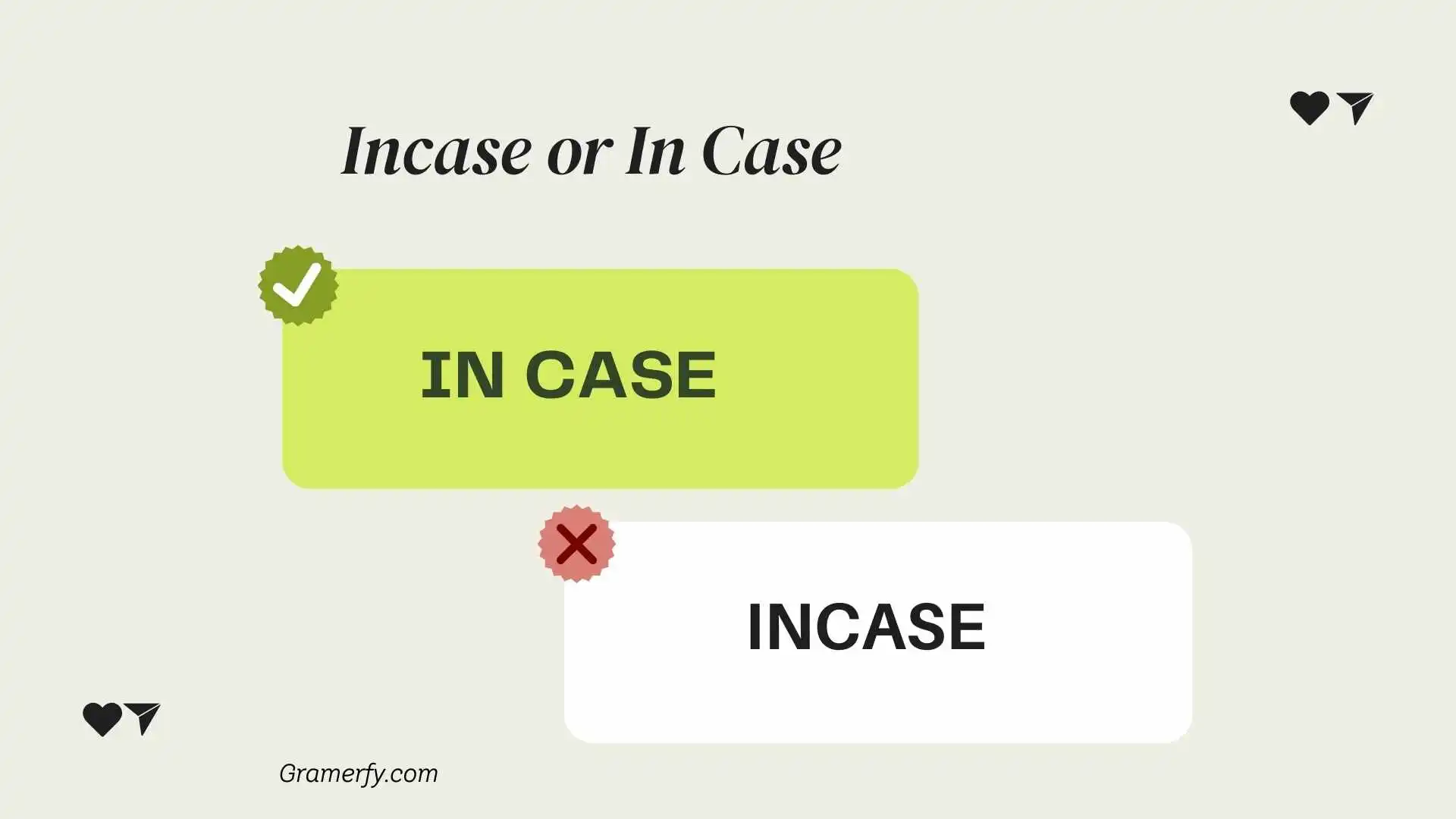
Have you ever paused while typing and wondered, “Is it incase or in case?” You’re not alone. This tiny two-word confusion trips up students, bloggers, professionals, and even native English speakers every single day.
At first glance, both look correct. However, only one is actually standard English. The other? It’s a common spelling mistake that quietly sneaks into emails, essays, and social media captions.
That small space between in and case makes a big difference. One version follows proper grammar rules. The other doesn’t officially exist in modern English dictionaries. Surprised? Many people are.
What Does “In Case” Mean?
“In case” is a correct phrase in English. It is used to talk about precautions, possibilities, or reasons for doing something. It often means “if something happens” or “to be prepared for something.”
Usage of “In Case”
- To show precaution:
- Take an umbrella in case it rains.
- I brought some snacks in case we get hungry.
- Take an umbrella in case it rains.
- To explain a reason for doing something:
- I left early in case the traffic is bad.
- Save your work frequently in case the computer crashes.
- I left early in case the traffic is bad.
- With past or present actions:
- She called him in case he needed help.
- Keep extra batteries in case your flashlight dies.
- She called him in case he needed help.
Key Points about “In Case”
- Always two words: in case
- Followed by a clause (with subject and verb) or sometimes a noun:
- Correct: in case it rains
- Correct: in case of fire, use stairs
- Correct: in case it rains
- Expresses preparation or caution
What About “Incase”?
“Incase” as one word is incorrect in formal English. It is not recognized in dictionaries like Oxford or Cambridge. Some people type it in texting or informal writing, but you should avoid it in professional writing, emails, essays, or publications.
- ❌ Incorrect: I brought an umbrella incase it rains.
- ✅ Correct: I brought an umbrella in case it rains.
Tip: Always remember that “incase” is not standard English. If in doubt, split it into two words: in + case.
Incase vs In Case: Quick Comparison
| Feature | In Case | Incase |
| Correctness | ✅ Correct | ❌ Incorrect |
| Meaning | If something happens / for precaution | None (informal misuse) |
| Usage | Always two words | Avoid in formal writing |
| Example | Take an umbrella in case it rains | Take an umbrella incase it rains (wrong) |
| Formal/Informal | Both, especially formal writing | Only informal (not recommended) |
Common Mistakes with “In Case”
Even advanced learners make errors. Here are the most frequent mistakes:
- Writing “incase” in formal text
- Wrong: I called her incase she was late.
- Correct: I called her in case she was late.
- Wrong: I called her incase she was late.
- Using “in case” when “because” fits better
- Wrong: I stayed home in case I was sick.
- Correct: I stayed home because I was sick.
- Wrong: I stayed home in case I was sick.
- Confusing “in case of” with “in case”
- “In case of” is followed by a noun:
- Correct: In case of fire, use stairs.
- Wrong: In case of it rains, bring an umbrella.
- Correct: In case of fire, use stairs.
- “In case of” is followed by a noun:
- Omitting necessary words after “in case”
- Wrong: Bring food in case.
- Correct: Bring food in case we get hungry.
- Wrong: Bring food in case.
Spelling Tips to Avoid Mistakes
- Always write it as two words: in case
- If you’re unsure, ask: Can “in” and “case” stand alone in this sentence? If yes, use two words.
- Remember: incase is only seen in texting and social media, never in formal writing.
Examples of “In Case” in Sentences
Everyday Situations
- I bought extra water in case we go hiking.
- Take your coat in case it gets cold tonight.
- Keep a pen handy in case you need to sign forms.
Professional or Academic Writing
- Students should save their work frequently in case of technical errors.
- Emergency kits should be available in case of natural disasters.
- We conducted a backup survey in case the original data was lost.
With “In Case of”
- In case of fire, exit immediately.
- In case of emergency, dial 911.
- In case of injury, seek medical attention immediately.
FAQs About “Incase vs In Case”
1. Can I ever use “incase”?
No, “incase” is considered incorrect in standard English. Always use in case.
2. Is “in case of” different from “in case”?
Yes.
- In case: followed by a full clause → Bring food in case we get hungry.
- In case of: followed by a noun → In case of fire, use stairs.
3. Can “in case” mean “because”?
Not exactly. “In case” shows precaution. “Because” shows reason.
- Correct: I locked the door in case someone tries to enter.
- Wrong: I locked the door in case I was tired. (Use “because” here)
4. Is “incase” accepted in informal writing?
Some people use it in texting or social media, but it is still considered incorrect. Avoid it if you want to sound professional.
5. How do I remember “in case” is correct?
Think of it as: “in” + “case” = if something happens, just in that case, be prepared.
Conclusion
Understanding the difference between incase and in case is simple once you remember that “in case” is correct, and “incase” is not standard English. Always write two words when expressing precaution, possibility, or preparation. Avoid confusing it with “because” or misusing “in case of.”
Using in case correctly enhances clarity, makes your writing professional, and prevents embarrassment in formal situations. With this guide, you can now confidently use “in case” in emails, essays, and everyday communication. Remember the examples, follow the tips, and check your writing carefully. English clarity is just a habit away.