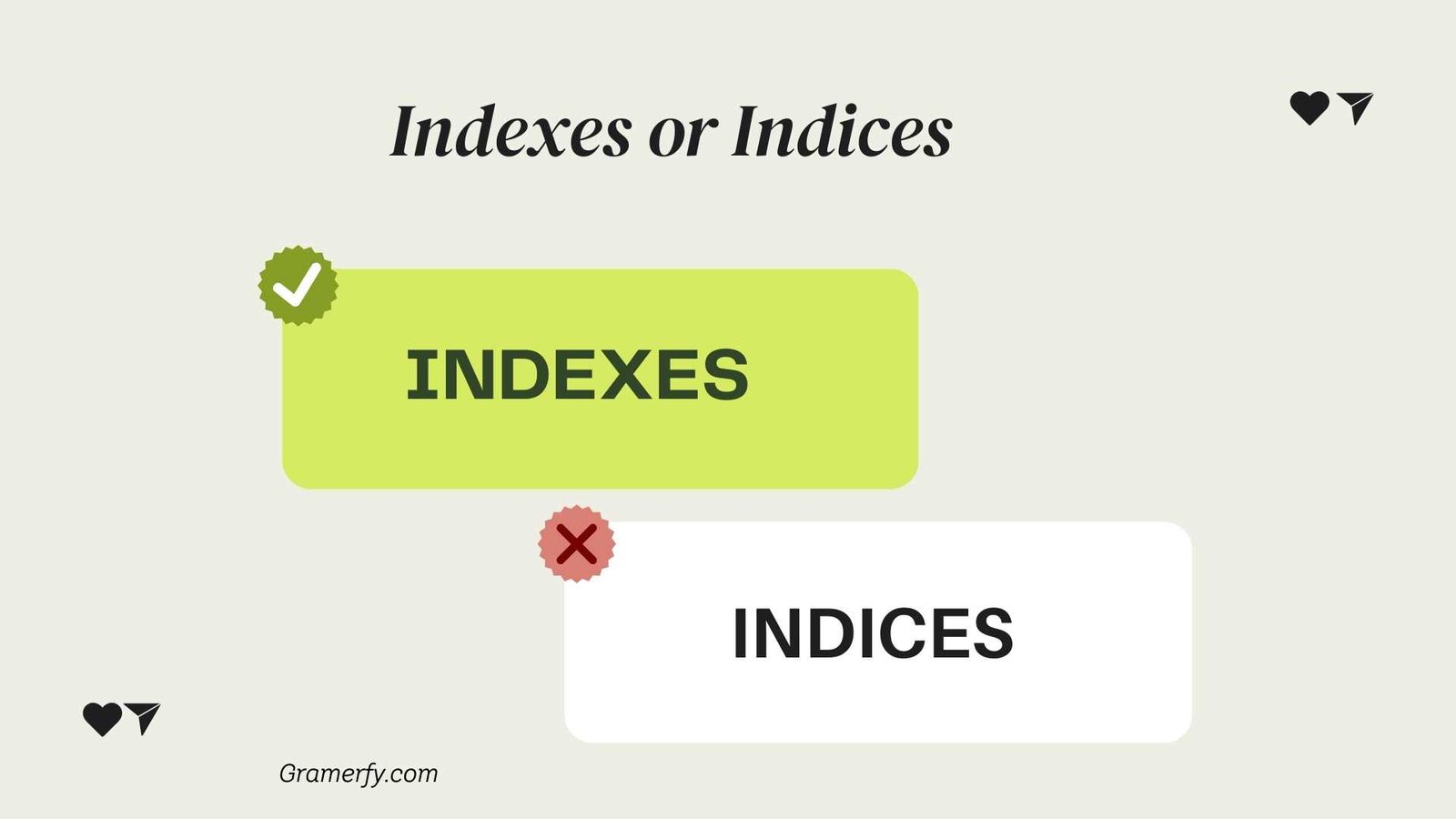
In the world of finance and data, understanding the terms Indexes and Indices is more than just a linguistic curiosity it’s essential for making sense of markets, statistics, and trends.
While both words essentially point to the same concept, “indexes” is more common in everyday English, whereas “indices” is often preferred in academic or technical contexts.
Choosing the right term depends on your audience and purpose, but grasping their meaning can elevate your communication and analytical skills.
Meaning and Usage of “Indexes”
The word “indexes” is the more general and modern plural form of “index.” It is widely used in everyday English, particularly in books, websites, databases, and business contexts.
Key Points about Indexes
- Definition: The plural form of “index,” referring to a list or system used to locate information.
- Common Contexts: Books, websites, libraries, computer databases, stock markets.
- Formality: Less formal than “indices” and suitable for everyday writing.
Examples of Indexes in Sentences
- The book contains several indexes to help readers find important topics quickly.
- Our website has indexes for all the articles in each category.
- Financial analysts often look at market indexes to measure stock performance.
Tip: If you’re writing for a general audience or digital content, “indexes” is usually the safer choice.
Meaning and Usage of “Indices”
“Indices” is the Latin-derived plural form of “index.” It is considered more formal and is typically used in mathematics, science, and finance.
Key Points about Indices
- Definition: The plural form of “index,” often used in technical, scientific, or formal contexts.
- Common Contexts: Mathematics, statistics, scientific reports, finance.
- Formality: More formal and precise than “indexes.”
Examples of Indices in Sentences
- The mathematician studied the indices of the matrix carefully.
- The economic report included several indices measuring inflation and employment rates.
- Chemical compounds are often written with indices to indicate quantities, like H₂O.
Tip: Use “indices” in professional, scientific, or mathematical writing to sound precise and authoritative.
Indexes vs. Indices: Comparison Table
| Feature | Indexes | Indices |
| Origin | Modern English | Latin |
| Formality | Informal / General | Formal / Technical |
| Common Contexts | Books, websites, databases, finance | Mathematics, science, statistics, finance |
| Audience | General readers | Professionals, academics |
| Example | The library has several indexes | The economist studied various indices |
Quick Tip: If in doubt, use indexes for general writing and indices for technical or formal writing.
Common Mistakes & Spelling Tips
Even native speakers get confused between indexes and indices. Here are some common mistakes and tips to avoid them:
Common Mistakes
- Using indices in casual writing:
❌ “I checked the book’s indices for recipes.”
✅ “I checked the book’s indexes for recipes.” - Using indexes in a scientific report:
❌ “The study analyzed multiple stock indexes.” (formal finance context)
✅ “The study analyzed multiple stock indices.” - Spelling errors:
- Wrong: indeces, indixes
- Correct: indices, indexes
- Wrong: indeces, indixes
Spelling Tips
- Indexes → Just add -es to index.
- Indices → Remember it’s Latin-based; the -i ending replaces the English plural.
Practical Examples in Different Contexts
Let’s see more real-life examples to help you understand when to use each word.
1. In Books and Literature
- Indexes: The textbook has a detailed indexes section at the back.
- Indices: ❌ (Too formal for casual book context)
2. In Mathematics
- Indices: The formula uses several indices to represent powers.
- Indexes: ❌ (Sounds informal in math)
3. In Finance and Economics
- Indexes: The S&P 500 and Dow Jones are popular stock indexes.
- Indices: Analysts track multiple economic indices to assess growth.
4. In Computer Databases
- Indexes: SQL databases use indexes to speed up searches.
- Indices: ❌ (Not commonly used in IT context)
FAQs (People Also Ask Style)
1. Are indexes and indices the same?
Yes, both are plural forms of “index,” but indexes is general, while indices is formal and technical.
2. Which one is correct in business writing?
Both can be correct, but indexes is more common for general business. Use indices for technical financial reports.
3. Can I use indices in casual writing?
It’s best to avoid indices in casual contexts; it may sound overly formal or confusing.
4. How do I remember the difference?
- Indexes → everyday use, books, websites.
- Indices → formal, scientific, financial.
5. Is “indeces” correct?
No. The correct plural forms are indexes and indices.
Conclusion
Choosing between indexes and indices is easier once you understand the context. Indexes is safe for general writing, websites, books, and databases, while indices fits technical, scientific, and financial writing.
By following this guide, you can confidently write with the correct plural form of index and avoid common mistakes.