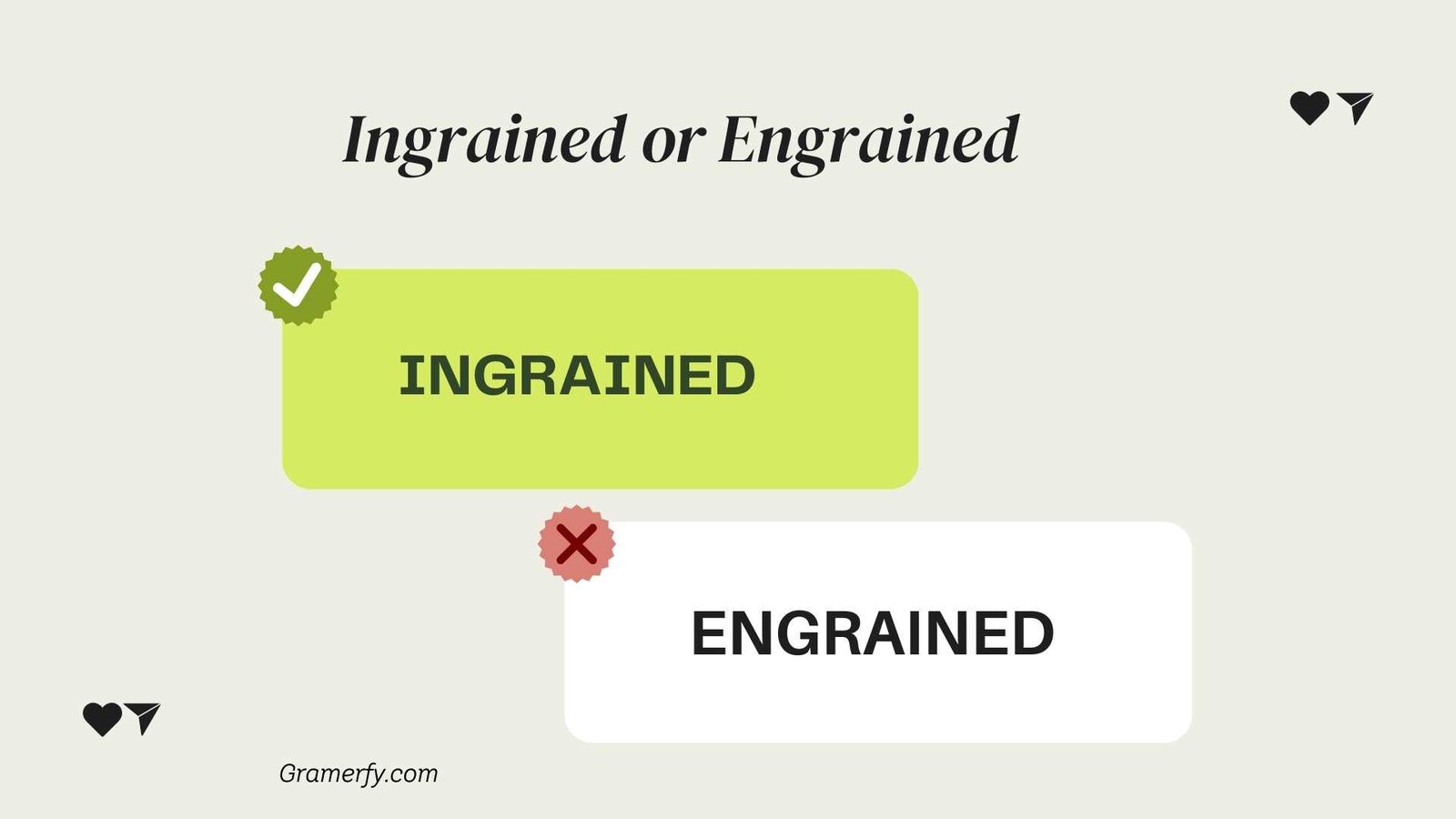
When it comes to mastering the English language, even a single word can spark confusion, especially when it comes to subtle spelling variations. One such pair that leaves many scratching their heads is “Ingrained” vs “Engrained.”
Though they sound similar and often seem interchangeable, each carries a distinct nuance that can completely change the meaning of a sentence.
Imagine writing a professional article or sending an important message and accidentally using the wrong form suddenly, your credibility is on the line.
Meaning and Correct Usage
1. Ingrained
Definition:
The word “ingrained” means something that is firmly fixed or deeply rooted. It is often used to describe habits, beliefs, attitudes, or qualities that are difficult to change.
Examples:
- Honesty is ingrained in her character.
- Bad habits can become ingrained if not corrected early.
- The idea of teamwork is ingrained in our company culture.
Usage Tip:
- Use ingrained when describing qualities or habits that are deeply established over time.
2. Engrained
Definition:
“Engrained” is an older form of the word “ingrained.” It has the same meaning but is now considered archaic and less common in modern English. Most dictionaries recommend using “ingrained” instead.
Examples (less common):
- Prejudices can be engrained in society.
- His love for reading was engrained from childhood.
Usage Tip:
- Avoid engrained in formal writing. Use ingrained for clarity and correctness.
Comparison Table: Ingrained vs Engrained
| Feature | Ingrained | Engrained |
| Correctness | Modern, widely accepted | Older, archaic |
| Common Usage | Very common | Rare |
| Meaning | Deeply fixed or established | Same as ingrained |
| Recommended in Writing | ✅ Yes | ❌ No |
| Examples | Ingrained habits, ingrained beliefs | Engrained habits (less used) |
Common Mistakes
Even native speakers sometimes confuse these words. Here are common mistakes to avoid:
- Spelling Confusion:
- ❌ He has many engrained habits.
- ✅ He has many ingrained habits.
- ❌ He has many engrained habits.
- Using Engrained in Modern Writing:
- ❌ The engrained traditions are hard to change.
- ✅ The ingrained traditions are hard to change.
- ❌ The engrained traditions are hard to change.
- Mixing with “engrave”:
Some people mistakenly link engrained to engrave because they sound similar. However, ingrained is about deeply established qualities, not carving something physically.
Spelling Tips
- Remember the “in-” prefix: Modern English prefers ingrained, not engrained.
- Think of “in” = inside, meaning something is fixed inside a person or thing.
- If you are unsure, always default to ingrained—it’s the correct, widely accepted form.
Examples in Sentences
Here are more examples to help you understand usage:
Habits and Personality
- Punctuality is ingrained in his daily routine.
- Kindness should be ingrained in every child.
Ideas and Beliefs
- Patriotic feelings were ingrained in the community.
- Stereotypes can become ingrained if not challenged.
Workplace and Culture
- Teamwork is ingrained in our company culture.
- Safety procedures are ingrained into every training session.
FAQs (People Also Ask)
1. Is it “ingrained” or “engrained”?
Answer: The correct and modern spelling is ingrained. Engrained is an older, less common form and is rarely used today.
2. What does “ingrained” mean?
Answer: It means something is deeply fixed, established, or difficult to change, like habits, beliefs, or attitudes.
3. Can I use “engrained” in formal writing?
Answer: It is not recommended. Use ingrained for clarity and correctness.
4. Are “ingrained” and “engrained” interchangeable?
Answer: Technically yes, they have the same meaning. But modern English prefers ingrained.
5. How do I remember the correct spelling?
Answer: Think of “in” as inside or internal. Something ingrained is “inside” and fixed. Always default to ingrained in writing.
Key Takeaways
- Ingrained = modern, correct spelling for something deeply rooted.
- Engrained = archaic spelling; rarely used today.
- Meaning = something firmly fixed, like a habit or belief.
- Tip = Always use ingrained in writing and formal communication.
Conclusion
Confusing ingrained and engrained is common, but the solution is simple. Use ingrained in all modern writing, speech, and formal contexts. Remember: if a habit, idea, or quality is deeply established, it is ingrained—not engrained. This small spelling choice ensures your English is correct, professional, and easy to read.
With these tips, examples, and comparisons, you can confidently use ingrained in any context without second-guessing. Make it a habit to check your spelling, and soon it will be second nature!