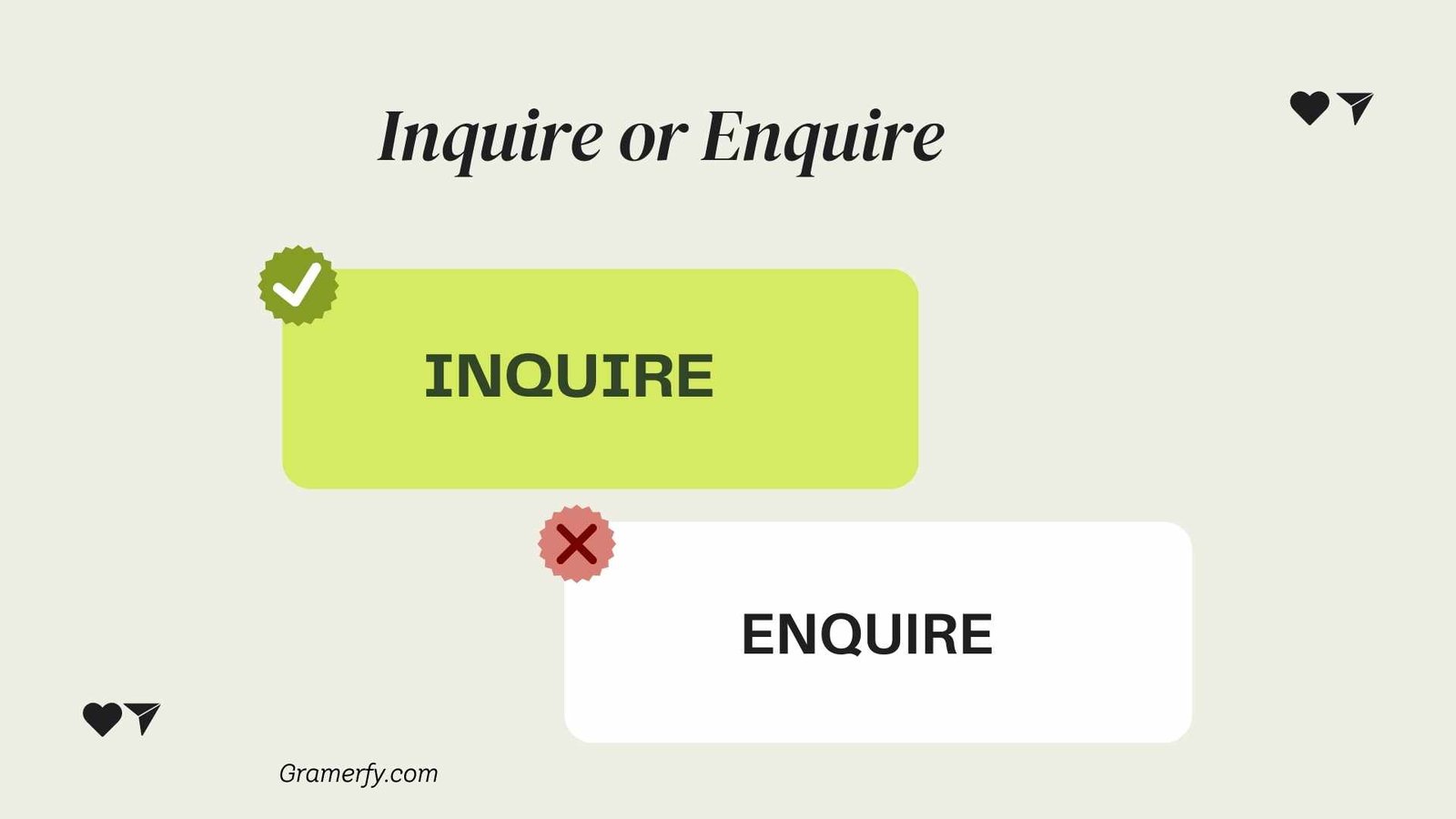
Words shape how people see you. And when it comes to “Inquire or Enquire,” even one letter can spark confusion. Have you ever paused mid-sentence and wondered which one is correct? You’re not alone.
This tiny spelling difference trips up students, writers, business owners, and even professionals every single day. Here’s the simple truth: both words mean the same thing. However, their usage depends on where you are and who you’re writing for.
One version dominates in American English. The other feels more natural in British English. That small detail can subtly influence your credibility, especially in academic writing, emails, job applications, and website content.
Meaning and Usage of “Inquire”
What Does “Inquire” Mean?
Inquire is a verb that means:
- To ask for information
- To investigate or look into something
It is often considered more formal and is commonly used in American English or in formal writing.
Examples:
- She called the hotel to inquire about room availability.
- The police will inquire into the cause of the accident.
- I would like to inquire if you offer online classes.
Key Points About “Inquire”:
- Formal or official situations
- Investigations or detailed questioning
- Common in business, legal, or academic contexts
Meaning and Usage of “Enquire”
What Does “Enquire” Mean?
Enquire is also a verb, meaning essentially the same as inquire:
- To ask a question
- To seek information
However, enquire is more common in British English and often used in everyday conversation. It’s less formal than inquire.
Examples:
- I went to the reception to enquire about the train schedule.
- She enquired whether the meeting had been canceled.
- Students often enquire about course details before enrolling.
Key Points About “Enquire”:
- Informal or conversational situations
- Commonly used in the UK
- Perfect for casual questions and polite requests
Inquire vs Enquire: Comparison Table
| Feature | Inquire | Enquire |
| Meaning | Ask for information, investigate | Ask for information |
| Formality | Formal, official | Informal, conversational |
| Region | American English (more common) | British English (more common) |
| Common Context | Business, legal, academic | Everyday conversation, casual |
| Examples | “They inquired about the contract.” | “She enquired about the train.” |
Tip: In general, use inquire in formal writing and enquire in casual British English. In most cases, people will understand either word, but it’s about tone and style.
Common Mistakes with “Inquire” and “Enquire”
Many learners make the following errors:
- Using enquire in American English documents:
- ❌ “I enquired about the loan.” (American formal writing)
- ✅ “I inquired about the loan.”
- ❌ “I enquired about the loan.” (American formal writing)
- Using inquire in casual conversation in the UK:
- ❌ “I inquired about the train times.” (UK casual conversation)
- ✅ “I enquired about the train times.”
- ❌ “I inquired about the train times.” (UK casual conversation)
- Spelling errors: Confusing “inquire” with enqure or “enquire” with inquir.
Spelling Tips:
- “Inquire” → starts with I, like information (formal info)
- “Enquire” → starts with E, like everyday English (casual questions)
Examples in Different Contexts
Formal / Business Context
- We inquired about the company’s annual report.
- The manager will inquire into the financial discrepancy.
- Customers are encouraged to inquire about warranty details.
Casual / Conversational Context
- She enquired about the new cafe in town.
- I enquired if my friend wanted to join the movie.
- Visitors often enquire about local attractions.
Questions in Email or Letters
- ❌ “I enquired if the product was available.” (In American English)
- ✅ “I inquired if the product was available.”
- ❌ “Can I inquire about train timings?” (In British casual English)
- ✅ “Can I enquire about train timings?”
FAQs (People Also Ask)
1. Are inquire and enquire the same?
Yes, they have the same meaning—both mean to ask for information. The difference is mostly about formality and region.
2. Which one should I use in American English?
Use inquire for both formal and professional contexts. Enquire is rarely used in American English.
3. Which one should I use in British English?
Both are accepted. Use enquire in casual speech and inquire in formal writing.
4. Can I use inquire in conversation?
Yes, but it may sound formal. For casual British English, “enquire” is more natural.
5. Is it wrong to mix them?
Not wrong, but consistency matters. Choose one based on formality and region.
Tips for Remembering the Difference
- I → Inquire → Information → Formal
- E → Enquire → Everyday → Casual / UK
Practice Exercises
Try filling in the blanks with inquire or enquire:
- I called the office to ________ about my appointment.
- The police will ________ into the theft.
- She ________ if her package had arrived.
- Students often ________ about scholarships.
Answers: 1. inquire 2. inquire 3. enquired 4. enquired
Conclusion
Choosing between inquire and enquire is simpler than it seems. Remembering the region and formality will help you pick the right word every time.
With practice, your emails, letters, and conversations will sound confident and professional.Now you can confidently ask questions in English without any doubt about spelling or style!