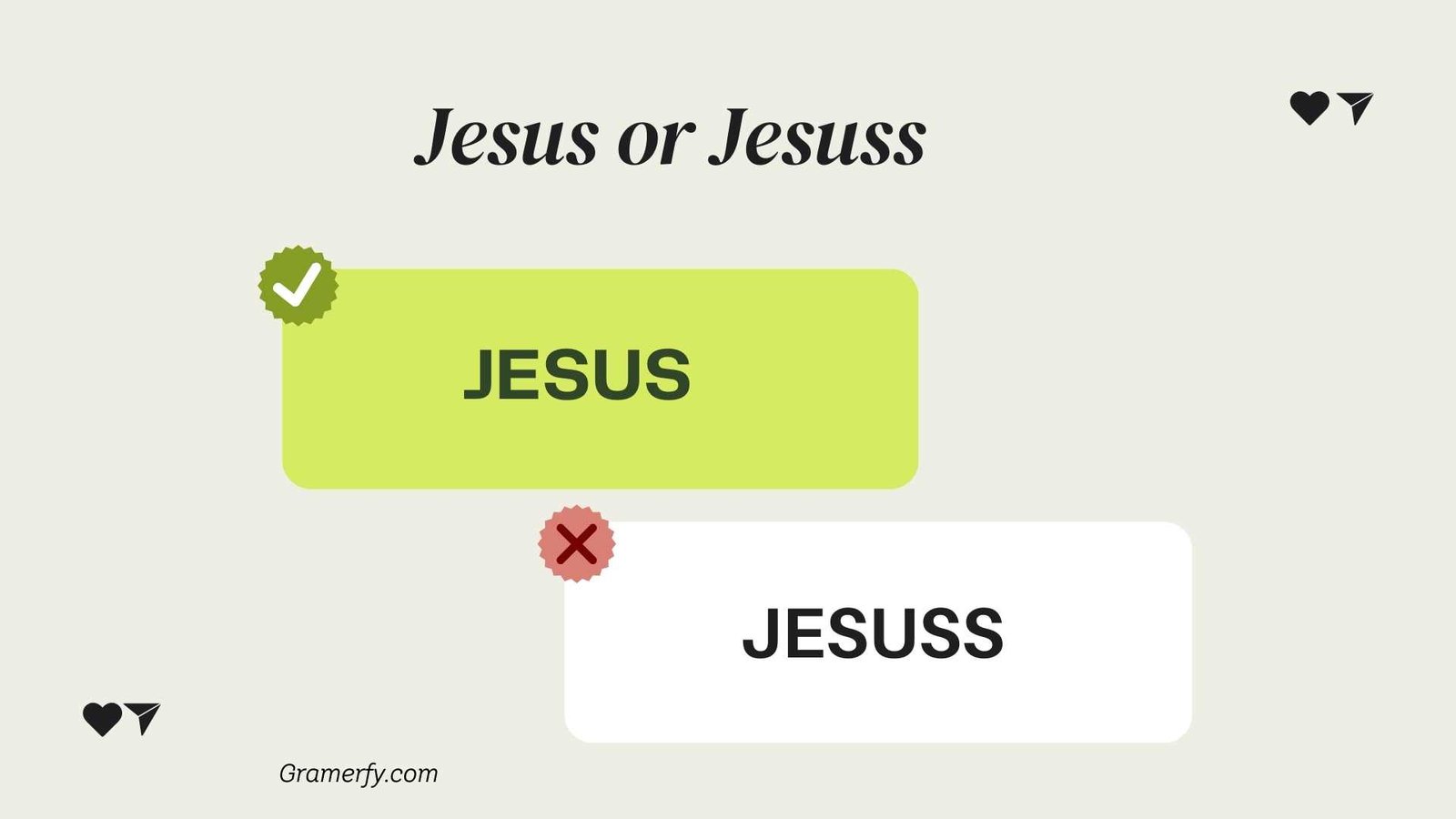
understanding the distinction between “Jesus” and “Jesuss” is essential, especially in today’s digital and informal communication landscape.
While “Jesus” is the historically and religiously accurate spelling, widely recognized across cultures and texts, “Jesuss” often appears as a typo, a casual variation, or in social media expressions.
Recognizing this difference helps maintain clarity in writing, research, and religious discussions. Moreover, it reflects the importance of respecting proper terminology when referring to significant historical or spiritual figures.
What Does “Jesus” Mean?
Jesus is a proper noun and refers to:
- Jesus Christ, the central figure of Christianity
- A name used in religious texts, history, and general conversations
Key points about “Jesus”:
- Always capitalized because it is a proper noun.
- Singular in form.
- Used in religious, historical, and conversational contexts.
Examples:
- “Many people celebrate the birth of Jesus on Christmas.”
- “Jesus taught love, kindness, and forgiveness.”
- “The story of Jesus is central to Christian beliefs.”
What About “Jesuss”?
The spelling “Jesuss” is incorrect in standard English.
- It is not recognized in dictionaries.
- It may appear as a typo or in informal online writing.
- Using Jesuss in formal writing, school assignments, or articles is considered a mistake.
Examples:
- ❌ “Many people celebrate Jesuss on Christmas.” (Incorrect)
- ✅ “Many people celebrate Jesus on Christmas.” (Correct)
Comparison: Jesus vs Jesuss
Here’s a simple table to help you remember the difference:
| Word | Correct/Incorrect | Meaning/Usage | Notes |
| Jesus | ✅ Correct | Refers to Jesus Christ; proper noun; always capitalized | Standard English; formal & informal |
| Jesuss | ❌ Incorrect | None in standard English; typo | Avoid in writing; only seen online |
Common Mistakes and Why They Happen
Many people write Jesuss due to:
- Typing errors – accidentally pressing an extra “s”.
- Pronunciation confusion – people hear the ending sound and write it twice.
- Informal texting or social media – some may add extra letters for emphasis.
Tips to Avoid Mistakes:
- Always check the spelling in a dictionary.
- Remember: Jesus = correct; no extra “s” needed.
- Use spell-check tools in your word processor or browser.
Spelling Tips
- Capitalization matters – Always write Jesus, not jesus (except in casual texts).
- Never add extra letters – one “s” at the end is enough.
- Visualize the name – Think of famous phrases like “Jesus Christ”, which only have one “s” at the end.
- Practice writing sentences – repetition helps avoid mistakes.
Multiple Examples in Sentences
Here are more examples for clear understanding:
- Correct: “Many followers of Jesus pray daily.”
- Correct: “The teachings of Jesus have inspired millions.”
- Correct: “We learned about Jesus in history class.”
- Incorrect: “Many followers of Jesuss pray daily.”
- Incorrect: “The teachings of Jesuss have inspired millions.”
Frequently Asked Questions (FAQs)
1. Is it ever correct to write Jesuss?
No, Jesuss is not correct in any formal, academic, or professional context.
2. Can Jesuss be used online?
Some people type Jesuss on social media to emphasize or express surprise, but it’s still a spelling error.
3. How do I remember the correct spelling?
Think of the most common phrase: Jesus Christ. No extra “s” at the end.
4. Is Jesus a common name?
Yes, in many cultures, Jesus is a given name, particularly in Spanish-speaking countries, pronounced differently but spelled the same.
5. Should I capitalize Jesus in all cases?
Yes, always capitalize Jesus, as it is a proper noun.
Conclusion
In short, the correct spelling is Jesus, and Jesuss is incorrect. By remembering the proper capitalization, avoiding extra letters, and using simple practice sentences, you can always get it right.
Whether writing academically, religiously, or casually, using Jesus correctly shows respect for the word and ensures clear communication. Always double-check your spelling, and when in doubt, remember the simple rule: one “s” at the end, and always capitalized.