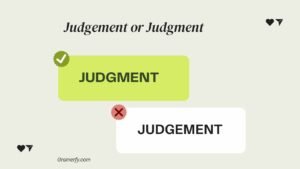
Ever found yourself stuck between “judgement” or “judgment” and wondered which one is actually correct? You’re not alone. This tiny spelling difference confuses thousands of writers every single day.
It looks simple, yet it can quietly affect your grammar, your professionalism, and even your credibility. One extra “e” might not seem like a big deal. However, in formal writing, details matter.
Here’s the interesting part: both spellings exist. Yes, you read that right. But they are not used in the same way everywhere.
What Does “Judgment” Mean?
Judgment is a noun that refers to:
- The ability to make decisions or form sensible opinions.
- A formal decision given by a court.
- The act of judging someone or something.
Examples:
- The lawyer’s judgment in the case was fair and balanced.
- She has excellent judgment when choosing the right employees.
- The teacher’s judgment about the students’ projects was appreciated.
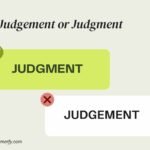
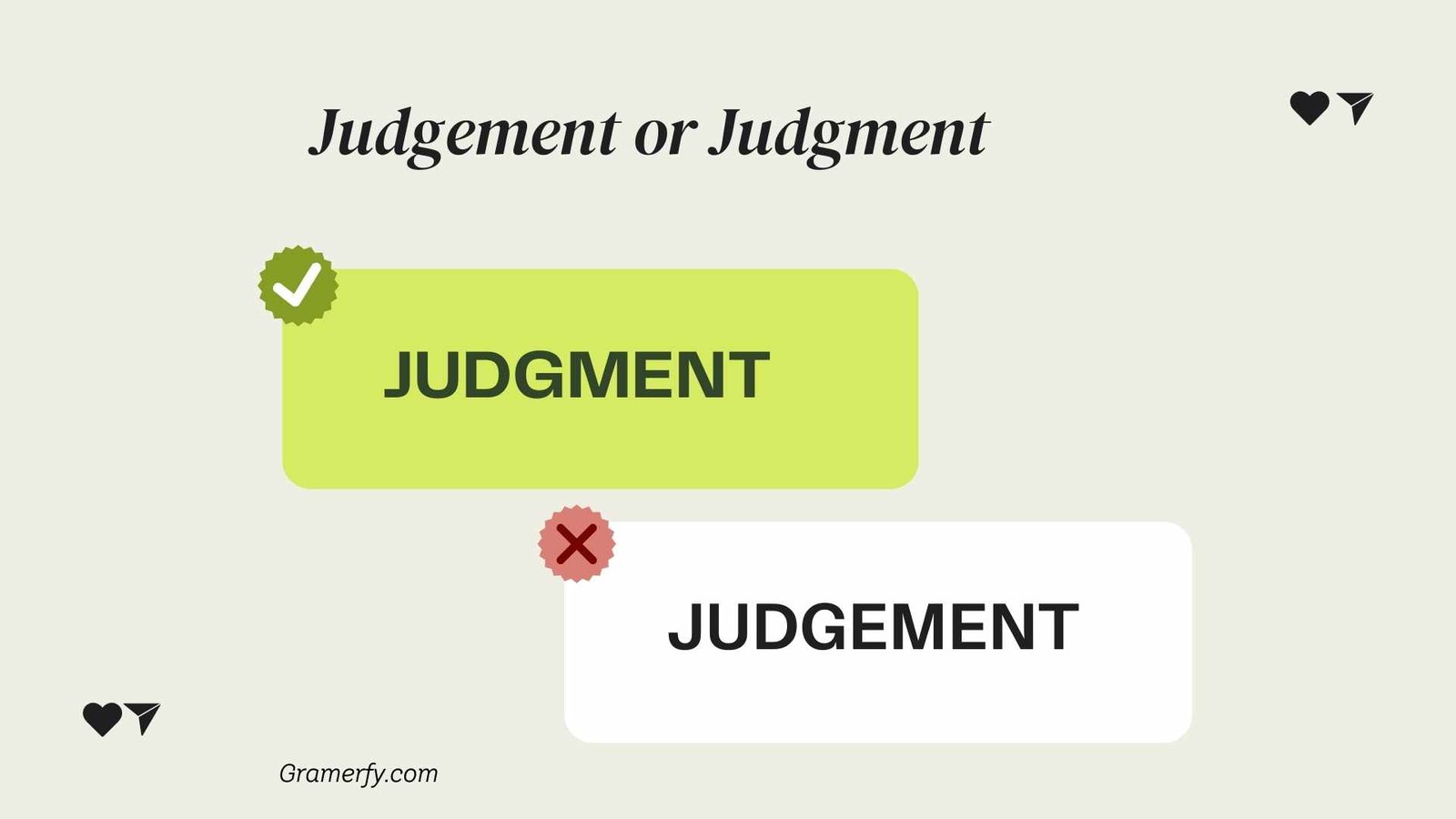
✅ Note: Judgment is the preferred spelling in American English, especially in legal contexts.
What Does “Judgement” Mean?
Judgement is essentially the same word but with a slightly different spelling. It is more commonly used in British English for:
- The act of forming an opinion about someone or something.
- Decisions made in personal or moral contexts rather than legal contexts.
Examples:
- In her opinion, his judgement was clouded by anger.
- It takes careful judgement to manage a team effectively.
- He waited for the final judgement of the committee.
✅ Note: In British English, judgement is more common outside the courtroom, whereas judgment is often reserved for legal matters.
Comparison: Judgement vs Judgment
Here’s a simple table to make the difference clear:
| Feature | Judgment | Judgement |
| Spelling preference | American English | British English |
| Common usage | Legal decisions, formal | Personal opinion, general |
| Examples | Court judgment | Careful judgement |
| Frequency | More common globally | Less common, but widely used in UK |
Tip: If you are writing for an American audience, stick to judgment. For a British audience, judgement is acceptable in general contexts.
Common Mistakes with Judgment and Judgement
Even native speakers sometimes confuse these two. Here are common mistakes to avoid:
- Mixing up the spellings in formal writing
- ❌ Incorrect: The court gave its judgement. (US English context)
- ✅ Correct: The court gave its judgment.
- ❌ Incorrect: The court gave its judgement. (US English context)
- Using “judgment” when meaning personal opinion in British English
- ❌ Incorrect: He has poor judgment. (British context, informal)
- ✅ Correct: He has poor judgement.
- ❌ Incorrect: He has poor judgment. (British context, informal)
- Confusing pronunciation with spelling
Both are pronounced the same way: /ˈdʒʌdʒmənt/. Don’t let pronunciation confuse you in writing. - Adding unnecessary letters
- ❌ Incorrect: judgemant, judgemint, judgegment
- ✅ Correct: judgment (US), judgement (UK)
- ❌ Incorrect: judgemant, judgemint, judgegment
Spelling Tips to Remember
- US English: Always use judgment in any formal or legal writing.
- UK English: Use judgement for opinions, judgment for court rulings.
- Memory trick: If you are in the US, “judgment” drops the extra “e” like many other American spellings.
More Examples for Clarity
Judgment (American English / legal):
- The Supreme Court’s judgment will affect millions of people.
- The manager’s judgment during the crisis saved the company.
- He awaited the final judgment in his tax case.
Judgement (British English / general):
- Her judgement about the book was highly respected.
- It takes good judgement to handle tricky situations.
- Parents must use careful judgement when guiding children.
FAQs (People Also Ask)
1. Is “judgement” wrong?
No, judgement is not wrong. It is correct in British English, especially for personal opinions or non-legal contexts.
2. Can I use “judgment” in the UK?
Yes, judgment is acceptable, particularly in legal documents or court-related writing.
3. Which is more common globally?
Judgment is more widely used worldwide, largely due to American English influence.
4. Do both words have the same meaning?
Yes, they mean the same thing: forming an opinion, decision-making, or legal rulings. Spelling and context determine usage.
5. How do you remember the difference?
Think US = judgment (legal/formal) and UK = judgement (personal opinions).
Conclusion
In the end, the difference between “Judgement” and “Judgment” comes down to regional spelling preferences, not meaning. Both words carry the same definition and are used in similar contexts. However, “Judgment” is the preferred spelling in American English, especially in legal and formal writing, while “Judgement” appears more often in British English.
If you’re writing for a specific audience, it’s smart to follow their regional style. Consistency matters more than the spelling itself. Once you choose one version, stick with it throughout your content to maintain clarity, professionalism, and credibility in your writing.