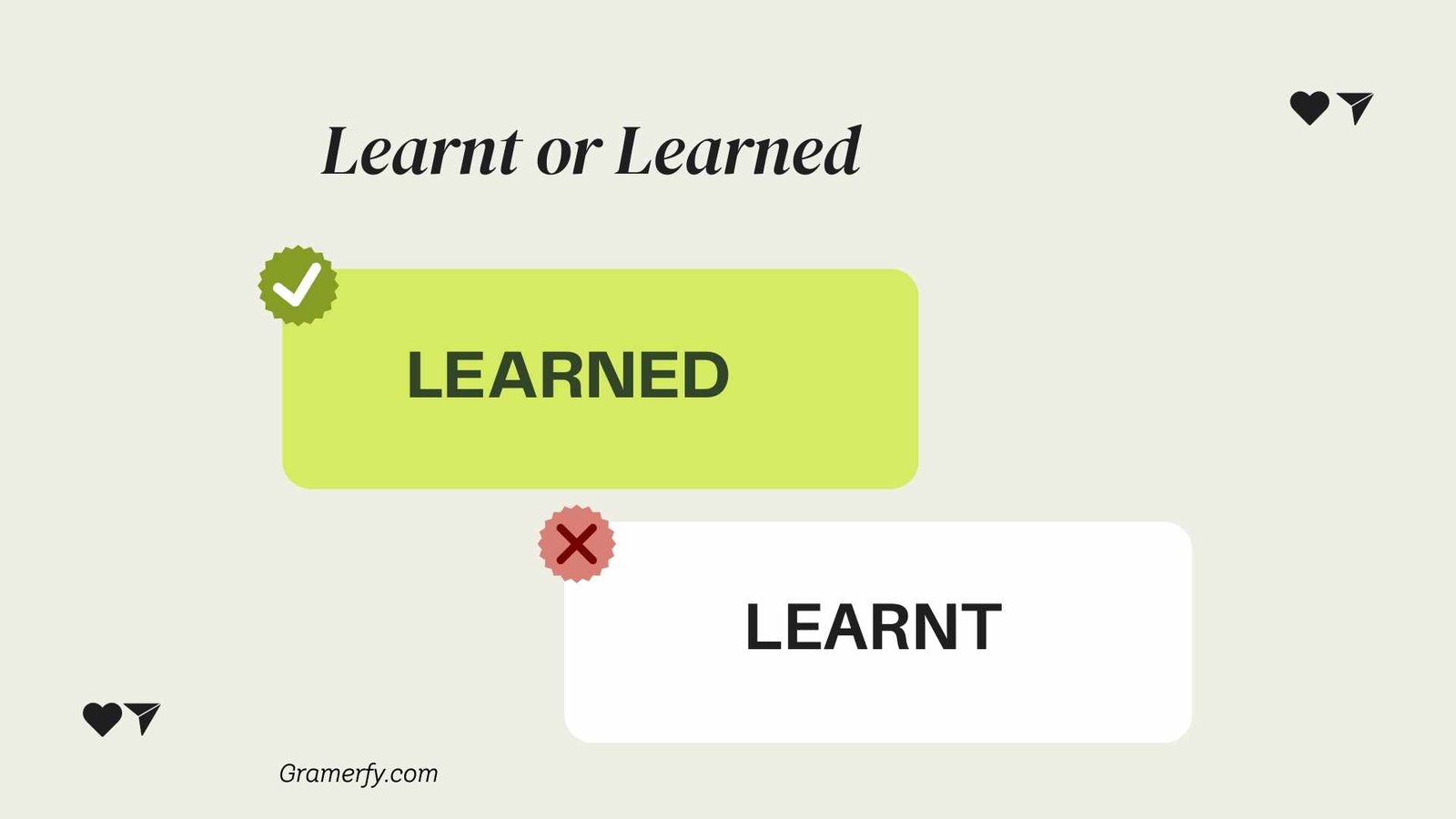
Have you ever paused while writing and wondered, “Is it learnt or learned?” You’re not alone. This tiny spelling difference confuses thousands of English learners every single day.
At first glance, both words look correct. However, choosing the wrong one can make your writing feel inconsistent or even awkward especially if you’re writing for a global audience.
Here’s the good news: the difference between learnt and learned is simpler than you think. It mostly depends on where your audience lives and which type of English you’re using.
What Does “Learned” Mean?
“Learned” is the most common past tense and past participle form of learn, especially in American English. It indicates that someone acquired knowledge or a skill in the past.
Examples:
- I learned how to ride a bicycle when I was seven.
- She learned English in school.
- They have learned a lot from their mistakes.
Key points:
- Common in American English.
- Suitable for formal and informal writing.
- Works for both past tense and past participle: “I learned” and “I have learned”.
What Does “Learnt” Mean?
“Learnt” is the British English variant of the past tense and past participle of learn. Its meaning is exactly the same as learned, but it is more commonly used in the UK, Australia, and New Zealand.
Examples:
- I learnt how to swim last summer.
- She has learnt many new skills at work.
- They learnt about the new rules yesterday.
Key points:
- Common in British English.
- Can be used in everyday conversation and writing.
- Functions as past tense and past participle.
Learnt vs Learned: A Quick Comparison
Here’s a simple table to compare the two forms:
| Feature | Learned | Learnt |
| Region | American English | British English |
| Use | Past tense & past participle | Past tense & past participle |
| Formality | Suitable for formal writing | Suitable for informal and formal writing |
| Examples | I learned a new word today. | I learnt a new word today. |
| Preference | More common in US | More common in UK, Australia, New Zealand |
How to Use “Learned” Correctly
- Past Tense:
- I learned to drive when I was 16.
- She learned the truth yesterday.
- I learned to drive when I was 16.
- Past Participle:
- I have learned a lot from my experiences.
- He has learned English over the years.
- I have learned a lot from my experiences.
- Formal Writing Tip:
- Use learned in essays, reports, and official documents, especially in American English.
- Use learned in essays, reports, and official documents, especially in American English.
How to Use “Learnt” Correctly
- Past Tense:
- We learnt new techniques at the workshop.
- She learnt the rules of the game quickly.
- We learnt new techniques at the workshop.
- Past Participle:
- I have learnt how to cook pasta perfectly.
- They have learnt important lessons from history.
- I have learnt how to cook pasta perfectly.
- Regional Preference Tip:
- Use learnt in UK-based writing, or if you are writing for an audience familiar with British English.
- Use learnt in UK-based writing, or if you are writing for an audience familiar with British English.
Common Mistakes with “Learnt” and “Learned”
- Mixing regional styles:
Using learnt in American English writing can seem unusual. - Spelling mistakes:
People sometimes write learned as learnd, which is incorrect. - Overusing one form:
Switching randomly between learnt and learned in the same document can confuse readers. - Wrong tense usage:
Remember: Both learnt and learned can be past tense and past participle, not present tense.
Spelling Tips
- American English: Always use learned.
- British English: Use learnt for past forms.
- Remember the “t” at the end of learnt. Don’t drop it.
- Learned has an extra “e,” which makes it look more formal.
Examples of “Learned” and “Learnt” in Sentences
Learned (American English):
- I learned about climate change in school.
- She learned how to use the new software.
- We have learned from our mistakes.
Learnt (British English):
- I learnt to drive when I was fifteen.
- They learnt the importance of teamwork.
- She has learnt several new recipes recently.
FAQs About “Learnt” and “Learned”
Q1. Can I use “learnt” in American English?
A1. Yes, it’s understood, but it sounds more British. Americans prefer learned.
Q2. Are “learnt” and “learned” interchangeable?
A2. Mostly, yes. They mean the same thing, but the choice depends on your audience and region.
Q3. Which is more formal?
A3. Learned is slightly more formal, especially in writing.
Q4. How do I remember which one to use?
A4. Think: US → learned, UK → learnt. Easy!
Q5. Can “learned” be an adjective?
A5. Yes! In phrases like “a learned scholar,” it means knowledgeable, not past tense.
Tips for English Learners
- Stick to one style in your writing.
- Practice using both forms in sentences.
- Pay attention to your audience: British or American English.
- Review examples from books, newspapers, and websites.
- Remember: Both forms are correct—context decides usage.
Conclusion
Choosing between learnt and learned is simple once you know your audience and region. Both are past forms of learn and convey the same meaning. Use learned in American English and formal writing, while learnt fits British English and casual contexts.
Avoid mixing styles, watch for spelling errors, and practice with real sentences. With consistent usage, your English will sound natural and professional, whether speaking or writing. Remember, mastery comes from using them confidently in daily communication.