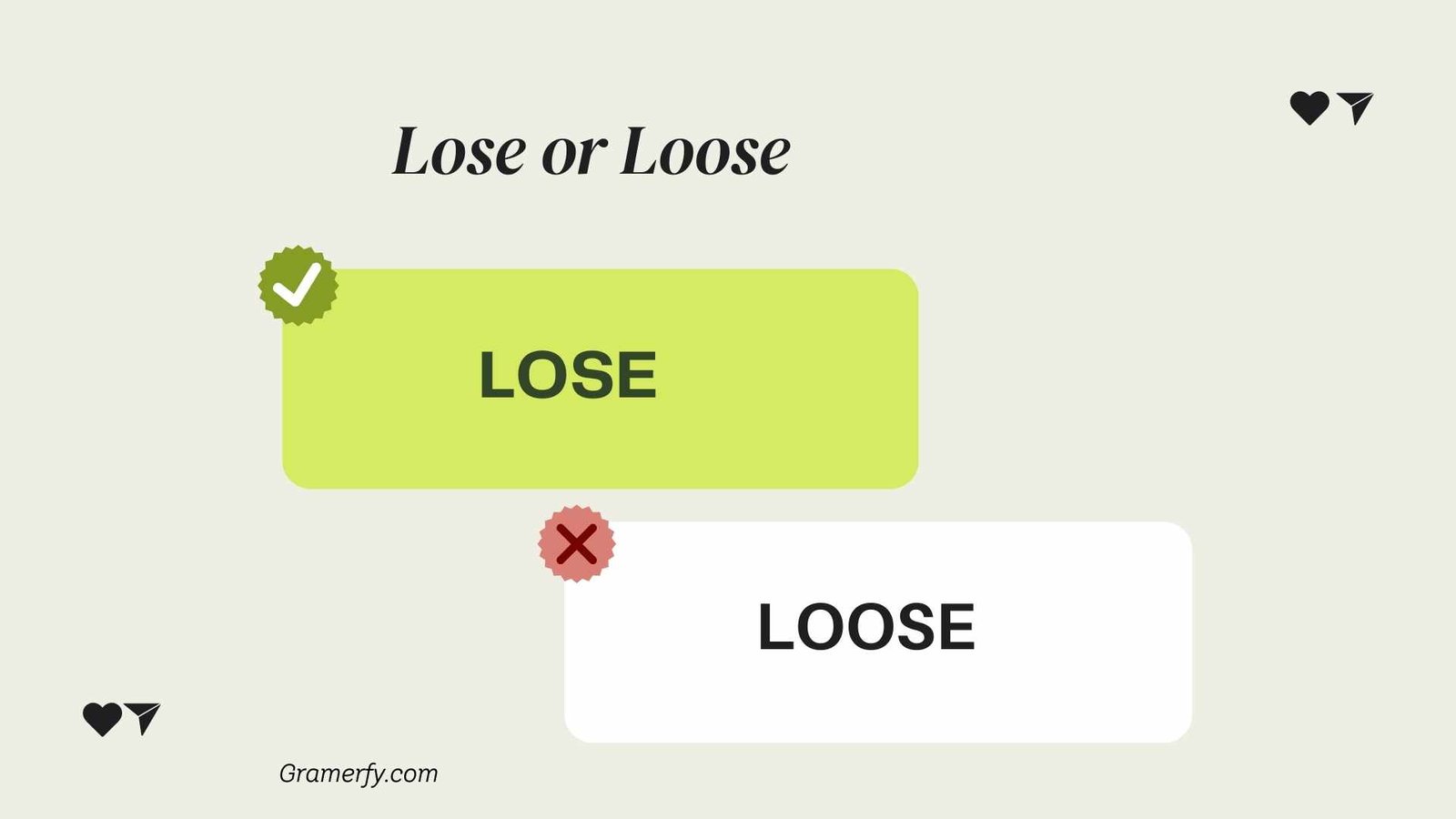
Words can make or break your message and “Lose or Loose” is one of the most confusing word pairs in English. At first glance, they look almost identical. Just one extra “o” changes everything. However, their meanings are completely different.
One means to misplace something or fail to win. The other describes something that is not tight. Simple? Not always.
Many people mix them up in emails, social media posts, assignments, and even professional writing. That tiny spelling mistake can weaken your credibility in seconds. Imagine writing “I don’t want to loose this game” instead of “lose.” It may seem small, but readers notice.
What Does “Lose” Mean?
“Lose” is a verb that means:
- To fail to keep something
- To be defeated
- To misplace or not find something
Examples of “Lose” in Sentences
- I don’t want to lose my keys again.
- Our team might lose the game if we don’t try harder.
- She was sad to lose her favorite necklace.
Quick Tip: If you can replace the word with “misplace”, “fail”, or “not win”, use lose.
What Does “Loose” Mean?
“Loose” is usually an adjective. It describes something that is:
- Not tight
- Free or relaxed
Examples of “Loose” in Sentences
- My shoes are too loose, I need a smaller size.
- The dog got loose from its leash.
- He wore a loose shirt for comfort.
Quick Tip: If you can replace the word with “baggy”, “slack”, or “free”, use loose.
Lose vs Loose: Key Differences
| Feature | Lose | Loose |
| Part of Speech | Verb | Adjective (sometimes verb for “release”) |
| Meaning | Fail to keep or misplace something | Not tight, free, or relaxed |
| Example | Don’t lose your wallet. | Your shirt is too loose. |
| Sound Similarity | /luːz/ | /luːs/ |
Remember: “Lose” is about losing control or possession, while “loose” is about freedom or slackness.
Common Mistakes with “Lose” and “Loose”
Many learners mix these words because they sound similar. Here are frequent errors and how to avoid them:
- Incorrect: I hope I don’t loose my phone.
Correct: I hope I don’t lose my phone. - Incorrect: This knot is too lose.
Correct: This knot is too loose. - Incorrect: He always looses in competitions.
Correct: He always loses in competitions.
Spelling Tip:
- Lose → Only one “o”. Think: “You lose something, and there’s no extra letter to hold it.”
- Loose → Double “o”. Think: “Double o means more space, like loose clothing.”
Examples to Remember
Sentences with Lose
- Don’t lose hope; things will get better.
- If you lose weight too quickly, it may be unhealthy.
- She didn’t want to lose the opportunity.
Sentences with Loose
- The window is loose, so it rattles in the wind.
- Wear loose clothes in hot weather.
- The horse broke loose from the stable.
Tips to Never Confuse Them Again
- Check the meaning first: Are you talking about failing to keep something or about slack/tightness?
- Use mnemonic tricks: “Lose” = “loss”; “Loose” = “loosened.”
- Read out loud: The pronunciation difference is subtle, but hearing it helps retention.
- Practice with sentences: Make your own examples for daily items: keys, shoes, clothes, competitions.
People Also Ask (FAQs)
1. Can “loose” ever be a verb?
Yes! It can mean to release or set free, but this use is rare. Example: The hunter loosed the arrow.
2. Is “losse” correct spelling?
No, “losse” is incorrect. Always write lose with one “o”.
3. How do I remember the difference between “lose” and “loose”?
- Lose → One “o”, like losing something.
- Loose → Double “o”, think of “loosen” or baggy items.
4. Which one to use: “loose weight” or “lose weight”?
Correct: lose weight. “Loose weight” is wrong because “loose” is not a verb for reducing weight.
5. Can “lose” be used for emotions?
Yes! Example: Don’t lose patience with your children.
Practice Exercises
Fill in the blanks with lose or loose:
- Don’t ______ your keys again.
- This sweater is too ______ for me.
- I always ______ in chess against my brother.
- The dog got ______ during our walk.
- Be careful not to ______ your temper.
Answers: 1. lose 2. loose 3. lose 4. loose 5. lose
Fun Trick to Remember
Think of it like this:
- Lose → Something goes away (one “o” goes).
- Loose → Something has space or freedom (double “o” is wide/open).
This small trick sticks in memory and helps avoid mistakes.
Conclusion
Knowing the difference between lose and loose is simple once you understand their meanings and contexts. Lose is always about misplacing, failing, or not winning, while loose describes slack, freedom, or comfort. By using examples, tables, and spelling tips, you can avoid common mistakes and write like a confident English speaker.
Remember the mnemonic tricks and practice often, and soon mixing these words will be a thing of the past. Correct usage not only improves your writing but also boosts your credibility in communication, whether for school, work, or daily life.