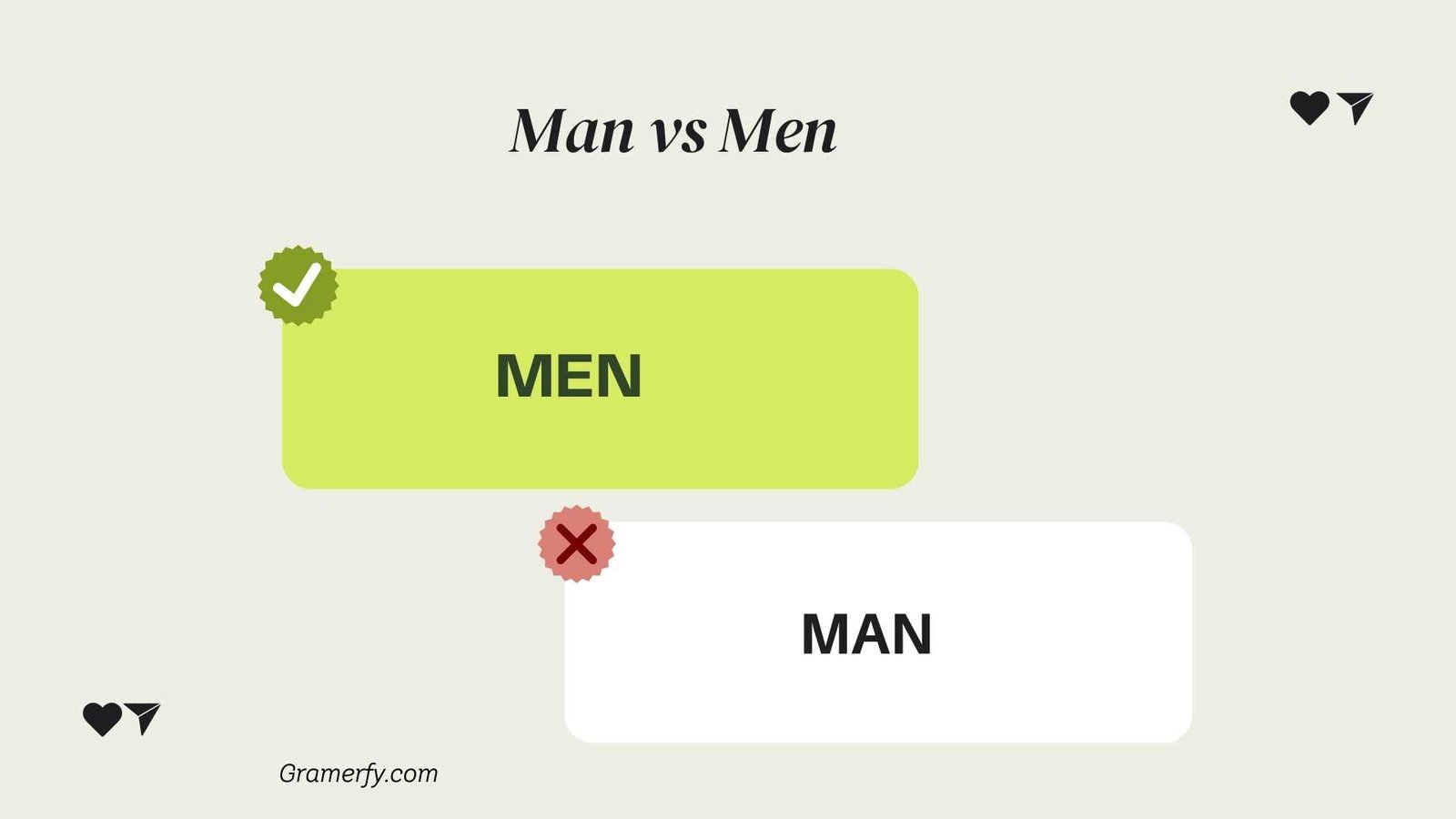
Man vs Men sounds simple. Yet, it opens the door to a powerful conversation about identity, strength, and human nature. At first glance, both words look alike. However, their meanings travel in very different directions.
One speaks of the individual. The other represents humanity as a whole. That small difference creates a big impact.In language, writing, and everyday speech, people often confuse Man vs Men.
But understanding it can sharpen your communication and boost your confidence. Imagine choosing the right word and instantly sounding clearer, smarter, and more professional. That’s the magic of mastering this tiny detail.
What Does “Man” Mean?
The word “man” is a singular noun. It refers to one adult male human.
Key Points About “Man”
- Refers to one person.
- Used for adult males, not children (for children, we say “boy”).
- Can also be used in general expressions or proverbs.
Examples of “Man”
- The man is reading a newspaper.
- That man is my neighbor.
- A brave man never gives up.
Common Expressions with “Man”
- Man of honor – A person who behaves with integrity.
- Every man for himself – Each person must take care of themselves.
- Man in the street – A regular person, not a specialist.
What Does “Men” Mean?
The word “men” is the plural form of “man.” It refers to two or more adult males.
Key Points About “Men”
- Always refers to more than one male.
- Used when discussing a group.
- Often used in job titles or collective expressions.
Examples of “Men”
- The men are working in the garden.
- All the men in the room stood up.
- Two men helped me carry my bags.
Common Expressions with “Men”
- Working men – Men who are employed, especially in labor jobs.
- Men at work – A sign indicating workers in action.
- Gentlemen and men of the army – Formal way to address groups.
Man vs Men: Key Differences
To make it easier to understand, here is a comparison table:
| Feature | Man | Men |
| Number | Singular (1) | Plural (2 or more) |
| Example | The man is tall. | The men are tall. |
| Usage | Refers to one adult male | Refers to multiple adult males |
| Common mistakes | Using “man” instead of “men” when talking about groups | Using “men” for one person |
| Pronunciation | /mæn/ | /mɛn/ |
How to Use “Man” and “Men” Correctly
Here are some rules and tips to avoid mistakes:
Rule 1: Singular vs Plural
- Use man for one person.
- Use men for two or more people.
❌ Incorrect: I saw three man in the park.
✅ Correct: I saw three men in the park.
Rule 2: Pronouns
- Man → he/him/his
- Men → they/them/their
Example: The man lost his wallet.
Example: The men lost their wallets.
Rule 3: Job Titles
Some job titles may use man even when referring to multiple people, but you often need context:
- Fireman → Firefighters
- Policeman → Police officers
- Salesman → Salesmen
Rule 4: Collective vs Individual Meaning
Sometimes “man” is used to refer to humanity in general:
- Man has always explored the unknown. (Here, “man” means humans in general.)
- Men are often judged by their actions. (Refers specifically to adult males.)
Common Mistakes and Spelling Tips
- Mixing singular and plural forms
- ❌ I saw a lot of man in the street.
- ✅ I saw a lot of men in the street.
- ❌ I saw a lot of man in the street.
- Pronunciation confusion
- Man → /mæn/ (short “a” sound)
- Men → /mɛn/ (short “e” sound)
- Man → /mæn/ (short “a” sound)
- Using “man” for groups
Remember: “man” = one, “men” = more than one. - Writing in formal vs informal contexts
- “Man” can sometimes be used informally to refer to people casually: Hey, man!
- “Men” is rarely used informally except in plural references.
- “Man” can sometimes be used informally to refer to people casually: Hey, man!
Examples in Sentences
Using “Man”
- A man was waiting at the bus stop.
- The man who called you is my uncle.
- That man looks very tired.
Using “Men”
- Many men participated in the marathon.
- The men of the village gathered for a meeting.
- All the men at the party were dancing.
Advanced Tips for English Learners
- Collective Nouns: Sometimes a group can be called a “man” collectively:
- Example: The man on the moon refers to a single astronaut.
- Example: The man on the moon refers to a single astronaut.
- Idiomatic Expressions: Some phrases don’t follow plural rules:
- Man vs. Men – “All men are created equal” (plural used for humanity in general)
- Man vs. Men – “All men are created equal” (plural used for humanity in general)
- Avoid Overgeneralization: Do not use “man” for “men” in professional or academic writing.
FAQs (People Also Ask)
Q1: Is “men” the plural of “man”?
A: Yes, “men” is the correct plural form of “man.”
Q2: Can “man” refer to both singular and plural?
A: Usually no, but in philosophical or general contexts, “man” can mean humanity.
Q3: How do I know when to use “man” or “men”?
A: Count the number of people: 1 → man, 2 or more → men.
Q4: Are there other plural forms of man besides “men”?
A: No, “men” is the only correct plural of “man.”
Q5: Is “mans” correct?
A: ❌ No, “mans” is incorrect when referring to multiple men. Use men.
Conclusion
Pay attention to singular and plural forms, use correct pronouns, and be mindful of common mistakes. With practice, using these words will become second nature.
Remember, correct grammar improves your writing, speaking, and confidence in English. Now, the next time you want to describe one person or a group, you’ll know exactly whether to say man or men!