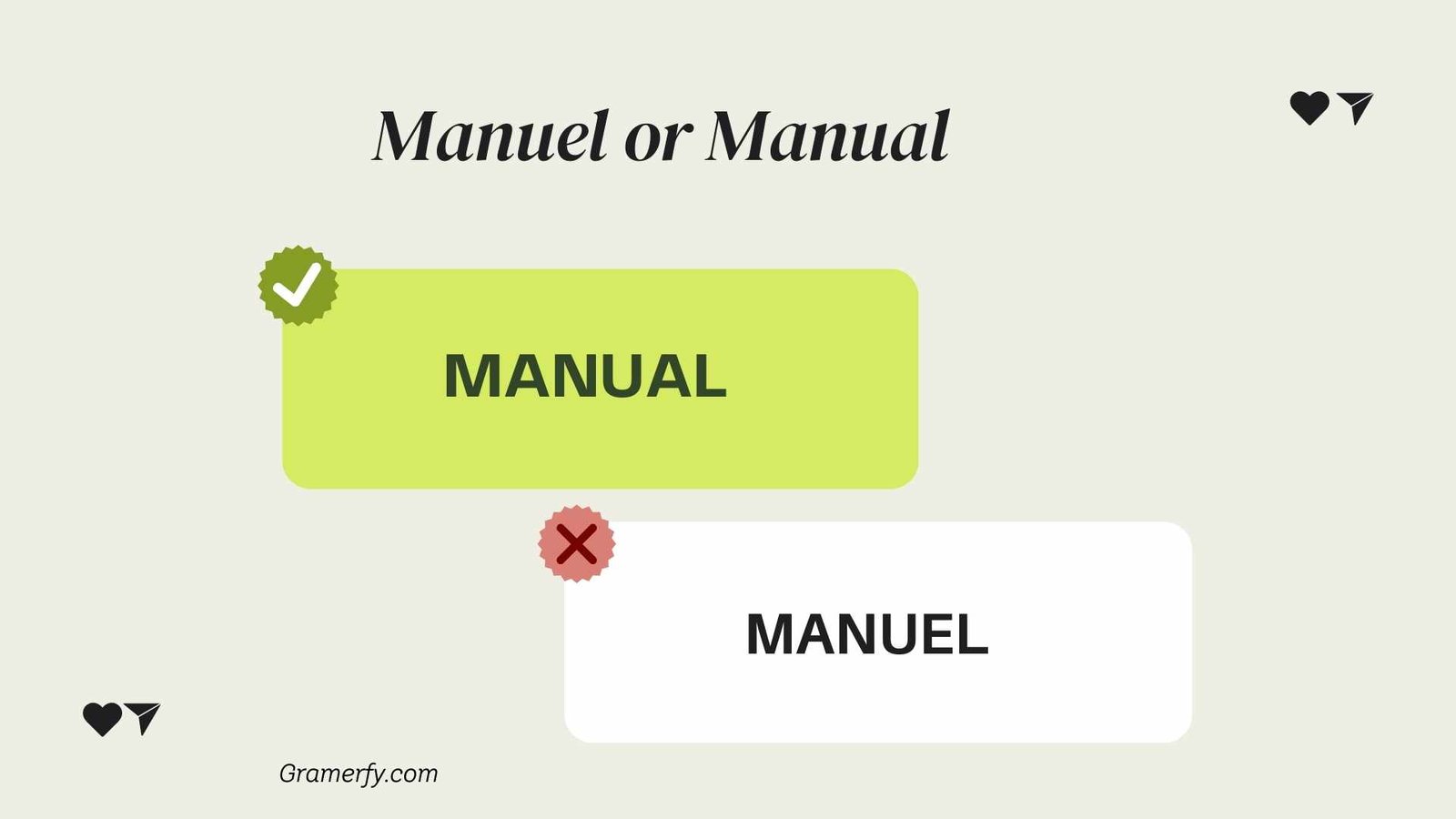
Confused between “Manuel” or “Manual”? You’re not alone. These two words look almost identical, yet they mean completely different things. One small spelling change can flip the entire meaning of your sentence.
Imagine writing an email, a blog post, or even an academic paper and accidentally mixing them up. It might seem minor, but it can instantly affect your credibility.
That’s why understanding the real difference between Manuel and Manual is more important than you think.Here’s the simple truth: one is usually a person’s name, while the other relates to instructions or something done by hand.
Meaning of Manual
What Does “Manual” Mean?
The word manual is a very common English word. It can be used as a noun, an adjective, and sometimes even relates to manual labor.
At its core, manual means something that is:
- Done by hand
- Related to hands
- A written guide or instruction book
Manual as a Noun
As a noun, manual usually means a book or document that gives instructions.
Examples:
- Please read the manual before using the washing machine.
- The car manual explains how to change a tire.
- This software manual is very easy to understand.
Manual as an Adjective
As an adjective, manual describes work or actions done by hand rather than by machines or automatically.
Examples:
- He does manual labor at the construction site.
- The factory still uses manual tools.
- This camera has manual focus.
Common Uses of “Manual”
You’ll often see manual in phrases like:
- User manual
- Instruction manual
- Manual labor
- Manual work
- Manual control
- Manual transmission
👉 Manual is a standard, everyday English word.
Meaning of Manuel
What Does “Manuel” Mean?
The word manuel is not a common English word. In most cases, Manuel is:
- A proper noun
- A male given name, especially in Spanish, Portuguese, and French cultures
Examples:
- Manuel is my cousin’s name.
- Manuel works as a software engineer.
- The author Manuel García wrote this book.
Manuel as a Rare Noun (Advanced Usage)
In very old or specialized contexts (mostly historical or religious), manuel can refer to:
- A handbook
- A ritual book
⚠️ This usage is extremely rare in modern English and not recommended for everyday writing.
Important Note
If you’re writing normal English content, instructions, guides, or articles, you almost never need “manuel.”
Manuel or Manual: Key Differences Explained
This is where most confusion happens. Let’s break it down clearly.
Comparison Table: Manuel vs Manual
| Feature | Manuel | Manual |
| Part of speech | Proper noun (name) | Noun / Adjective |
| Common usage | Very rare | Very common |
| Meaning | A person’s name | Instruction book or hand-based work |
| Used in everyday English | ❌ No | ✅ Yes |
| Example | Manuel is my friend | Read the manual |
👉 If you are unsure, “manual” is almost always the correct choice.
Correct Usage of Manual in Sentences
Here are clear, beginner-friendly examples to help you use manual correctly.
Manual as a Noun – Examples
- I lost the instruction manual.
- The teacher gave us a grammar manual.
- This phone comes with a detailed manual.
Manual as an Adjective – Examples
- She prefers manual work over office jobs.
- This door has a manual lock.
- The machine requires manual operation.
Correct Usage of Manuel in Sentences
Remember, Manuel is mostly a name.
Manuel as a Name – Examples
- Manuel lives in Spain.
- I spoke to Manuel yesterday.
- Manuel and I went to college together.
👉 Capital “M” is important because it’s a proper noun.
Common Mistakes People Make
Let’s look at some very common errors and how to fix them.
❌ Incorrect: Manuel for Instructions
- ❌ Please read the manuel carefully.
✅ Correct:
- ✔️ Please read the manual carefully.
❌ Incorrect: Manuel Labor
- ❌ He does manuel labor.
✅ Correct:
- ✔️ He does manual labor.
❌ Incorrect: Using Manuel Instead of Manual in SEO Content
- ❌ Download the user manuel.
✅ Correct:
- ✔️ Download the user manual.
Spelling Tips to Remember the Difference
Here are some easy tricks to avoid confusion:
1: Think of “Hand”
- Manual comes from the Latin word manus (hand)
- If it involves hands or instructions → manual
2: Think of a Person
- Manuel = a person’s name
- Names start with capital letters
3: Check Context
Ask yourself:
- Is this a book or guide? → Manual
- Is this a person’s name? → Manuel
Manuel or Manual in British and American English
Good news! 😊
There is no difference between British and American English for this pair.
- Manual is correct in both
- Manuel remains a name in both
Why “Manual” Is So Important in SEO and Writing
Using the wrong spelling can hurt:
- SEO rankings
- Professional image
- Reader trust
Search engines recognize manual as the correct keyword. Using manuel instead can lead to:
- Missed traffic
- Lower readability
- Confused users
👉 Always double-check spelling in headings, meta tags, and content.
Manuel or Manual: Which One Should You Use?
In 99% of writing situations, the correct word is:
✅ Manual
Use manual when talking about:
- Instruction books
- Guides
- Hand-based work
- Controls or processes
Use Manuel only when referring to:
- A person’s name
FAQs: Manuel or Manual (People Also Ask)
Is “manuel” a correct English word?
Yes, but it is mainly a name, not a common English word used in writing or instructions.
Is it user manual or user manuel?
✅ User manual is correct.
❌ User manuel is incorrect.
Can “manuel” mean instruction book?
Only in very old or rare contexts. In modern English, manual is the correct word.
Why do people confuse manuel and manual?
Because they look similar and are pronounced almost the same, especially by non-native speakers.
Is manual used as a verb?
No. Manual is used as a noun or adjective, not as a verb.
What is manual labor?
Manual labor means physical work done by hand, often involving effort and skill.
Is Manuel a common English name?
It’s more common in Spanish, Portuguese, and French-speaking cultures, but it is still used in English-speaking countries.
Final Thoughts
In summary, “Manuel” is typically a personal name, while “Manual” refers to a guide or set of instructions. Mixing them up can lead to confusion, so context is key:
If you’re talking about a person, use Manuel; if it’s about directions, procedures, or how-to content, choose Manual. Remembering this simple distinction ensures your writing is accurate and clear every time.