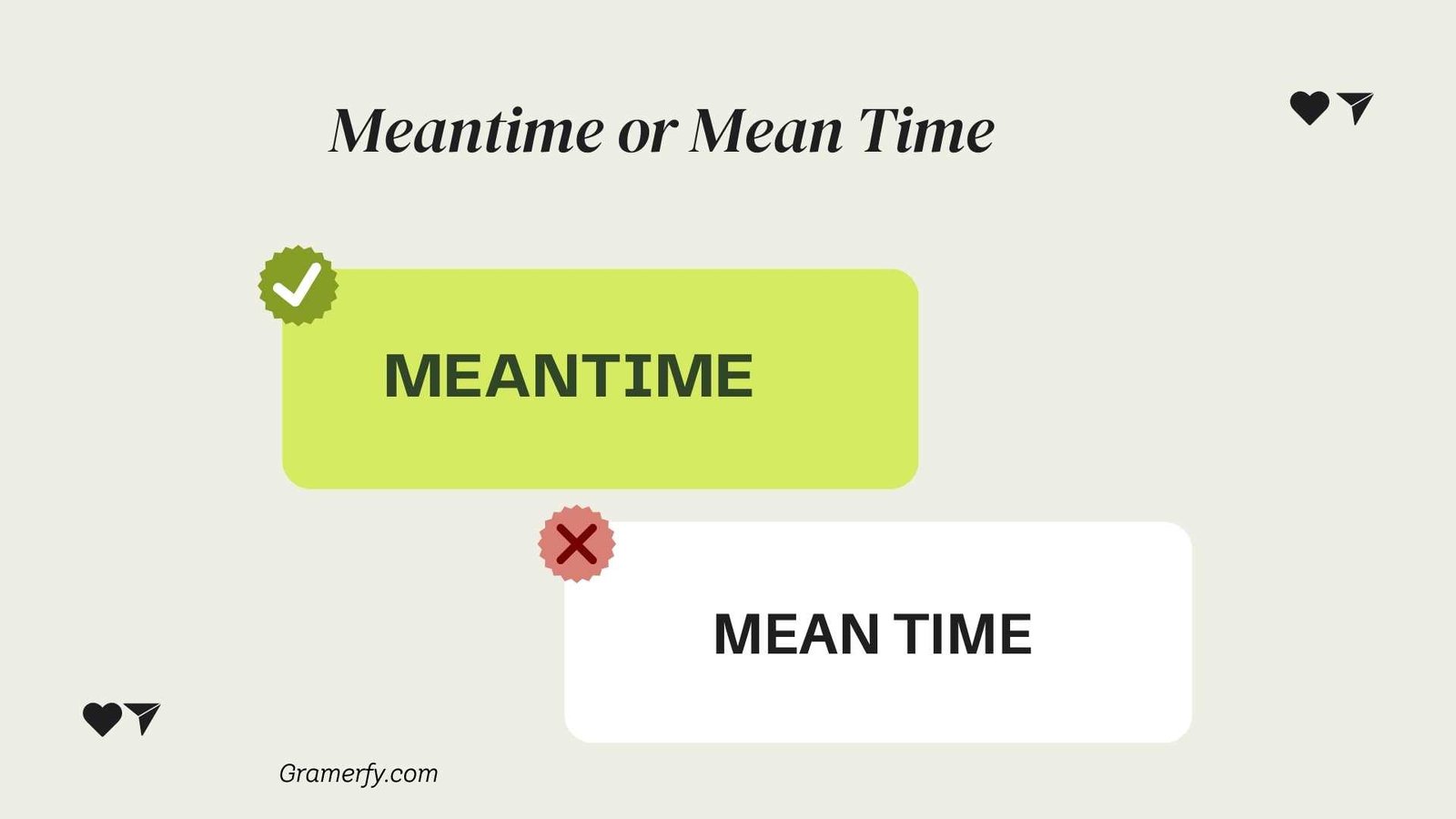
Confused between “meantime” or “mean time”? You’re not alone. These two terms look almost identical, yet they carry completely different meanings. One tiny space can change the entire message of your sentence.
Imagine writing an important email, a blog post, or even a social media caption and using the wrong one. It might seem small, but details like this shape how professional and polished your writing appears.
So, what’s the real difference between meantime and mean time? When should you use one over the other? And why do so many people mix them up?
What Does “Meantime” Mean?
Definition of Meantime
Meantime is a noun and sometimes an adverb. It refers to the period of time between two events.
In simple words, meantime means:
The time between now and another event
Correct Usage of Meantime
We use meantime when talking about something that happens while waiting for something else.
It often appears in phrases like:
- in the meantime
- meanwhile (a similar word)
Examples of Meantime in Sentences
- The doctor will see you soon. In the meantime, please wait here.
- The food will be ready in 20 minutes. Meantime, let’s set the table.
- She is preparing for the exam. In the meantime, she is also working part-time.
- The manager is busy right now. In the meantime, you can speak to his assistant.
Is “Meantime” One Word?
Yes ✅
Meantime is always written as one word when you are referring to a period between two events.
What Does “Mean Time” Mean?
Definition of Mean Time
Mean time is a two-word phrase, and it has a very different meaning from meantime.
It refers to:
- Average time
- A technical or mathematical concept
- A scientific measurement of time
Common Contexts Where “Mean Time” Is Used
The phrase mean time is mostly used in:
- Science
- Engineering
- Statistics
- Physics
- Technical writing
For example:
- Mean Time Between Failures (MTBF)
- Mean solar time
- Mean time calculations
Examples of Mean Time in Sentences
- The mean time taken to complete the task is two hours.
- Engineers calculated the mean time between system failures.
- The experiment recorded the mean time of all results.
- The device has a long mean time between breakdowns.
⚠️ Important Note:
In everyday conversation, mean time is rarely used unless you are talking about averages or technical data.
Meantime vs Mean Time: Key Differences Explained
Quick Comparison Table
| Feature | Meantime | Mean Time |
| Word Form | One word | Two words |
| Part of Speech | Noun / Adverb | Noun phrase |
| Meaning | Time between events | Average or calculated time |
| Usage | Everyday English | Technical / scientific |
| Common Phrase | In the meantime | Mean time between failures |
| Beginner Friendly | Yes | No (technical) |
When Should You Use “Meantime”?
Use meantime when:
- You are talking about waiting
- You mean during that period
- You want a natural, conversational tone
- You are writing blogs, emails, stories, or casual content
More Examples of Correct Meantime Usage
- The train is delayed. In the meantime, grab a coffee.
- She’s cooking dinner. Meantime, I’ll finish my homework.
- We’re waiting for approval. In the meantime, continue your work.
- He went to college. Meantime, his brother started a business.
When Should You Use “Mean Time”?
Use mean time only when:
- You are talking about averages
- You are writing technical or academic content
- The context involves data, calculations, or measurements
More Examples of Mean Time Usage
- The mean time for delivery is three days.
- Scientists measured the mean time of the reaction.
- The machine’s mean time between failures is impressive.
- This report includes the mean time taken by all participants.
Common Mistakes People Make
Mistake #1: Writing “Mean Time” Instead of “Meantime”
❌ Incorrect:
- I’ll call you later. Mean time, finish the report.
✅ Correct:
- I’ll call you later. Meantime, finish the report.
Mistake #2: Splitting “Meantime” into Two Words
❌ Incorrect:
- In the mean time, please wait.
✅ Correct:
- In the meantime, please wait.
Mistake #3: Using Meantime in Technical Writing
❌ Incorrect:
- The meantime between failures is low.
✅ Correct:
- The mean time between failures is low.
Easy Spelling Tips to Remember the Difference
1: Think of “Meanwhile”
- Meantime ≈ Meanwhile
- Both are one word
- Both talk about waiting or a period between events
2: Think of “Average”
- Mean = average
- Mean time = average time
- Used in math and science
3: Casual vs Technical Rule
- Casual conversation → Meantime
- Technical discussion → Mean time
Meantime vs Meanwhile: Are They the Same?
Similarities
- Both refer to time between events
- Both are used in everyday English
Differences
| Word | Usage |
| Meantime | Slightly formal |
| Meanwhile | More common in speech |
Example
- Meantime, I’ll prepare the documents.
- Meanwhile, I’ll prepare the documents.
Both are correct, but meanwhile is more popular in spoken English.
Frequently Asked Questions (FAQs)
Is “meantime” one word or two?
Meantime is always one word when referring to a period between events.
Is “mean time” ever correct?
Yes. Mean time is correct when talking about averages or technical measurements.
Can I use “mean time” instead of “meantime”?
No. They are not interchangeable and have different meanings.
Which is more common in daily English?
Meantime is far more common in everyday speaking and writing.
Is “in the meantime” formal?
It’s neutral—suitable for both formal and informal situations.
Can I replace “meantime” with “meanwhile”?
Yes, in most cases. Both express a similar idea.
Do native speakers confuse these two?
Yes! Even native speakers sometimes mix them up in writing.
Is “meantime” acceptable in academic writing?
Yes, but mostly in narrative or explanatory sections, not technical calculations.
Practice Sentences (Try It Yourself)
Choose the correct option:
- The system rebooted. In the ________, the team waited.
👉 meantime - The ________ between failures is five hours.
👉 mean time - She’s busy right now. ________, let’s start without her.
👉 Meantime - Scientists calculated the ________ of all responses.
👉 mean time
Final Verdict: Meantime or Mean Time?
Let’s make it simple:
- Use “meantime” when talking about waiting or the time between events
- Use “mean time” when discussing averages, data, or technical time measurements
If your sentence sounds conversational or casual, meantime is almost always the right choice.
Conclusion
The difference between meantime and mean time may look small, but their meanings are completely different. One is perfect for everyday conversation, while the other belongs to technical and scientific writing.
By remembering that meantime = meanwhile and mean time = average time, you’ll never mix them up again. Mastering small grammar details like this makes your writing clearer, more professional, and more confident.