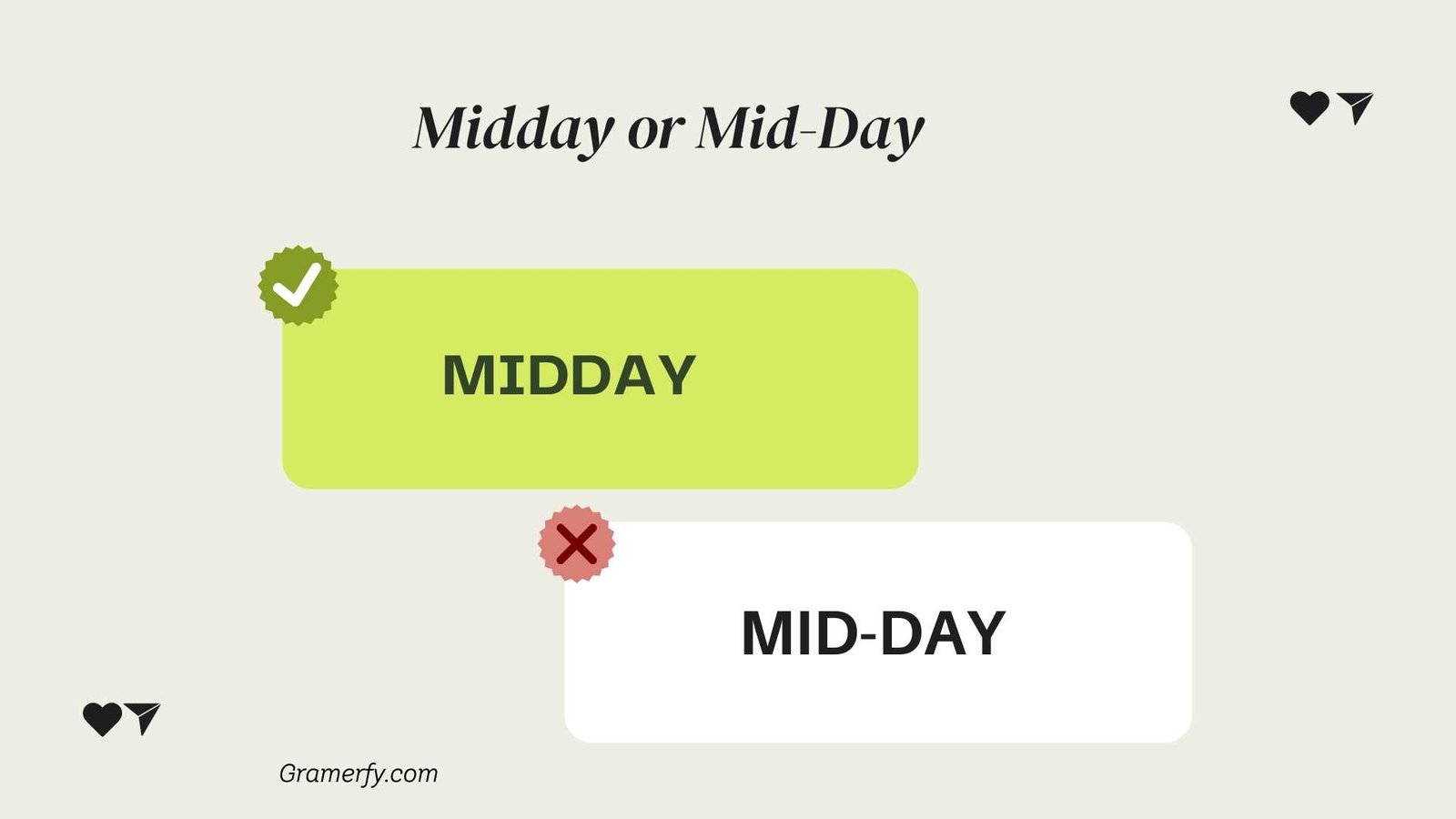
When it comes to telling time, many people get confused between Midday and Mid-Day. Though they sound identical, the way we write them can subtly change the tone of our text.
Midday, often used in formal writing, refers to the exact middle of the day, 12:00 PM ,when the sun is at its peak, casting sharp shadows and filling the world with bright, energizing light.
On the other hand, Mid-Day is sometimes used in casual contexts, like in blogs, social media posts, or lifestyle articles, giving a friendly, approachable feel to your writing.
Meaning of Midday
The word midday refers to the middle of the day, usually around 12:00 PM or noon. It is used to describe a specific time or period of the day when the sun is at its highest point in the sky.
Examples:
- I usually take a short walk at midday.
- The sun is brightest at midday.
- Let’s meet for lunch around midday.
Key Points:
- Midday is a noun.
- It can also function as an adjective: The midday sun was scorching hot.
Meaning of Mid-Day
Mid-day is essentially the same as midday, but it uses a hyphen. This hyphenated form is less common in modern English and is generally considered old-fashioned. Some style guides still accept it, but most contemporary writers prefer midday without the hyphen.
Examples:
- The picnic started at mid-day.
- Mid-day breaks are common in some countries.
Key Points:
- Mid-day is interchangeable with midday in meaning.
- Avoid using mid-day in modern, professional writing.
Midday vs Mid-Day: Which One to Use?
Here’s a simple comparison to help you remember the correct usage:
| Feature | Midday | Mid-Day |
| Correct Modern Usage | ✅ Preferred | ⚠ Less common |
| Form | Single word | Hyphenated |
| Function | Noun / Adjective | Noun / Adjective |
| Examples | Midday sun, midday meal | Mid-day sun, mid-day meal |
| Style Guide Advice | Modern writing | Older texts or informal |
Bottom line: For contemporary English, always prefer midday. Use mid-day only if following a specific style guide or in historical/old-fashioned texts.
Common Mistakes with Midday and Mid-Day
Even native speakers make mistakes with these words. Here are some common errors to watch out for:
- Using both forms in the same text:
❌ I left at mid-day, and the midday sun was hot.
✅ I left at midday, and the midday sun was hot. - Confusing with midnight:
❌ I woke up at midday. (if you mean 12:00 AM)
✅ I woke up at midnight. - Adding unnecessary hyphens:
❌ mid Day
✅ midday - Incorrect plural usage:
❌ I have two middays today.
✅ I have two midday meetings today.
Spelling Tips for Midday
- Remember it is one word in modern English.
- Do not capitalize mid- unless it starts a sentence.
- Avoid adding extra hyphens; “mid-day” is rarely needed today.
- Think of midday as “middle of the day” without spaces or hyphens.
Examples of Correct Usage
Here are some beginner-friendly examples:
Noun Usage:
- We have a break at midday.
- The meeting is scheduled for midday.
Adjective Usage:
- The midday sun was intense.
- She enjoyed a midday walk in the park.
In Sentences with Time:
- Let’s meet at midday, not in the morning.
- The train arrives at midday sharp.
FAQs About Midday and Mid-Day
1. Is “midday” one word or two words?
Answer: In modern English, midday is one word. The hyphenated form mid-day is less common.
2. Can I use “mid-day” in formal writing?
Answer: It’s better to avoid it. Use midday for professional or formal writing.
3. Does “midday” mean 12:00 PM exactly?
Answer: Usually yes, but it can also refer to the general middle of the day.
4. Is “midday” the same as “noon”?
Answer: Yes, they are generally interchangeable, though “noon” is slightly more precise.
5. Can I use “midday” as an adjective?
Answer: Yes! Example: The midday sun was hot.
Tips to Remember Midday vs Mid-Day
- Think modern vs old-fashioned: Midday = modern, mid-day = old-fashioned.
- Hyphen rule: If it sounds like one word, write it as one word: midday.
- Visual cue: “Midday” is just “middle of the day” in a compact form.
Conclusion
In summary, midday and mid-day mean the same thing: the middle of the day or noon. However, midday is the preferred modern form, and it’s clearer and simpler for writing. Avoid using the hyphen unless required by an older style guide or specific publication.
Remember, using the correct form not only improves your grammar but also makes your writing look professional and polished. Stick to midday in most cases, and you’ll never go wrong.