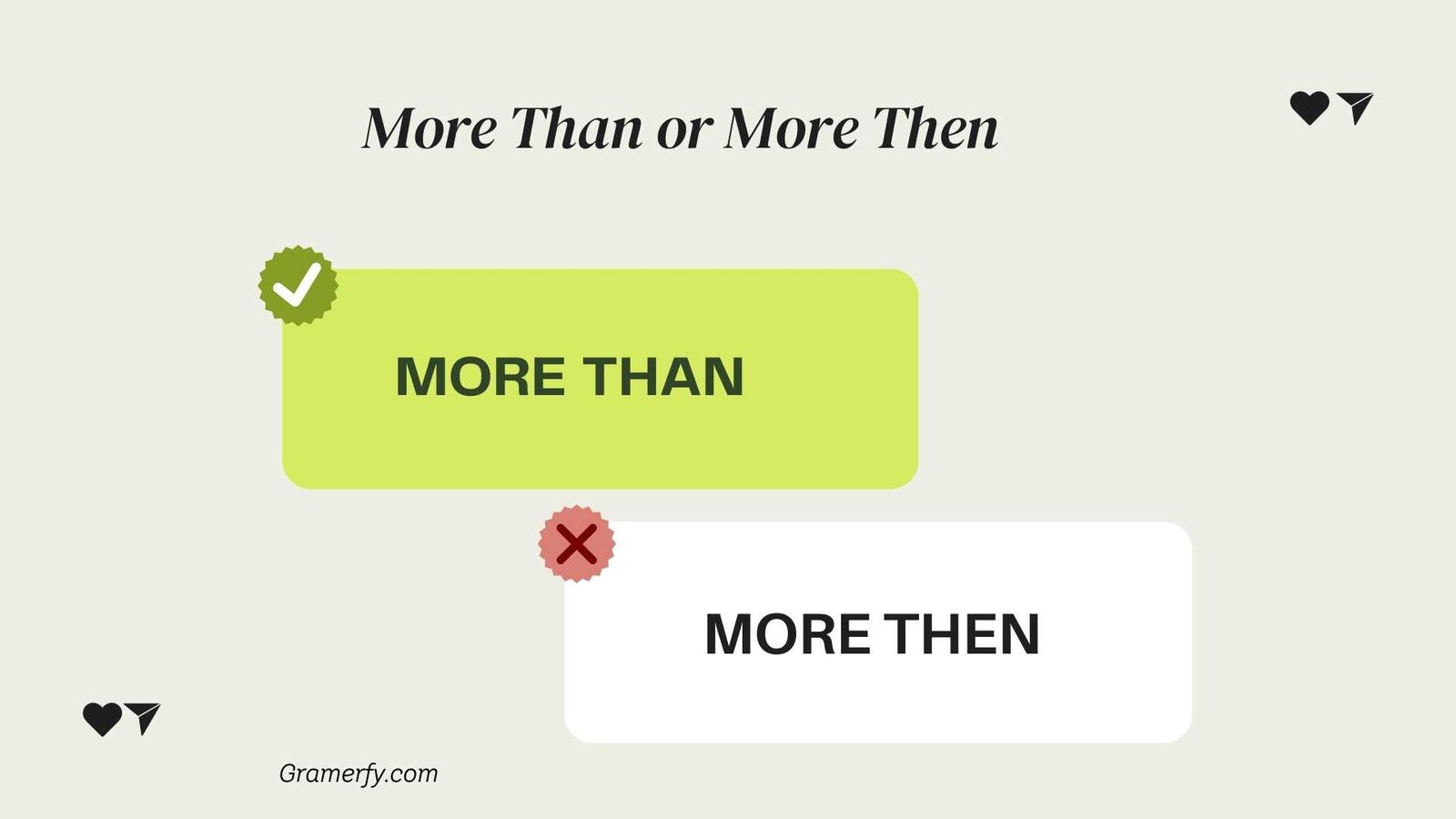
Have you ever paused mid-sentence, wondering whether to write “more than” or “more then”? You’re not alone. This tiny pair of words trips up thousands of writers every day, from students and bloggers to professionals and native English speakers.
One small slip can change the meaning of your sentence or make it look unpolished. That’s why understanding the difference between more than and more then is so important.
At first glance, they look almost identical. However, they play very different roles in English grammar. One is widely correct and commonly used. T
What Does “More Than” Mean?
Definition
“More than” is used to indicate a greater amount, number, degree, or extent of something. It shows comparison and is often used in numbers, quantities, or degrees.
Usage Examples
- I have more than ten books on my shelf.
- She earns more than her brother.
- The exam was more than difficult—it was almost impossible!
Key Points
- Always indicates quantity, number, or degree.
- Can be used in comparisons or emphasis.
- Never related to time sequences or events happening next.
What Does “More Then” Mean?
Definition
“More then” is often a mistake, but if used correctly, “then” refers to time or sequence of events. The phrase “more then” is rarely correct in standard English. It might appear in sentences like:
- I will do more, then I will rest.
- Eat more, then go outside to play.
Notice here, “then” is a separate word, meaning after that. There is no grammatical phrase “more then” in proper English.
Key Points
- “Then” relates to time, sequence, or consequence.
- Using “more then” instead of “more than” is a common error.
- Always double-check if you are comparing something (more than) or describing a sequence (then).
Comparison Table: More Than vs More Then
| Feature | More Than | More Then |
| Meaning | Indicates quantity, degree, or comparison | Refers to time or sequence (rarely correct as a combined phrase) |
| Common Use | Numbers, amounts, degrees, emphasis | Events happening next, order of actions |
| Correct Example | I have more than 5 pens. | Finish your homework, then play outside. |
| Incorrect Example | I have more then 5 pens. | — |
| Tip | Use when comparing or measuring | Use “then” alone for time sequence |
Common Mistakes with “More Than” and “More Then”
- Using “more then” for comparison
❌ Wrong: She has more then 10 apples.
✅ Correct: She has more than 10 apples. - Confusing “then” with “than” in general
❌ Wrong: I would rather go to the park then the beach.
✅ Correct: I would rather go to the park than the beach. - Forgetting “then” is about time, not quantity
❌ Wrong: I want more then success.
✅ Correct: I want more than success.
Tips to Remember the Difference
- Than = comparison (more, less, better, worse)
- Then = time or sequence (first, next, after that)
- A simple trick: If you are comparing numbers, amounts, or qualities, always use than.
- If you are talking about what happens next, use then.
Multiple Examples in Sentences
Correct Use of More Than
- The car costs more than $20,000.
- She is more than capable of handling this project.
- There were more than 50 people at the party.
- I love you more than words can express.
- The problem is more than just a simple mistake.
Correct Use of Then
- Finish your homework, then you can watch TV.
- If it rains, then we will stay inside.
- First, we will eat, then we will go shopping.
- Take the medicine, and then rest for an hour.
Incorrect Examples
- ❌ I have more then 10 dollars.
- ❌ She is taller more then her brother.
- ❌ I will go to the park more then eat ice cream.
Why People Confuse “More Than” and “More Then”
- Pronunciation: They sound similar in casual speech.
- Typing errors: Quick writing often leads to mistakes.
- Lack of understanding: Many learners do not know that than is for comparison.
- Auto-correct mistakes: Phones sometimes change than to then automatically.
FAQs (People Also Ask)
1. Is it “more than” or “more then”?
Answer: It is more than when comparing numbers, amounts, or degrees. Use then only for time sequences.
2. Can I say “more then” in a sentence?
Answer: Only if then is used for sequence. Example: “Eat more, then rest.” Otherwise, it is incorrect.
3. How can I remember the difference between than and then?
Answer:
- Than = comparison → “I like coffee more than tea.”
- Then = time → “Finish work, then relax.”
4. Is “more then” a correct phrase?
Answer: No, “more then” as a combined phrase is usually incorrect. It’s mostly a typo of “more than.”
5. Can native speakers make this mistake?
Answer: Yes, even native speakers sometimes type “more then” by accident, especially in casual writing or texting.
Common Spelling and Grammar Tips
- Always double-check your sentence: Are you comparing (than) or sequencing (then)?
- Use a spell-checker or grammar tool to avoid auto-correct errors.
- Read your sentences aloud; sometimes hearing it clarifies whether comparison or sequence is intended.
- Practice writing small sentences using more than and then to strengthen memory.
Practice Exercises
Choose the correct option:
- She has (more than / more then) 20 dresses.
- Finish your homework, (than / then) go outside.
- I would rather eat pizza (than / then) pasta.
- He wants (more than / more then) success in life.
- We will clean the house, (than / then) go shopping.
Answers: 1. more than 2. then 3. than 4. more than 5. then
Conclusion
Mixing up “more than” and “more then” is a common mistake, but it’s easy to fix once you understand the rules.
By practicing examples and remembering these tips, you can write clearly and avoid this common grammar pitfall.