Ever stumbled across the words moulding and molding and wondered if they mean different things or if one is simply wrong? You’re not alone. This small spelling difference sparks big curiosity among writers, designers, manufacturers, and everyday English users.
At first glance, they look like twins. However, a closer look reveals a fascinating story about language evolution, regional preferences, and subtle usage differences.
In this guide, you’ll discover why both spellings exist, when to use each one, and how choosing the correct form can instantly improve your writing’s clarity and professionalism.
Meaning of “Moulding”
Moulding is the British English spelling of the word molding. It has several related meanings, depending on the context:
- In Construction & Interior Design:
- Refers to decorative strips used to cover transitions between surfaces, like walls and ceilings.
- Example: “The room had beautiful crown moulding around the ceiling.”
- Refers to decorative strips used to cover transitions between surfaces, like walls and ceilings.
- In Shaping Materials:
- The process of shaping a substance by putting it into a mold.
- Example: “The artist is skilled at clay moulding.”
- The process of shaping a substance by putting it into a mold.
- Figurative Use:
- Can refer to shaping someone’s character or behavior.
- Example: “Education plays a key role in the moulding of young minds.”
- Can refer to shaping someone’s character or behavior.
Summary:
- British English preferred.
- Used for both literal and figurative shaping.
Meaning of “Molding”
Molding is the American English spelling of moulding. Its meanings are almost identical to the British version:
- In Construction & Interior Design:
- Decorative strips or trims used in homes and buildings.
- Example: “The living room features elegant crown molding.”
- Decorative strips or trims used in homes and buildings.
- In Shaping Materials:
- Shaping materials like clay, plastic, or metal using a mold.
- Example: “Industrial molding is used to produce plastic parts.”
- Shaping materials like clay, plastic, or metal using a mold.
- Figurative Use:
- Influencing or shaping ideas or behavior.
- Example: “Parents play a role in the molding of a child’s character.”
- Influencing or shaping ideas or behavior.
Summary:
- American English preferred.
- Same uses as moulding.
Moulding vs Molding: Comparison Table
| Feature | Moulding (British English) | Molding (American English) |
| Spelling Preference | British | American |
| Meaning | Shaping/trim/decorative strip | Shaping/trim/decorative strip |
| Pronunciation | /ˈmoʊldɪŋ/ | /ˈmoʊldɪŋ/ |
| Common Contexts | Home decor, crafts, education | Home decor, crafts, education |
| Figurative Use | Yes | Yes |
| Industry Usage | Architecture, arts, crafts | Architecture, arts, crafts |
Key Takeaway: The difference is mainly spelling and regional usage. The meaning and pronunciation are the same.
Common Mistakes & Spelling Tips
Even native speakers can get confused between moulding and molding. Here are some common mistakes:
- Using American spelling in British English writing
- ❌ Wrong: “The room had beautiful crown molding.” (in UK writing)
- ✅ Correct: “The room had beautiful crown moulding.”
- ❌ Wrong: “The room had beautiful crown molding.” (in UK writing)
- Using British spelling in American English writing
- ❌ Wrong: “He specializes in clay moulding.” (in US writing)
- ✅ Correct: “He specializes in clay molding.”
- ❌ Wrong: “He specializes in clay moulding.” (in US writing)
- Mixing up with “molding” in other contexts
- Some may confuse molding with mold (fungus), but context usually clears it up.
- Example: “The cake was perfect after molding.” (not fungus!)
- Some may confuse molding with mold (fungus), but context usually clears it up.
Spelling Tips:
- If writing for a UK audience, stick with moulding.
- If writing for a US audience, use molding.
- Remember: both are pronounced the same way.
Examples in Sentences
Construction & Interior Design
- UK: “We installed elegant ceiling moulding in the dining room.”
- US: “We installed elegant ceiling molding in the dining room.”
Shaping Materials
- UK: “The sculptor’s clay moulding was highly detailed.”
- US: “The sculptor’s clay molding was highly detailed.”
Figurative Use
- UK: “Teachers are vital in the moulding of children’s minds.”
- US: “Teachers are vital in the molding of children’s minds.”
Mixed Context
- UK: “The chocolate candies were ready for moulding into shapes.”
- US: “The chocolate candies were ready for molding into shapes.”
Tips for Choosing the Right Word
- Know Your Audience:
- Use moulding in UK English, Australia, and other Commonwealth countries.
- Use molding in the US and Canada.
- Use moulding in UK English, Australia, and other Commonwealth countries.
- Check the Style Guide:
- Academic or professional writing may follow a specific style (Oxford, APA, etc.).
- Academic or professional writing may follow a specific style (Oxford, APA, etc.).
- Consistency is Key:
- Do not switch between spellings in the same document.
- Do not switch between spellings in the same document.
FAQs (People Also Ask)
1. Is “moulding” or “molding” correct?
Both are correct. Moulding is British English, and molding is American English.
2. Can I use “moulding” in American writing?
It’s better to use molding in American English to match local conventions.
3. Do “moulding” and “molding” mean the same thing?
Yes, they mean the same. The difference is regional spelling.
4. How do you pronounce “moulding” and “molding”?
Both are pronounced the same: /ˈmoʊldɪŋ/.
5. Are there industries where one spelling is preferred?
Yes. Architects and interior designers often use molding in the US and moulding in the UK.
6. Can “molding” refer to fungus?
No, “molding” in the sense of shaping is different from mold (the fungus). Context matters.
Conclusion
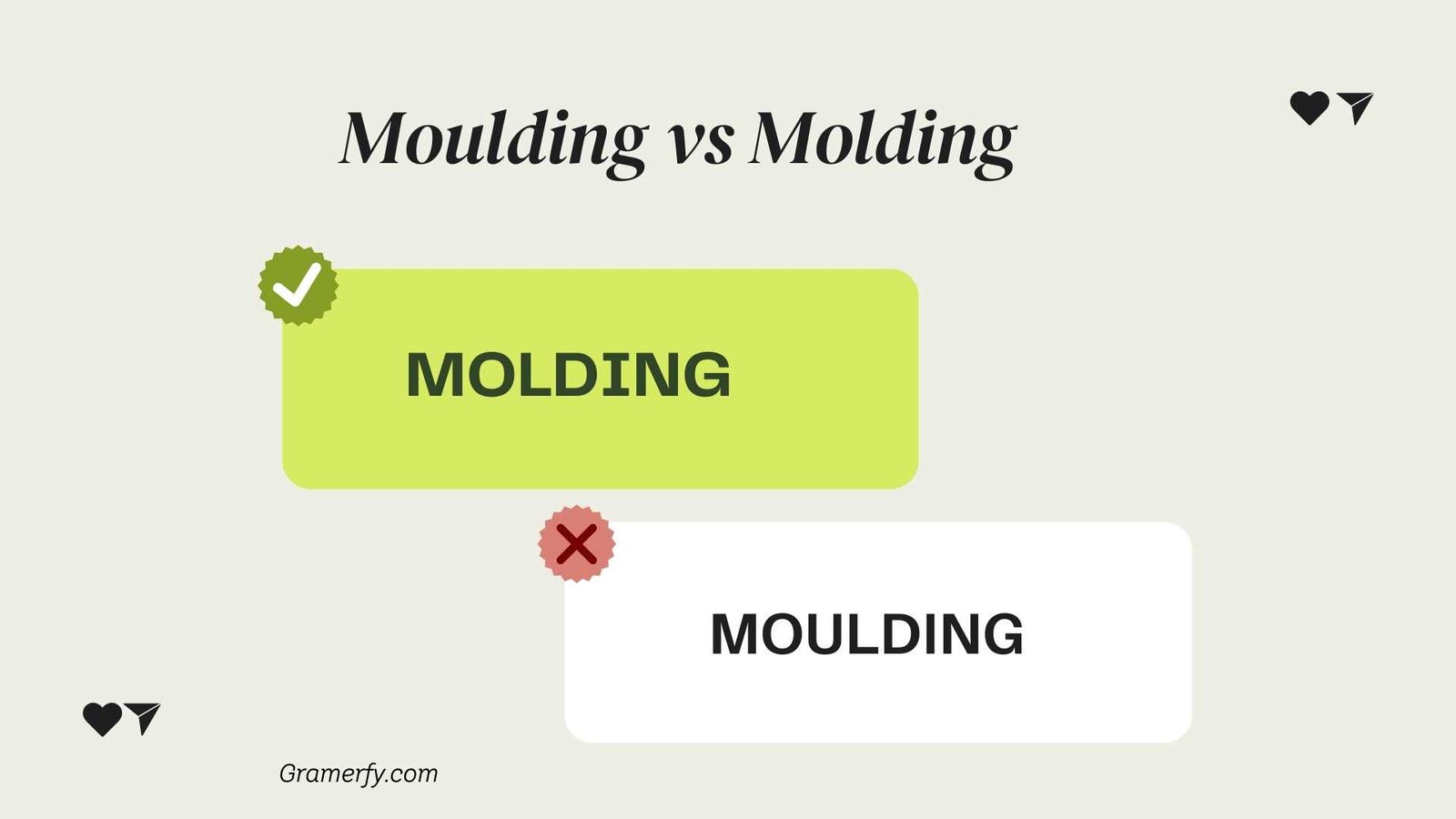
Understanding the difference between moulding vs molding is simple once you remember the key rule: British English = moulding, American English = molding. The meanings are identical, the pronunciation is the same, and the choice depends on your audience. Whether you’re writing about interior design, crafts, or figurative shaping, using the correct spelling will make your writing polished and professional.
Consistency, awareness of your audience, and proper usage are the keys to mastering these tricky variants. Next time you decorate a room, shape some clay, or write about character development, you’ll confidently pick the right spelling.