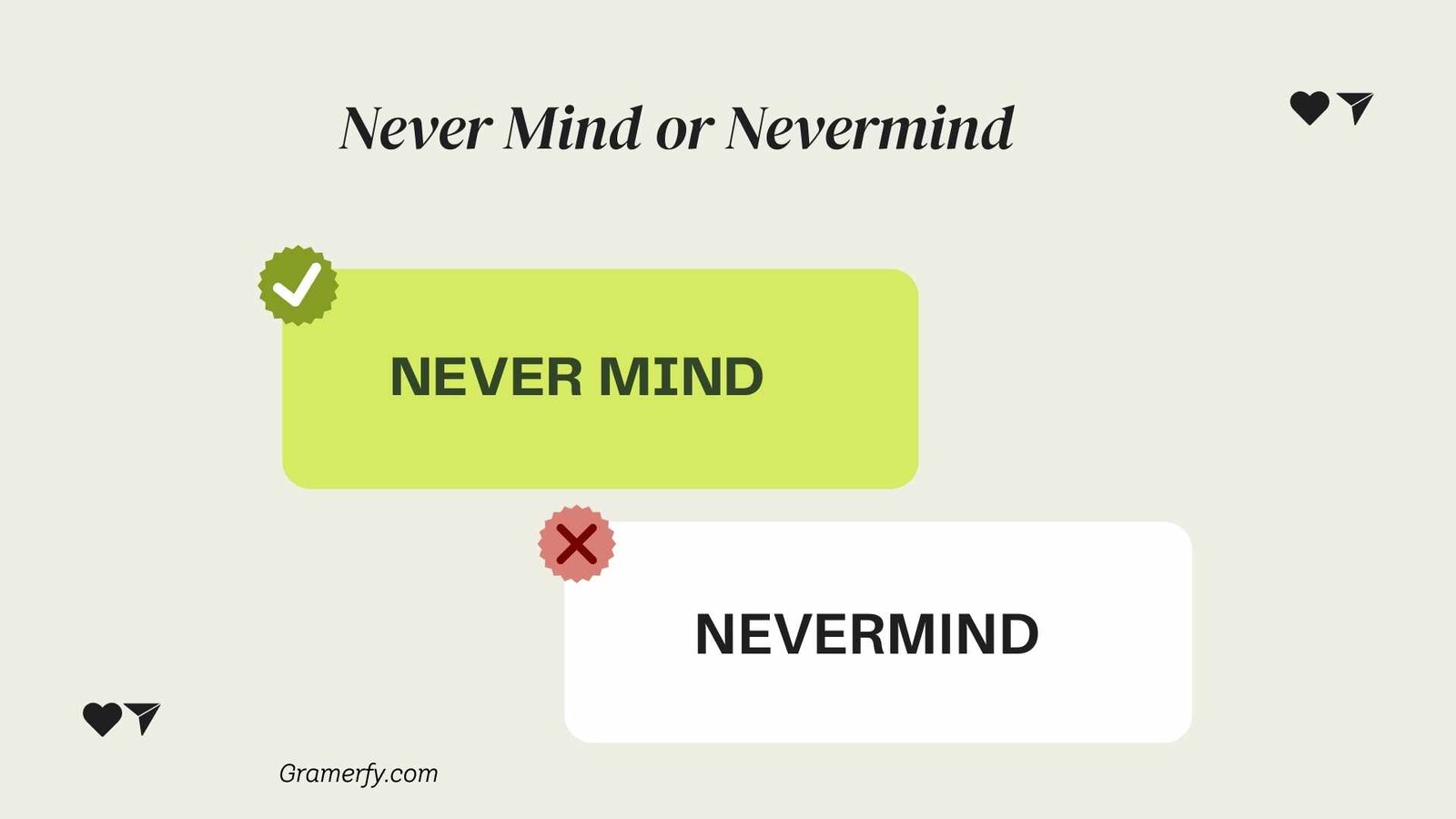
Never Mind or Nevermind these two simple words might seem small, but they can have a huge impact on communication. Have you ever wondered if there’s a difference between “Never mind” and “Nevermind”?
Every day, we see these phrases in texts, emails, social media posts, or casual conversations, yet many people get confused about which one is correct in a particular context.
Using them correctly can make your messages sound polite, casual, or even playful, while using them incorrectly might create misunderstanding.
What Does “Never Mind” Mean?
“Never mind” is a two-word phrase commonly used in English to tell someone not to worry about something or ignore what was just said. It is informal but widely accepted in both spoken and written English.
Key Meanings:
- To disregard something
- Example: “Oh, never mind. It’s not important.”
- Example: “Oh, never mind. It’s not important.”
- To tell someone not to worry
- Example: “Never mind the mess; we can clean it later.”
- Example: “Never mind the mess; we can clean it later.”
- To retract a question or statement
- Example: “Did you find the book? – Never mind, I found it myself.”
- Example: “Did you find the book? – Never mind, I found it myself.”
Usage Tip: Always write it as two separate words when you mean “forget it” or “ignore what I said.”
What About “Nevermind”?
“Nevermind” is a single word, but it is less common and often considered informal or casual. It can also appear as a brand name, song title, or artistic expression (like Nirvana’s album Nevermind).
Key Notes on “Nevermind”:
- Not typically used in standard formal writing.
- Sometimes used in casual texting or online writing, but it’s safer to stick with never mind in professional or educational contexts.
Example in casual usage:
- “Nevermind, I’ll do it myself.”
Notice how this looks similar to the two-word version—but in formal English, it’s better to separate it.
Comparison: Never Mind vs Nevermind
| Feature | Never Mind | Nevermind |
| Word count | 2 words | 1 word |
| Formality | Standard, correct | Informal, casual |
| Usage | Correct for spoken and written English | Mostly informal, artistic, or online |
| Meaning | Ignore, forget, don’t worry | Same meaning, but informal or stylistic |
| Examples | “Never mind, I understand now.” | “Nevermind, let’s move on.” |
| Recommended in writing | ✅ | ⚠️ Use cautiously |
Tip: If in doubt, always choose never mind. It is universally accepted and error-free.
Common Mistakes With “Never Mind” and “Nevermind”
- Writing “nevermind” in formal essays or emails
- ❌ Wrong: “Nevermind the instructions, I’ll figure it out.”
- ✅ Correct: “Never mind the instructions; I’ll figure it out.”
- ❌ Wrong: “Nevermind the instructions, I’ll figure it out.”
- Using it when it doesn’t fit the context
- “Never mind” should only be used to dismiss, retract, or ignore something. Don’t use it randomly.
- “Never mind” should only be used to dismiss, retract, or ignore something. Don’t use it randomly.
- Confusing it with “mind”
- ❌ Wrong: “I nevermind you.” (This is incorrect)
- ✅ Correct: “Never mind what I said earlier.”
- ❌ Wrong: “I nevermind you.” (This is incorrect)
- Capitalization errors
- At the start of a sentence: Never mind is capitalized.
- In the middle of a sentence: use lowercase unless it’s a proper noun.
- At the start of a sentence: Never mind is capitalized.
Examples of Correct Usage
In Conversation
- “Do you need help with your homework?”
– “Never mind, I’ve got it.” - “I can’t make it to the party tonight.”
– “Never mind, we’ll catch up another time.”
In Writing
- “I thought you wanted the report today, but never mind; we can submit it tomorrow.”
- “She asked if I liked the movie, but I said never mind because it wasn’t important.”
Texting / Informal
- “Nevermind, I solved it myself!”
- “Oh, nevermind, it’s fine.”
Spelling Tips
- Always remember never mind = two words for standard English.
- Nevermind = one word is mostly for informal online writing or titles.
- Trick to remember: If you can replace it with “forget it”, you should use never mind.
FAQs (People Also Ask)
1. Can I use “nevermind” in school assignments?
No, always use never mind in formal writing to avoid mistakes.
2. Is “never mind” the same as “forget it”?
Yes, it has the same meaning in most situations. You can use them interchangeably.
3. Is “nevermind” wrong?
Not exactly wrong, but it’s informal and better suited for texting or artistic usage.
4. How do I pronounce “never mind”?
It’s pronounced exactly as it reads: /ˈnev.ər maɪnd/.
5. Can I start a sentence with “Never mind”?
Yes! Example: “Never mind, I found the answer myself.”
Quick Usage Checklist
- ✅ Use never mind for formal, correct writing.
- ⚠️ Use nevermind only for casual online texts or titles.
- ✅ Remember, never mind = ignore / forget / don’t worry.
- ❌ Avoid using nevermind in essays, business emails, or exams.
Conclusion
In English, the difference between never mind and nevermind is mostly about formality and spelling. Never mind is correct, professional, and universally accepted. Nevermind, while sometimes seen online or in titles, should be avoided in formal writing.
By keeping this guide in mind, you will never confuse these two forms again. Remember the key tip: if you mean “forget it” or “ignore that,” always write it as two words never mind. Your writing will look polished, natural, and grammatically correct.