When writing or speaking in English, small details can make a big difference especially when it comes to word forms. One such interesting case is “Newfound” vs “New-Found.”
At first glance, they may look almost identical, but their usage can raise questions for writers, students, and even seasoned professionals. Should you use the closed form “newfound” or the hyphenated “new-found”? Does one sound more modern, more correct, or more formal?
This subtle distinction often appears in phrases like newfound confidence, newfound freedom, or newfound success. Understanding which form is preferred and why can instantly polish your writing and help you sound more natural in English.
What Does “Newfound” Mean?
Newfound is an adjective that describes something recently discovered, realized, or acquired. It emphasizes the freshness or newness of an experience, feeling, or quality.
Examples:
- She felt a newfound confidence after completing the course.
- His travels gave him a newfound appreciation for different cultures.
- They enjoyed a newfound friendship that grew over the summer.
Key Points:
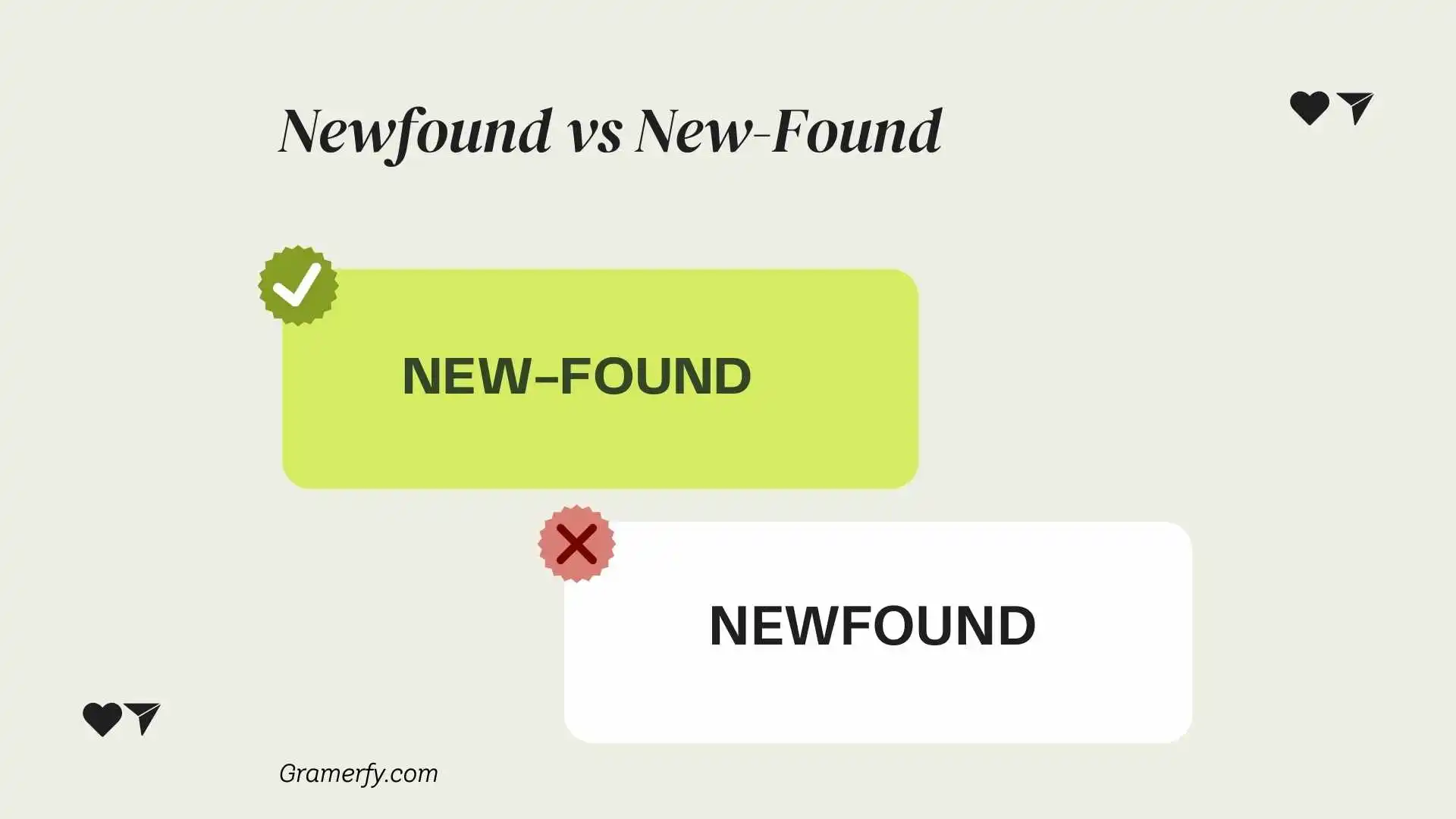
- Usually used without a hyphen in modern English.
- Commonly paired with nouns like love, hope, respect, freedom, confidence, joy.
- Emphasizes something recently discovered in a positive sense.
What Does “New-Found” Mean?
New-found is essentially the same as “newfound,” but the hyphen is less common in modern usage. Traditionally, hyphenation was used for clarity, especially in formal writing or older texts.
Examples:
- The explorers shared a new-found excitement about the uncharted island.
- He expressed a new-found respect for his teacher.
- Their new-found courage surprised everyone.
Key Points:
- Hyphenated version of “newfound.”
- Can appear in formal writing or older literature.
- Meaning is almost identical to “newfound.”
Newfound vs New-Found: Comparison Table
| Feature | Newfound | New-Found |
| Spelling | No hyphen | With hyphen |
| Modern Usage | Preferred | Less common |
| Formality | Neutral to informal | More formal or traditional |
| Common Collocations | newfound love, newfound joy | new-found respect, new-found courage |
| Example Sentence | She had newfound courage. | She had new-found courage. |
| Emphasis | Recent discovery or feeling | Same meaning, slightly formal |
How to Use “Newfound” Correctly
- Before a noun:
- Always place newfound directly before the noun it describes.
- Example: He showed newfound patience with his students.
- Always place newfound directly before the noun it describes.
- Expressing feelings or qualities:
- It’s perfect for emotions, attitudes, or qualities recently realized.
- Example: She felt newfound freedom after quitting her job.
- It’s perfect for emotions, attitudes, or qualities recently realized.
- Avoid overusing in one sentence:
- Too many “newfound” words can sound repetitive.
- Better: He gained a sense of freedom and confidence.
- Too many “newfound” words can sound repetitive.
Common Mistakes
- Using as a verb or noun:
- ❌ Wrong: I newfound a hobby.
- ✅ Correct: I discovered a newfound hobby.
- ❌ Wrong: I newfound a hobby.
- Mixing with old expressions:
- ❌ Wrong: He has an old-newfound interest.
- ✅ Correct: He has a newly discovered interest.
- ❌ Wrong: He has an old-newfound interest.
- Hyphen confusion:
- Modern English prefers newfound over new-found.
- Use hyphen only if your style guide asks for it.
- Modern English prefers newfound over new-found.
Spelling Tips
- Think of “newfound” as one word: new + found → something newly found.
- If you see a hyphen in older texts, treat it as equivalent to “newfound.”
- Remember: no plural form—“newfounds” is incorrect.
Examples of “Newfound” in Sentences
- After the seminar, she had a newfound interest in history.
- The child displayed newfound bravery during the storm.
- They developed a newfound respect for each other.
- Traveling abroad gave him newfound wisdom.
- Her success brought a newfound sense of pride.
Examples of “New-Found” in Sentences
- The hikers felt a new-found excitement when they reached the peak.
- He wrote about his new-found enthusiasm for painting.
- The team celebrated their new-found victory.
- She gained a new-found perspective on life.
- His speeches inspired a new-found motivation among students.
When to Choose “Newfound” vs “New-Found”
- Use newfound in modern writing and casual texts.
- Use new-found if you are writing formal papers, older-style prose, or adhering to British English in traditional contexts.
- Both are interchangeable in meaning, but the hyphen is optional today.
FAQs (People Also Ask)
Q1: Can I use “newfound” and “new-found” interchangeably?
Yes, the meaning is the same. The hyphen is mostly a stylistic choice.
Q2: Is “newfound” formal or informal?
It is neutral—works in both formal and informal contexts.
Q3: Can “newfound” be used for objects?
Yes, but it is most often used for feelings, qualities, or experiences.
- Example: He displayed newfound skills in coding.
Q4: Which is more common today, “newfound” or “new-found”?
“Newfound” without the hyphen is far more common in modern English.
Q5: Can I write “newfound love” or “new-found love”?
Both are correct. “Newfound love” is preferred in contemporary writing.
Tips for Remembering
- Think of “found” → you found something new → newfound.
- Hyphen = optional → use it only if style or clarity requires.
- Usually describes emotions, skills, or experiences rather than objects.
Conclusion
In summary, newfound and new-found are virtually the same in meaning, describing something recently discovered or realized. The modern preference is newfound without a hyphen, especially in everyday writing.
Use them before nouns that describe emotions, qualities, or experiences. Avoid using them as verbs or nouns, and keep sentences natural and concise. Mastering these words adds nuance to your English, helping you sound both fluent and precise. Remember: when in doubt, “newfound” is your safe, modern choice.