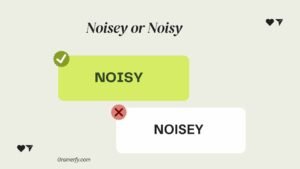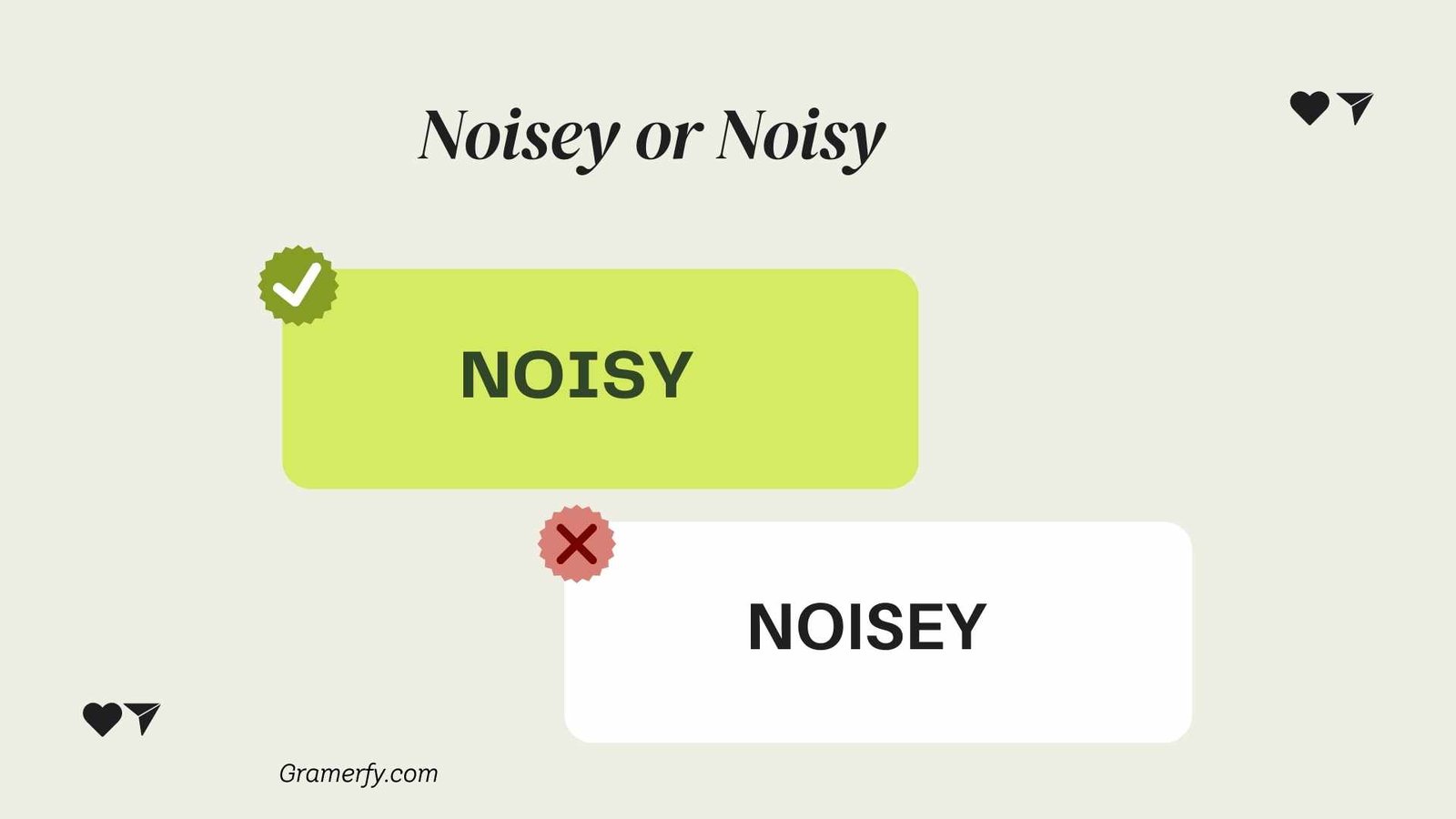
Have you ever paused while typing and wondered, is it “noisey” or “noisy”? You’re not alone. This tiny spelling confusion trips up thousands of writers every day. At first glance, both words look almost identical.
However, only one of them is actually correct in standard English. That small “e” can quietly turn your writing from polished to problematic.
In today’s fast-paced digital world, clear communication matters more than ever. Whether you’re writing a school essay, a social media caption, or a professional email, spelling mistakes can affect how people see you.
Meaning of Noisy
The word “noisy” is an adjective that describes something that makes a lot of sound. It is commonly used in everyday English to talk about sounds that are loud, distracting, or unpleasant.
Examples:
- The classroom was very noisy today because the children were excited.
- I can’t concentrate with that noisy traffic outside.
- Her noisy laugh could be heard across the room.
Key Points About “Noisy”:
- Spelling: N-O-I-S-Y
- Part of Speech: Adjective
- Meaning: Making a lot of sound; loud or disruptive
Is “Noisey” Correct?
No, “noisey” is incorrect. The word does not exist in standard English dictionaries. Using “noisey” in writing or formal communication is considered a spelling mistake.
Many people mistakenly add an “e” because of similar words like “cheesy” or “easy.” However, “noisy” does not follow this pattern.
Incorrect:
- The children were very noisey today.
Correct:
- The children were very noisy today.
Noisey vs Noisy: Comparison Table
| Feature | Noisy | Noisey |
| Spelling | N-O-I-S-Y | N-O-I-S-E-Y |
| Correct Usage | ✅ Correct | ❌ Incorrect |
| Meaning | Loud, making noise | None (not a word) |
| Examples | The street is noisy | Not used in standard English |
Common Mistakes with “Noisy”
- Adding an “e”: People often write “noisey” because they are used to words ending in -y.
- Confusing with “noise”: “Noise” is a noun, and “noisy” is the adjective form.
- Correct: The room is noisy.
- Incorrect: The room is noise.
- Correct: The room is noisy.
- Pronunciation errors: Some may pronounce “noisy” incorrectly as “nois-ee,” but the correct pronunciation is /ˈnɔɪ.zi/.
How to Remember the Correct Spelling
Here are some simple tricks:
- Trick 1: Think of noise + y = noisy. Just add “y” to “noise.”
- Trick 2: Remember: No extra e is needed. “Noisey” is wrong.
- Trick 3: Practice with examples in sentences.
Example Sentences:
- The dog next door is very noisy at night.
- I prefer a quiet cafe rather than a noisy one.
- Schools can be noisy in the morning.
Examples in Everyday English
Using “noisy” correctly is easy if you practice with everyday situations:
- Home:
- My neighbors are noisy, so I can’t sleep.
- My neighbors are noisy, so I can’t sleep.
- School/Office:
- The noisy classroom made it hard to focus.
- The noisy classroom made it hard to focus.
- Traffic/City:
- New York is a noisy city with cars honking all day.
- New York is a noisy city with cars honking all day.
- Events:
- The concert was fun but very noisy.
- The concert was fun but very noisy.
FAQs (People Also Ask)
1. Can I write “noisey”?
No, “noisey” is not correct. The right spelling is “noisy.”
2. What is the difference between “noise” and “noisy”?
- Noise: Noun (e.g., The noise is loud.)
- Noisy: Adjective (e.g., The street is noisy.)
3. Is “noisy” formal or informal?
Noisy is neutral. It can be used in both formal and informal English.
4. Can “noisy” describe a person?
Yes! It can describe a person who talks loudly or makes a lot of sound:
- He is a noisy child.
5. Any spelling tips for “noisy”?
- Think noise + y.
- Avoid adding an extra “e.”
- Practice with example sentences.
Conclusion
In English, spelling mistakes like “noisey” are common, but the correct word is “noisy.” Remember: “noisy” is an adjective describing loud sounds or disturbances.
By following these simple tips thinking of noise + y, practicing sentences, and using it in daily conversation you can confidently use “noisy” in your writing and speaking. Avoid “noisey” completely; it is always considered wrong. Using the right spelling not only improves your English but also makes your communication clear and professional.