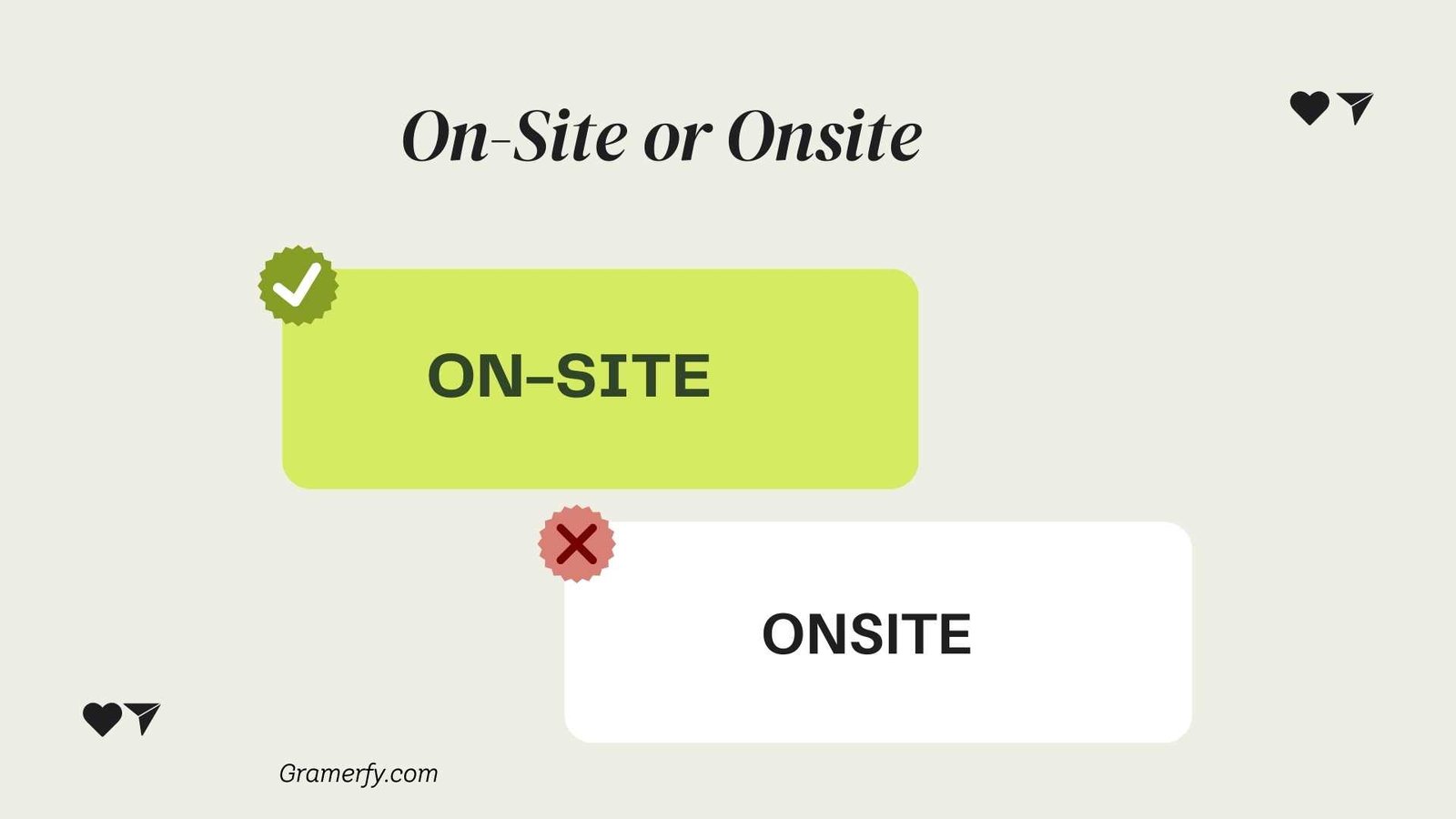
In today’s fast-paced digital and business world, the terms On-Site and Onsite pop up everywhere, but many still wonder what they truly mean and why the distinction matters.
It’s about on-site SEO, where your website’s content and structure are optimized directly on your pages, or onsite services, where professionals come to your physical location, understanding these concepts can completely transform the way you approach work, marketing, and customer experiences.
Confusion between “on-site” and “onsite” might seem minor, but in reality, it can impact strategy, communication, and even results.
What Does “On-Site” Mean?
On-site is a compound adjective or adverb often used with a hyphen. It describes something that happens or exists at a particular location, usually a workplace, office, or event.
Examples of “On-Site”
- The company offers on-site training for all employees.
- There is on-site parking available for guests.
- Our team provides on-site technical support.
Key Points:
- Always hyphenate when using it before a noun (e.g., on-site support).
- It emphasizes the location where something occurs.
- It is widely accepted in formal and business English.
What Does “Onsite” Mean?
Onsite is simply the non-hyphenated version of on-site. It is more common in American English and especially in digital writing, where hyphens are often dropped.
Examples of “Onsite”
- Employees can access onsite resources anytime.
- The hospital provides onsite childcare facilities.
- Our IT department ensures onsite network security.
Key Points:
- Works the same way as on-site in meaning.
- Often preferred in online content, tech writing, and informal contexts.
- Some style guides accept it as a single word without a hyphen.
On-Site vs Onsite: The Difference
While on-site and onsite are interchangeable in meaning, the main differences are:
| Feature | On-Site | Onsite |
| Spelling | Hyphenated | Non-hyphenated |
| Formality | More formal | Less formal / casual |
| Usage | Traditional writing | Modern / online writing |
| Common regions | UK English | US English |
| Typical contexts | Business, academic, print | Websites, tech, digital content |
Tip: If you’re writing for an official report or academic document, on-site is often preferred. For blogs, websites, or casual content, onsite is fine.
How to Use “On-Site” or “Onsite” Correctly
1. Before a Noun (Adjective Use)
- Correct: We provide on-site training for employees.
- Correct: Our website offers onsite tutorials for beginners.
- Incorrect: We provide onsite for employees. (missing noun)
2. As an Adverb
- Correct: The technician will work on-site tomorrow.
- Correct: The consultant visited onsite last week.
Rule: When describing where something happens, both can work.
Common Mistakes and Spelling Tips
Mistake 1: Mixing Hyphen Usage
- ❌ The company offers onsite-training.
- ✅ The company offers on-site training.
- ✅ The company offers onsite training.
Tip: Hyphenate when used as an adjective before a noun. Remove the hyphen if using the word as a standalone adverb.
Mistake 2: Confusing with “Site” Alone
- ❌ The work will happen site.
- ✅ The work will happen on-site / onsite.
Tip: “Site” alone is a noun (e.g., construction site). Always pair with “on.”
Mistake 3: Overuse in Writing
- ❌ All tasks must be done on-site, and the on-site team will handle the on-site setup.
- ✅ All tasks must be done on-site, and the team will handle setup.
Tip: Avoid repetitive use. Use synonyms like at the location, at the facility, or locally.
Multiple Examples for Clarity
- The IT company provides on-site hardware repair.
- Employees are encouraged to attend onsite workshops.
- On-site security is available 24/7 in the building.
- The hospital ensures onsite patient care during emergencies.
- Our team will conduct the on-site survey tomorrow.
- You can access all onsite facilities without additional charges.
- On-site catering will be arranged for the conference.
- The technician worked onsite to fix the server issues.
- On-site inspections are required before project approval.
- The company offers onsite childcare for employees’ children.
When to Use Hyphenated vs Non-Hyphenated
Hyphenated: On-Site
- Preferred in formal documents, academic writing, newspapers, or books.
- Makes compound words clearer to read.
Example: The on-site team completed the work efficiently.
Non-Hyphenated: Onsite
- Popular in digital content, blogs, and American English.
- Modern, streamlined writing style.
Example: The onsite meeting starts at 10 AM.
Tip: Always check the style guide you follow (APA, Chicago, or company rules).
FAQs (People Also Ask Style)
1. Is “on-site” the same as “onsite”?
Yes. They mean the same thing. The difference is mainly hyphenation and formality.
2. Can I use “onsite” in formal writing?
Yes, but many style guides still prefer on-site in formal or academic writing.
3. When should I hyphenate?
Use a hyphen when the word comes before a noun to act as an adjective.
Example: on-site inspection.
4. Can “onsite” be used as an adverb?
Yes. Both on-site and onsite can describe where an action happens.
Example: The team will work onsite tomorrow.
5. Is “on-site” more common in British English?
Yes. British English tends to prefer the hyphenated on-site, while American English often uses onsite.
Conclusion
Both on-site and onsite are correct, but your choice depends on formality, region, and context. By understanding these subtle differences, you can confidently write professional emails, articles, reports, and website content without grammar mistakes.