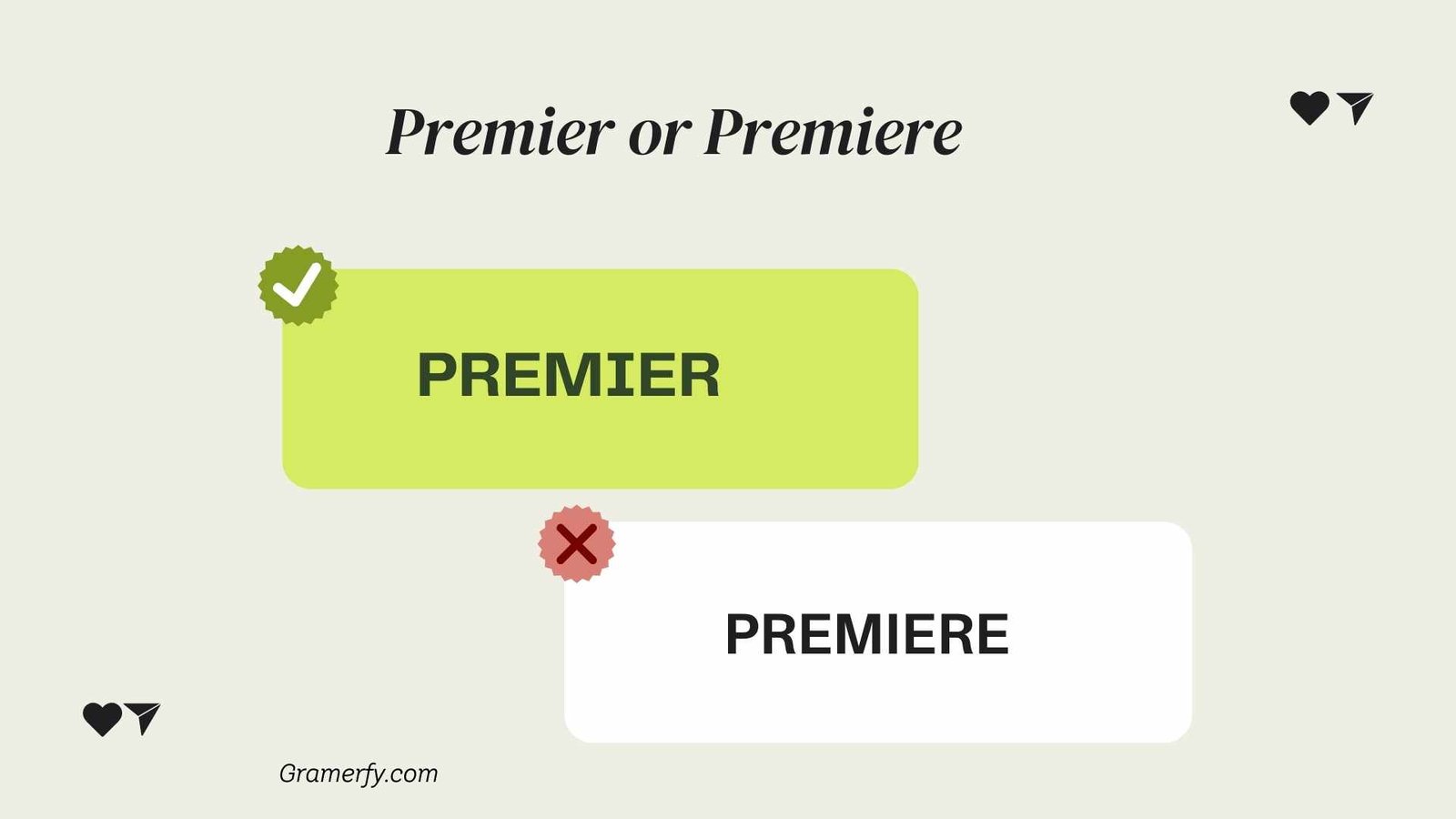
When it comes to words that exude prestige, exclusivity, and first-class experiences, few can rival “Premier” and “Premiere.” Though they sound similar, each carries its own unique charm and significance.
Premier often signals top-tier quality, leadership, or the very best in any field whether it’s a premier service, event, or product that sets the standard for others to follow.
On the other hand, Premiere usually shines in the world of entertainment, fashion, and arts, representing the very first public showing or debut of a film, play, or event, creating buzz and excitement.
Meaning and Correct Usage
Premier
Premier is an adjective or noun. Its main meanings are:
- Adjective: The first in importance, rank, or position.
- Example: She is the premier chef in the city.
- Meaning: She is the top or most important chef.
- Example: She is the premier chef in the city.
- Noun: A head of government, especially in some countries.
- Example: The Premier of Canada gave a speech yesterday.
- Meaning: The leader or prime minister of the government.
- Example: The Premier of Canada gave a speech yesterday.
Key Points About Premier:
- Usually refers to something top-ranked or first in status.
- Can also refer to political leaders in certain countries.
- Pronounced: /ˈprɛm.i.ər/
Premiere
Premiere is a noun or verb. Its meanings are:
- Noun: The first public performance of a movie, play, or show.
- Example: The new movie had its premiere last night.
- Meaning: The first showing of a film or performance.
- Example: The new movie had its premiere last night.
- Verb: To show or perform something publicly for the first time.
- Example: The film will premiere at the festival next week.
- Example: The film will premiere at the festival next week.
Key Points About Premiere:
- Related to events, movies, shows, or performances.
- Indicates the first public appearance or showing.
- Pronounced: /prɪˈmɪər/
Premier vs Premiere: Quick Comparison
| Feature | Premier | Premiere |
| Part of Speech | Adjective, Noun | Noun, Verb |
| Meaning | First in importance; leader of government | First public showing of a performance or movie |
| Usage Example | She is the premier scientist of her field. | The play will premiere tomorrow. |
| Pronunciation | /ˈprɛm.i.ər/ | /prɪˈmɪər/ |
| Common Confusion | People confuse it with movie openings | People confuse it with “premier” meaning top-ranked |
How to Use “Premier” Correctly
Here are some practical examples to help you understand premier better:
- He is the premier athlete in the league.
- Meaning: He is the most important or best athlete.
- Meaning: He is the most important or best athlete.
- The Premier announced new policies today.
- Meaning: The head of the government made an announcement.
- Meaning: The head of the government made an announcement.
- Our company is the premier provider of online courses.
- Meaning: Our company is the leading or top provider.
- Meaning: Our company is the leading or top provider.
Tips for Using Premier:
- If you’re talking about top-ranking or importance, use premier.
- If it’s about politics and government leaders, Premier can be capitalized.
- Never use it for movies or shows; that’s premiere.
How to Use “Premiere” Correctly
Here are some practical examples to help you understand premiere better:
- The movie will premiere on Friday.
- Meaning: The first showing of the movie happens on Friday.
- Meaning: The first showing of the movie happens on Friday.
- The premiere of the new play was attended by celebrities.
- Meaning: The first performance of the play.
- Meaning: The first performance of the play.
- She attended the film premiere in Hollywood.
- Meaning: She went to the first public showing of a movie.
- Meaning: She went to the first public showing of a movie.
Tips for Using Premiere:
- Always related to arts, movies, or shows.
- Can be a noun (the event itself) or a verb (to debut the event).
- Do not confuse with premier, which refers to ranking or leaders.
Common Mistakes and How to Avoid Them
Many learners mix up premier and premiere because they sound similar. Here are the most common mistakes:
- Wrong: The new movie is the premier of the year.
Correct: The new movie is the premiere of the year. - Wrong: She is attending the film premiere, the best actress in the premier category.
Correct: She is attending the film premiere. She is the best actress in the premier category. - Wrong: The Premier of the movie was amazing.
Correct: The premiere of the movie was amazing.
Spelling Tips:
- Remember -ier at the end of premier → usually for ranking or leaders.
- Remember -ere at the end of premiere → often linked to shows or events.
Examples in Sentences
Here’s a mix of premier and premiere used correctly in real-life situations:
Premier:
- The premier university in the country has excellent professors.
- Italy’s Premier addressed the nation.
- He is considered the premier violinist of his generation.
Premiere:
- The Broadway show will premiere next month.
- The movie’s premiere attracted thousands of fans.
- The artist’s new music video will premiere online tonight.
Tips to Remember the Difference
- Premier = top or first in rank → Think priority, position, leadership.
- Premiere = first showing or debut → Think performance, movie, or event.
- If in doubt, check if it’s about importance or first public performance.
FAQs (People Also Ask)
1. Can “premier” be used for movies?
No. Premier is for ranking or leaders. Use premiere for movies or shows.
2. Is “premiere” ever used as an adjective?
No. Premiere is only a noun or a verb. Adjective form is premier.
3. How do you pronounce “premier” and “premiere”?
- Premier: /ˈprɛm.i.ər/
- Premiere: /prɪˈmɪər/
4. Should “Premier” be capitalized?
Yes, when referring to a political leader. Example: The Premier of Ontario spoke today.
5. Can I use “premiere” as a verb?
Yes. Example: The movie will premiere at the festival next week.
Conclusion
Understanding the difference between premier and premiere is essential for clear, professional, and accurate English writing. By practicing these tips, checking the context, and remembering the spelling rules, you’ll never confuse these two words again.
Correct usage not only improves your writing but also helps you sound more confident and fluent in English.