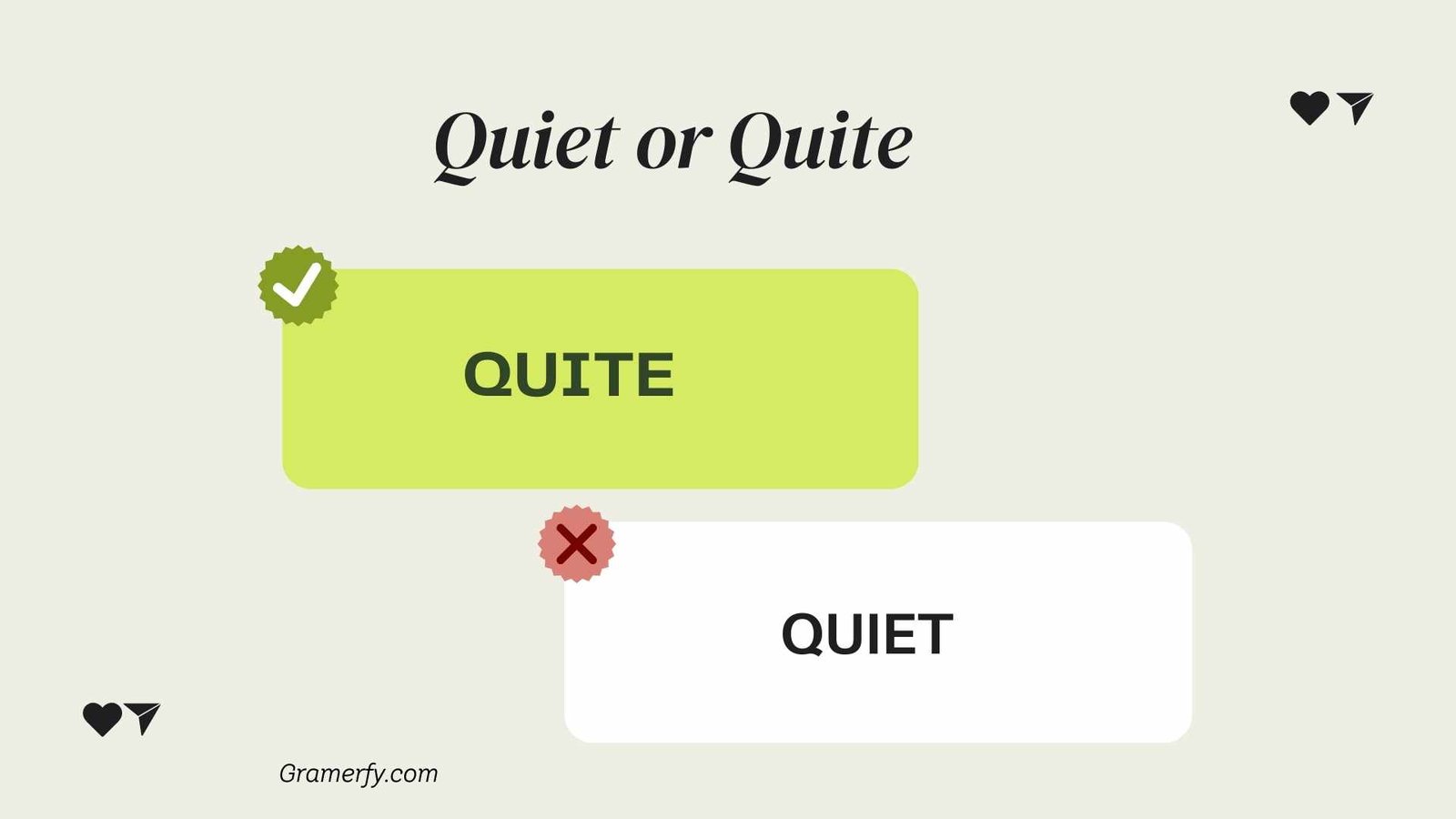
Have you ever stumbled over the words “quiet” and “quite” and wondered why they sound so similar yet mean completely different things?
Many people mix them up, turning a simple sentence into a confusing puzzle. Quiet refers to silence, calmness, or the absence of noise, painting a serene picture in your mind.
On the other hand, quite is an adverb used to emphasize degree, like saying “very” or “completely,” adding intensity to your expressions. Understanding the difference isn’t just about grammar it’s about expressing yourself clearly and confidently.
What Does “Quiet” Mean?
Quiet is usually an adjective or noun that relates to silence or calmness. It is about the absence of noise or disturbance.
Usage of Quiet as an Adjective
- Meaning: Not noisy, calm, or peaceful.
- Examples:
- The library is very quiet today.
- Please be quiet during the movie.
- She has a quiet personality.
- The library is very quiet today.
Usage of Quiet as a Noun
- Meaning: Silence or peace.
- Examples:
- I enjoy the quiet of the morning.
- Let’s sit and enjoy the quiet.
- I enjoy the quiet of the morning.
Other Notes on Quiet
- Often used with words like room, place, time, or voice.
- Common phrases:
- Keep quiet – remain silent.
- Quiet down – reduce noise.
- Keep quiet – remain silent.
What Does “Quite” Mean?
Quite is an adverb that is used to intensify or emphasize adjectives or verbs. It often means “very,” “completely,” or “to some extent,” depending on the context.
Usage of Quite
- Meaning: Very, completely, or somewhat.
- Examples:
- She is quite talented. (very talented)
- I am quite sure about this answer. (completely sure)
- The movie was quite interesting. (somewhat interesting)
- She is quite talented. (very talented)
Notes on Usage
- Quite modifies adjectives, adverbs, or sometimes verbs.
- It is never used to describe silence or noise (that’s quiet).
- Common collocations:
- Quite good, quite happy, quite sure, quite easy
- Quite good, quite happy, quite sure, quite easy
Key Differences Between Quiet and Quite
| Feature | Quiet | Quite |
| Part of Speech | Adjective / Noun | Adverb |
| Meaning | Silent, calm, peaceful | Very, completely, to some extent |
| Usage Example | The room is quiet. | She is quite smart. |
| Related Words | Silence, peaceful, calm | Very, completely, fairly |
| Common Mistake | Using it to mean “very” | Using it to mean “silent” |
Common Mistakes and How to Avoid Them
1: Confusing Quiet and Quite
- ❌ Wrong: The room is quite.
- ✅ Correct: The room is quiet.
Tip: Ask yourself, “Am I talking about silence or emphasizing something?”
2: Misplacing Quite
- ❌ Wrong: She is quiet talented.
- ✅ Correct: She is quite talented.
3: Overusing Quite
- ❌ Wrong: The cake was quite, quite, quite delicious.
- ✅ Correct: The cake was quite delicious.
Easy Tips to Remember
- Quiet = silence → Think “shhh.”
- Quite = very/completely → Think “emphasis.”
- Replace quite with very; if it still makes sense, it’s correct.
- Imagine quiet as describing sound and quite as describing degree.
Examples in Sentences
Using Quiet
- The classroom was quiet during the test.
- I love sitting in a quiet park.
- He speaks in a quiet voice.
Using Quite
- This puzzle is quite tricky.
- I am quite sure she will come.
- The weather is quite pleasant today.
Mixed Examples
- ❌ Wrong: The library is quite.
- ✅ Correct: The library is quiet.
- ❌ Wrong: She is quiet confident.
- ✅ Correct: She is quite confident.
FAQs (People Also Ask)
1. Can “quiet” be used as a verb?
Yes! “Quiet” can also be used as a verb meaning to make silent or calm.
- Example: The teacher quieted the students before starting the lesson.
2. Is “quite” used in British and American English the same way?
Mostly yes, but in British English, quite can sometimes mean fairly or somewhat, which is less intense than in American English.
3. Can “quiet” describe people?
Absolutely! It can describe someone’s personality or behavior.
- Example: He is a quiet and thoughtful person.
4. Can “quite” be used with verbs?
Yes, but it’s more common with adjectives or adverbs.
- Example: I quite enjoy reading.
5. How do I remember the difference between quiet and quite?
- Quiet = silence → Think of a library.
- Quite = very/completely → Think of emphasizing something.
Conclusion
In summary, quiet and quite are two words that often confuse English learners. Quiet is about silence and calmness, while quite is about emphasizing degree. Remembering the difference is easy if you focus on their meanings:
Use the tips and examples in this article to confidently choose the correct word. With practice, mixing them up will become a thing of the past.