Have you ever paused mid-sentence, unsure whether to write “their” or “thier”? You’re not alone! These two tiny words can make a massive difference in your writing and yet, they trip up even seasoned writers.
“Their” is one of the most commonly misused words in English, often confused with the misspelled “thier”. Knowing the difference isn’t just about grammar; it’s about credibility, clarity, and confidence.
Imagine sending a message or posting online, only to have readers fixate on a small typo instead of your powerful ideas. Mastering this simple distinction instantly elevates your writing and ensures your audience focuses on what you mean, not how you spell it.
What Does “Their” Mean?
“Their” is a possessive adjective used to show that something belongs to a person or people. It indicates ownership.
Examples of “Their” in Sentences:
- They forgot their books at school.
- The kids played with their toys in the park.
- Everyone should bring their own lunch.
Key points:
- Always shows possession.
- Works with plural nouns or people in general.
- Commonly confused with “there” and “they’re,” so pay attention to context.
What About “Thier”?
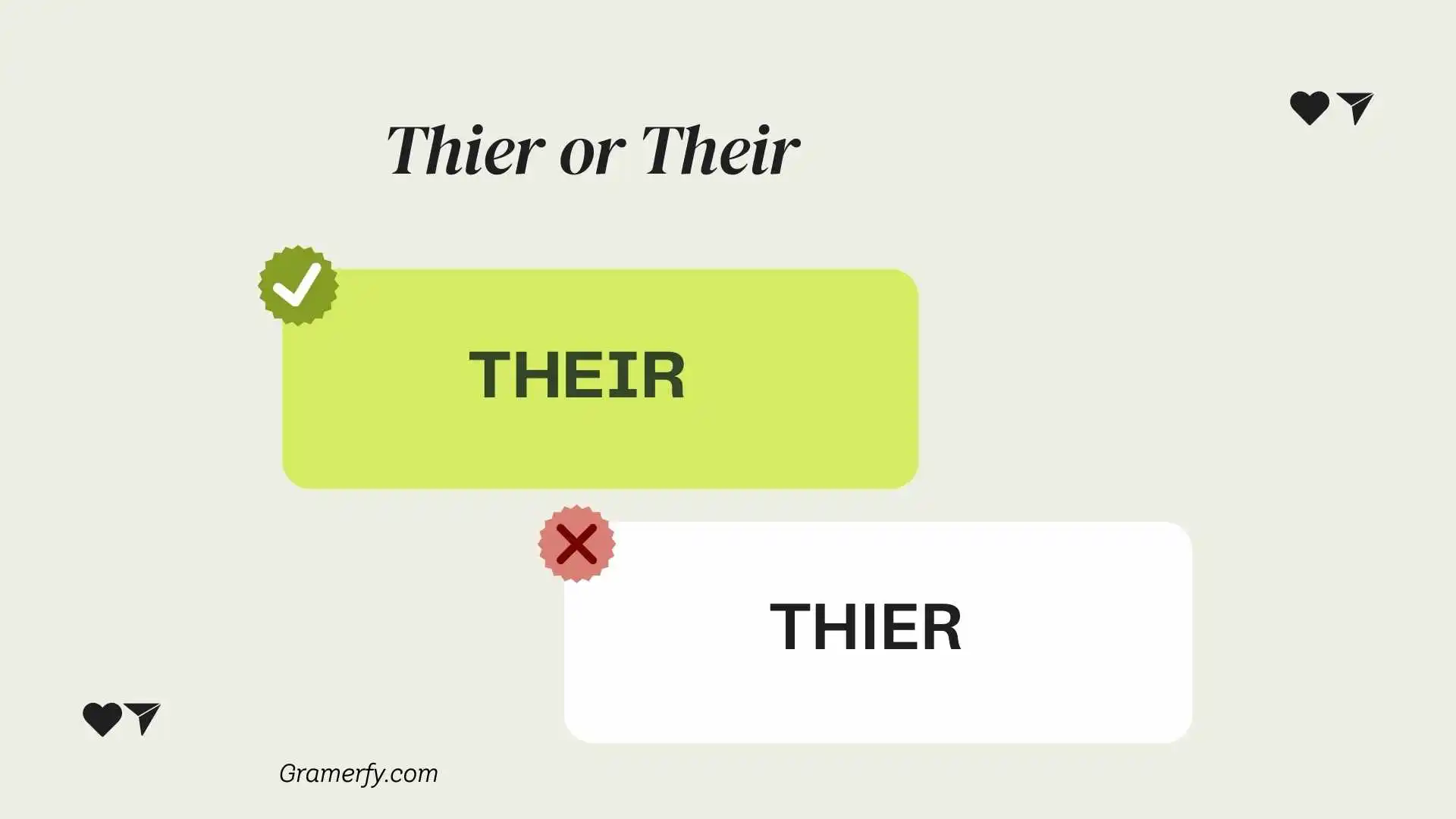
“Thier” is not a correct word in English. It is a common spelling mistake for “their.”
Examples of Incorrect Usage:
- Incorrect: I like thier new car.
- Correct: I like their new car.
Tips to avoid “thier”:
- Remember the correct order is i before e after th → “their.”
- Use mnemonic: “They own it, so it’s their thing.“
Their vs Thier: A Quick Comparison
| Word | Type | Meaning | Correct Usage Example | Notes |
| Their | Possessive adj. | Belongs to them | Their house is beautiful. | Always correct in formal writing |
| Thier | Incorrect | — | — | Common typo, avoid in writing |
Common Mistakes with “Their”
Even advanced writers sometimes make errors. Here are the most frequent mistakes:
1. Spelling Mix-ups
- Thier instead of their
- Tip: Think: “Their belongs to them.”
2. Confusing with Homophones
- There → Refers to a place or position. Example: The book is over there.
- They’re → Contraction of they are. Example: They’re going to the market.
- Incorrect: Thier going to school.
- Correct: They’re going to school.
3. Using “Their” with Singular Nouns
- Correct: Each student must bring their pencil. (Acceptable in modern English)
- Avoid awkward phrasing: Each student must bring his or her pencil.
Tips to Remember the Correct Spelling
- Mnemonic: “THEIR shows they have it.”
- Trick: “i” comes before e in “their” → not after h.
- Check: Replace “their” with “our” or “my” to see if it shows possession.
Multiple Examples of Correct Usage
Everyday Situations:
- School: The children forgot their uniforms.
- Home: Their dog is very friendly.
- Work: The employees submitted their reports on time.
Formal Writing:
- The researchers presented their findings at the conference.
- Students must respect their teachers and classmates.
Casual Conversation:
- Did you see their new car?
- I like their style!
Common Questions About “Their” and “Thier”
Q1. Can “thier” ever be correct?
A: No. “Thier” is always a spelling mistake. The correct word is their.
Q2. How do I remember “their” is correct?
A: Remember: “They own it, so it’s THEIR thing.” Also, practice writing sentences using their.
Q3. Is it okay to use “their” for a singular person?
A: Yes. Using their as a singular pronoun is widely accepted to avoid gender-specific words like his or her. Example: Each student should bring their notebook.
Q4. What’s the difference between “their,” “there,” and “they’re”?
- Their → Possession. Example: Their house is big.
- There → Place. Example: The keys are over there.
- They’re → Contraction for they are. Example: They’re happy today.
Q5. How common is the “thier” mistake?
Very common, especially in informal writing or texting. Always double-check spelling before submitting work.
Spelling Practice Activities
To master their and avoid thier, try these exercises:
- Fill in the blanks:
- The students forgot ___ homework.
- I like ___ new shoes.
- Everyone must bring ___ ID cards.
- The students forgot ___ homework.
- Correct the mistakes:
- Thier cat is adorable. → ___
- I like thier new house. → ___
- Thier going to the park. → ___
- Thier cat is adorable. → ___
Answer Key: their, their, their; their, their, they’re
Conclusion
Getting “their” right is simple once you understand it shows possession and is never spelled thier. By practicing, using mnemonic devices, and checking for common homophone errors, you can write confidently and clearly. Remember, small attention to detail can make a huge difference in your writing, whether it’s emails, essays, or social media posts.
Avoiding this tiny but frequent mistake will make your English look polished and professional. Keep practicing, and soon, distinguishing their from its incorrect forms will feel second nature.