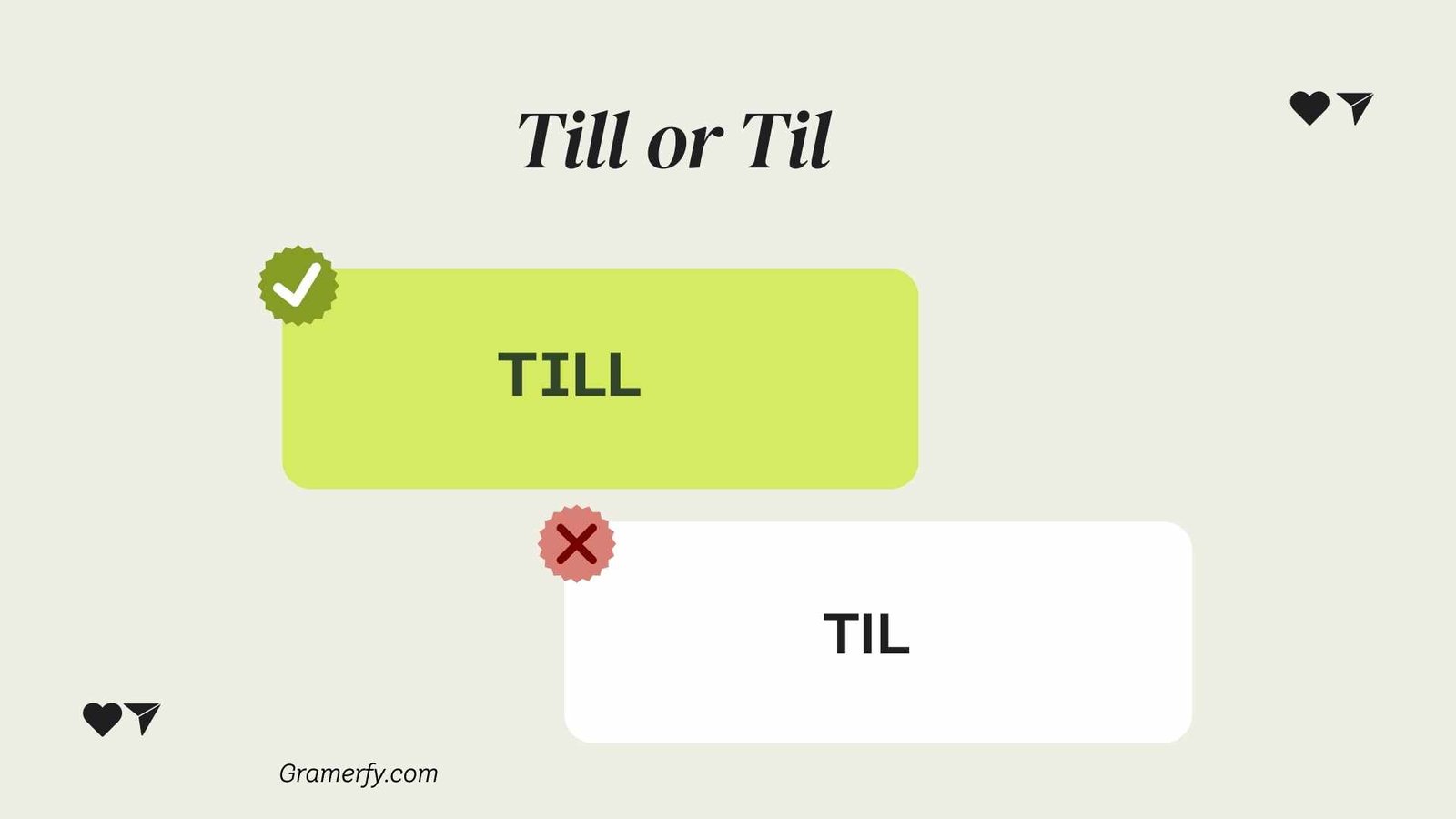
Have you ever paused mid-text and wondered whether it’s “till” or “til”? You’re not alone this tiny, seemingly simple word causes big confusion.
Despite its short length, the difference between “till” and “til” sparks debates among writers, students, and casual texters alike. Understanding it isn’t just about grammar; it’s about clarity, precision, and avoiding those awkward “wait, did I spell that right?” moments.
Surprisingly, “till” is the older, historically correct form, while “til” emerged as a modern shortcut popularized in casual writing and social media. Choosing the right version can subtly change your sentence’s tone, making it feel formal, relaxed, or downright trendy.
What Does “Till” Mean?
“Till” is a preposition and conjunction that means “up to the time of” or “before”. It is widely accepted in both formal and informal English.
Key points about “till”:
- It shows time up to a certain point.
- It is not a typo; “till” is the original word and older than “until.”
- Can be used in formal writing.
Examples:
- I will wait here till you return.
- She worked till midnight.
- Stay in the room till the teacher arrives.
Notice that “till” works perfectly in both speech and writing, making it versatile and correct.
What Does “Til” Mean?
“Til” is an informal shortening of “until.” It is often used in casual writing, such as text messages, social media, or song lyrics.
Key points about “til”:
- It is not standard in formal writing.
- Often seen in headlines, social posts, or creative contexts.
- Some people mistakenly write “til” without the apostrophe, but the technically correct form is ’til (with an apostrophe), as it is a contraction of until.
Examples:
- I’ll be home ’til 6 PM.
- Don’t leave ’til the movie ends.
- The sale is valid ’til tomorrow.
Till vs Til: Key Differences
| Feature | Till | Til / ’Til |
| Meaning | Up to the time of | Up to the time of (informal) |
| Formality | Formal and informal | Informal only |
| Correctness | Standard English | Non-standard; best in casual use |
| Usage | Written & spoken | Mostly casual writing |
| Relation to “until” | Synonym | Shortened form of “until” |
| Example | I waited till 5 PM. | I waited ’til 5 PM. |
Tip: If you are writing professionally, academic papers, or emails, always use till. Only use ’til for casual or creative writing.
Common Mistakes with Till and Til
- Spelling errors:
- ❌ I will wait til you return. (acceptable informally but not in formal writing)
- ✅ I will wait till you return. (preferred)
- ❌ I will wait til you return. (acceptable informally but not in formal writing)
- Confusing with “to”:
- ❌ Wait to 5 PM.
- ✅ Wait till 5 PM.
- ❌ Wait to 5 PM.
- Forgetting the apostrophe:
- ❌ I won’t leave til tomorrow.
- ✅ I won’t leave ’til tomorrow. (if using the informal form)
- ❌ I won’t leave til tomorrow.
- Using “til” in formal contexts:
- ❌ The project will continue til next week.
- ✅ The project will continue till next week.
- ❌ The project will continue til next week.
Tip: Think of “till” as the safest choice; it is correct in all contexts.
Spelling Tips
- Till is always spelled t-i-l-l.
- ’Til is spelled with an apostrophe because it replaces “un” in “until.”
- Remember: till ≠ til in formal writing.
Mnemonic:
- “Till” has two Ls → long-lasting correctness.
- “’Til” → casual, shortened form → like texting shorthand.
Multiple Examples in Sentences
Using Till:
- We have to wait till the rain stops.
- The store is open till 10 PM.
- Don’t speak till the teacher finishes explaining.
Using ’Til:
- I’m staying here ’til you come back.
- The concert goes on ’til midnight.
- Keep the lights on ’til I return.
Mixed Usage:
- Formal: Please wait till the meeting ends.
- Informal: I’ll hang out ’til you’re ready.
FAQs (People Also Ask)
Q1: Can I use “til” instead of “till”?
- Yes, in informal writing only. In formal writing, always use till.
Q2: Is “till” a typo for “until”?
- No, “till” is older than “until” and is completely correct.
Q3: Should I use an apostrophe with “til”?
- Technically, yes. The correct informal form is ’til because it’s a contraction of until.
Q4: Which is more common, “till” or “’til”?
- Till is more widely accepted and correct in all contexts. ’Til is mostly seen in casual writing.
Q5: Can I use “till” in professional emails?
- Absolutely. Till is safe, professional, and grammatically correct.
Conclusion
In the end, understanding the difference between “till” and “’til” is simpler than it seems. “Till” is the original, grammatically correct word used in formal writing, while “’til” is a modern contraction, often seen in casual texts, song lyrics, or social media posts.
Both convey the same meaning up to a certain time but choosing the right form depends on your audience and context. By knowing this small but important distinction, you can write with confidence, avoid common errors, and make your sentences clearer. Whether formal or informal, the choice is yours but clarity should always come first.