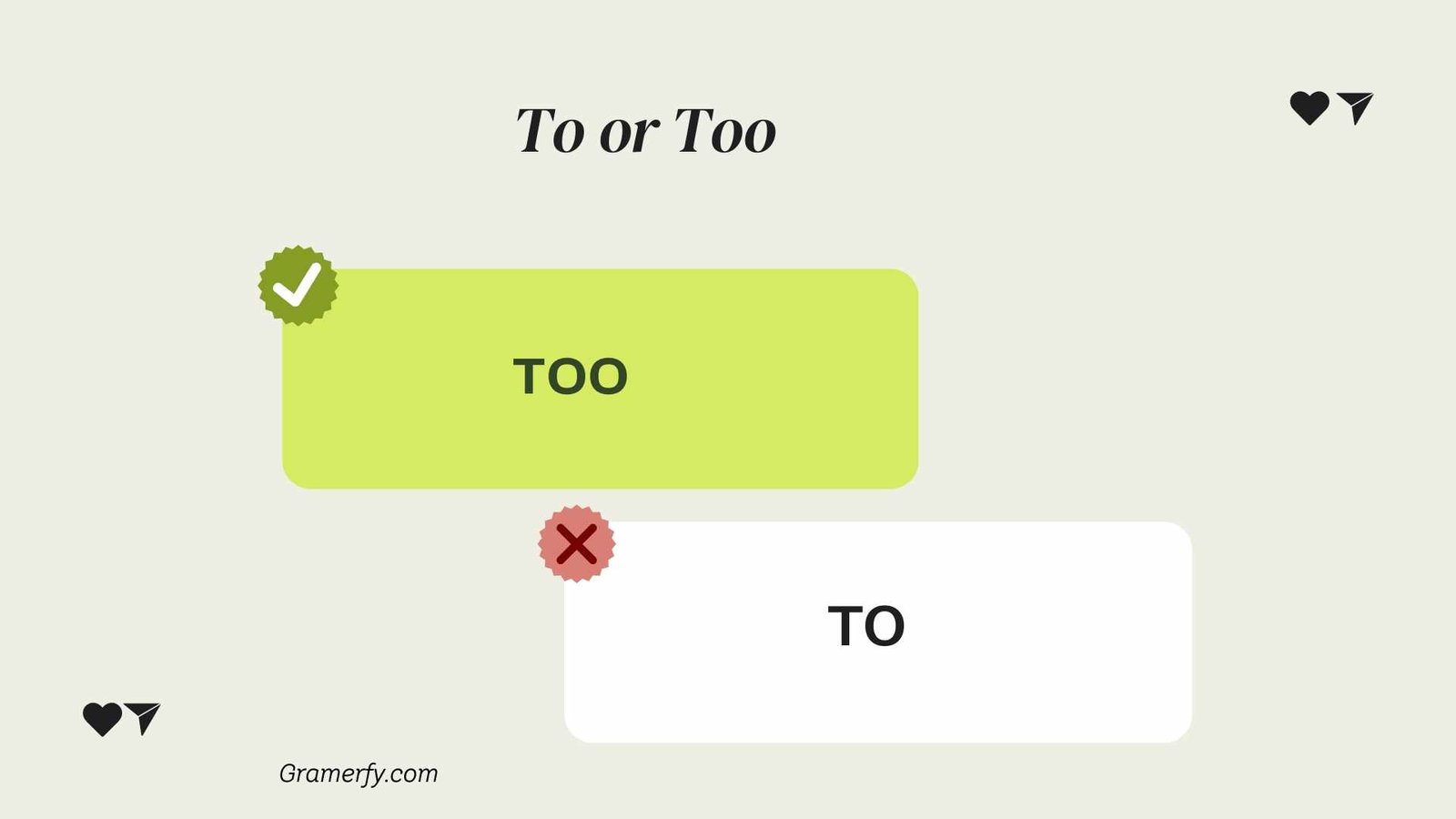
English can be tricky, and few words confuse learners as much as “to” and “too.” At first glance, they look almost identical, yet their meanings couldn’t be more different.
One tiny letter changes everything! “To” guides us, points us somewhere, or shows direction, while “too” signals excess, addition, or agreement.
Imagine sending a message saying, “I love you to,” instead of “I love you too” a simple mix-up, but it changes the whole meaning! This small pair of words has the power to turn clarity into chaos and make even native speakers pause.
Meaning and Usage of “To”
What Is “To”?
“To” is a versatile word in English. It can serve as:
- A preposition – showing direction, place, or position.
- Part of an infinitive verb – used before the base form of a verb.
Usage of “To” as a Preposition
When used as a preposition, “to” often indicates:
- Direction or movement
- Example: I am going to the park.
- Example: I am going to the park.
- Recipient or target
- Example: She gave the book to her friend.
- Example: She gave the book to her friend.
- Comparison or relation
- Example: I prefer coffee to tea.
- Example: I prefer coffee to tea.
Usage of “To” in Infinitives
“To” is used before the base form of a verb to make an infinitive. Infinitives often express purpose, intention, or action.
- Example: I want to learn English.
- Example: He needs to finish his homework.
- Example: She plans to travel next year.
Meaning and Usage of “Too”
What Is “Too”?
“Too” is an adverb. It is used to indicate:
- Excessiveness – something more than necessary.
- Addition – meaning “also” or “as well.”
Usage of “Too” for Excessiveness
“Too” shows that something is beyond a limit or degree.
- Example: The soup is too hot to eat.
- Example: He drives too fast.
- Example: This bag is too heavy for me.
Usage of “Too” to Mean “Also”
“Too” can also mean “also” or “in addition.”
- Example: I want to come too.
- Example: She likes ice cream, and I like it too.
- Example: He is joining the party, and his sister is coming too.
Comparison of “To” and “Too”
It’s helpful to see the differences in a table for quick understanding:
| Word | Part of Speech | Meaning | Example |
| To | Preposition / infinitive marker | Direction, recipient, infinitive verb | I am going to the store. |
| Too | Adverb | Excessive, also/too | This shirt is too small. / I want to come too. |
Common Mistakes with “To” and “Too”
Even experienced writers often confuse “to” and “too.” Here are some common errors and how to fix them:
Mistake 1: Using “to” instead of “too” for excessiveness
- ❌ This cake is to sweet.
- ✅ This cake is too sweet.
Tip: If it shows “more than necessary,” it’s too, never to.
Mistake 2: Using “too” instead of “to” for direction or purpose
- ❌ I am going too school.
- ✅ I am going to school.
Tip: If it indicates movement, direction, or infinitive, use to.
Mistake 3: Omitting “too” for “also”
- ❌ I want ice cream. (if adding to a previous statement)
- ✅ I want ice cream too.
Tip: Remember, too at the end of a sentence often means “also.”
Spelling Tips
- “To” has only two letters – simple and short, often part of movement or infinitive verbs.
- “Too” has double “o” – remember it means more than needed or also.
Memory trick:
- If it means “excessive” or “also,” think of double “o” for extra.
Examples of “To” in Sentences
- I am going to the market.
- She gave the keys to her brother.
- We need to talk about your homework.
- He wants to become a doctor.
- Please send this letter to my teacher.
Examples of “Too” in Sentences
- The coffee is too hot to drink.
- She is too tired to continue.
- I want to go to the party too.*
- This box is too heavy for me to lift.
- He likes chocolate, and I like it too.*
Quick Rules to Remember
- Use “to” for direction, recipient, or infinitive verbs.
- Use “too” for excessiveness or to mean “also.”
- If it makes sense to replace it with “also,” it’s too.
- If it shows movement, direction, or action, it’s to.
FAQs About “To” and “Too”
1. Can I use “too” at the beginning of a sentence?
Yes! For example: “Too many people arrived late.” Here it shows excessiveness.
2. Is “to” ever used alone without a verb?
Yes. For example: “I am going to the park.” Here to is a preposition, not part of an infinitive.
3. How do I remember the difference?
Think:
- To → movement, direction, infinitive
- Too → excessiveness, also
4. Can “too” be used before adjectives?
Yes. Example: “The bag is too heavy.” It shows too much of the adjective.
5. Is it okay to write “to” instead of “too” in casual writing?
No. In formal or proper writing, always use the correct form to avoid confusion.
Fun Tips to Avoid Confusion
- “Too” has two O’s → extra → excessive
- “To” is short → simple movement/direction
- Read your sentence aloud: If it means “also” or “more than needed,” it should sound like too.
Practice Exercise
Fill in the blanks with to or too:
- I want ___ go home.
- This bag is ___ heavy for me.
- She gave the gift ___ her friend.
- I would like to come ___.
- He is driving ___ fast.
Answers: 1. to | 2. too | 3. to | 4. too | 5. too
Conclusion
Understanding the difference between “to” and “too” is all about context. “To” usually shows direction, purpose, or connection, like “I am going to the store” or “Give this to her.” On the other hand, “too” means “also” or “excessively,” as in “I want to come too” or “This bag is too heavy.”
Mixing them up can change the meaning of your sentence entirely, but with practice, it becomes second nature. Paying attention to how each word functions in a sentence ensures clarity and precision. Mastering this small distinction makes your writing cleaner, smarter, and more professional.