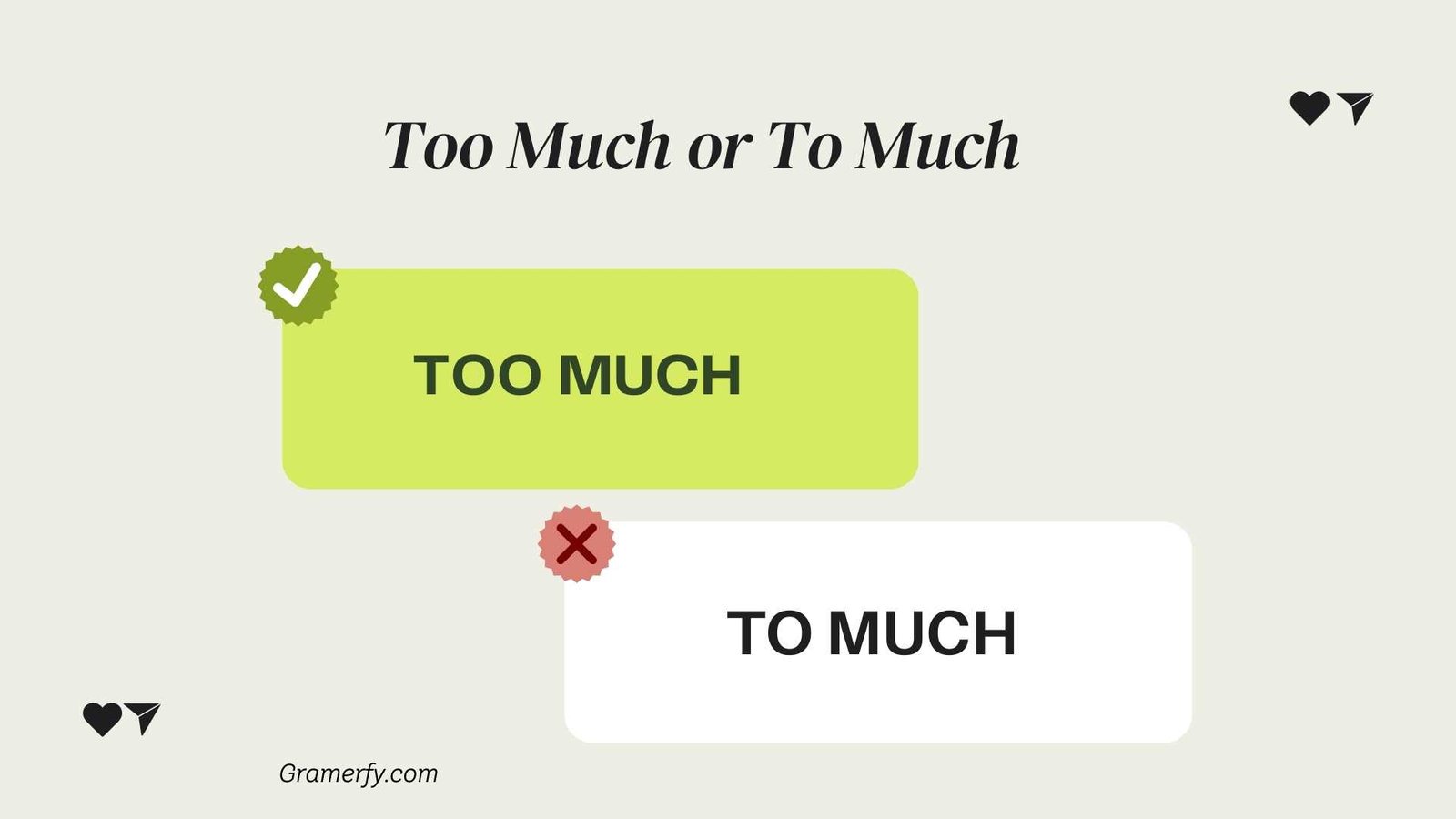
When it comes to mastering English, even small words can make a huge difference, and “Too Much or To Much” is one of those tricky pairs that often confuses writers and speakers alike.
People constantly stumble over when to use “too” versus “to”, and this tiny slip can completely change the meaning of a sentence. Imagine writing “I ate to much” instead of “I ate too much” it may seem minor, but it instantly affects your clarity and credibility.
Understanding this distinction not only polishes your writing but also boosts your confidence in communication, whether in emails, essays, or casual chats.
What Does “Too Much” Mean?
Definition of “Too Much”
Too much means more than needed, more than enough, or more than what is acceptable.
It is used when something is excessive.
Simple Meaning
Too much = more than necessary
Examples
- I ate too much food.
- She spends too much money.
- There is too much noise here.
- You are working too much these days.
In all these sentences, “too much” shows excess.
Is “To Much” Ever Correct?
Short Answer: No (Almost Never)
“To much” is grammatically incorrect in modern English.
Why?
Because:
- “To” is a preposition or part of an infinitive (to eat, to go).
- “Much” needs words like too, so, very, how before it.
❌ To much does not form a correct grammar structure.
Incorrect Examples
- ❌ I drank to much water.
- ❌ He talks to much.
- ❌ This bag is to much heavy.
Correct Versions
- ✅ I drank too much water.
- ✅ He talks too much.
- ✅ This bag is too much heavy. (better: “too heavy”)
Understanding the Words: “Too,” “To,” and “Much”
Before we go further, let’s understand these words separately.
What Does “Too” Mean?
Too has three main meanings:
- More than needed
- This coffee is too hot.
- This coffee is too hot.
- Also / as well
- I want to come too.
- I want to come too.
- Excessively
- You are too tired.
- You are too tired.
In “too much,” it means excessively.
What Does “To” Mean?
To is used:
- Before a verb
- I want to eat.
- I want to eat.
- To show direction
- Go to school.
- Go to school.
- To show purpose
- This gift is to help you.
- This gift is to help you.
“To” does NOT show excess.
What Does “Much” Mean?
Much means a large amount and is usually used with uncountable nouns.
Examples:
- much water
- much money
- much time
But “much” alone often sounds incomplete. That’s why we say:
- too much
- so much
- very much
- how much
Why “Too Much” Is Correct and “To Much” Is Wrong
Grammar Rule Explained Simply
- Too = excess
- Much = large amount
- Too + Much = excess amount
But:
- To does NOT mean excess
- To + Much has no grammar meaning
That’s why “to much” is incorrect.
Comparison Table: Too Much vs To Much
| Feature | Too Much | To Much |
| Grammatically correct | ✅ Yes | ❌ No |
| Meaning | Excess amount | No meaning |
| Common usage | Very common | Common mistake |
| Used in formal writing | ✅ Yes | ❌ No |
| SEO-friendly phrase | ✅ Yes | ❌ No |
How to Use “Too Much” Correctly
1. With Uncountable Nouns
Use too much before uncountable nouns.
Examples:
- too much water
- too much sugar
- too much noise
- too much stress
Sentences:
- There is too much sugar in this tea.
- We have too much work today.
2. At the End of a Sentence
You can also place too much at the end.
Examples:
- He talks too much.
- She complains too much.
- You worry too much.
3. In Negative Situations
“Too much” often shows a problem or complaint.
Examples:
- This room has too much heat.
- He has too much anger.
- There’s too much traffic.
4. With Verbs
You can use too much to modify verbs.
Examples:
- Don’t eat too much.
- He sleeps too much.
- She spends too much.
“Too Much” vs “Too Many”
Many learners also confuse too much and too many.
Basic Rule
- Too much → uncountable nouns
- Too many → countable nouns
Examples
| Correct Usage | Example |
| Too much water | Uncountable |
| Too much money | Uncountable |
| Too many people | Countable |
| Too many mistakes | Countable |
Common Mistakes with “Too Much”
Mistake 1: Writing “To Much”
❌ I ate to much cake.
✅ I ate too much cake.
Mistake 2: Using “Too Much” with Countable Nouns
❌ Too much apples
✅ Too many apples
Mistake 3: Overusing “Too Much” in Formal Writing
Sometimes “too much” sounds emotional. In formal writing, alternatives may be better.
Example:
- Informal: He talks too much.
- Formal: He speaks excessively.
Spelling Tips to Remember “Too Much”
Easy Memory Trick
👉 Too has two O’s because it means “extra.”
- Extra letters = extra meaning
- Too much = excess
Quick Test
Ask yourself:
“Does this sentence show excess?”
If yes → use too, not to.
Real-Life Examples of “Too Much”
Everyday English
- I drank too much coffee.
- This bag is too much heavy.
- You are thinking too much.
At School
- There is too much homework today.
- The teacher gives too much pressure.
At Work
- He works too much.
- We spent too much time on this project.
In Relationships
- She worries too much.
- He expects too much from others.
“Too Much” in Questions
Examples:
- Is it too much to ask?
- Did I talk too much?
- Are you working too much?
“Too Much” in Negative Sentences
Examples:
- I don’t eat too much sugar.
- She doesn’t spend too much money.
- We shouldn’t talk too much.
Synonyms of “Too Much”
To avoid repetition, you can use:
- Excessive
- Overly
- More than necessary
- An excessive amount
Examples:
- He shows excessive anger.
- She is overly emotional.
FAQs: People Also Ask About “Too Much or To Much”
Is “to much” ever correct?
No. “To much” is grammatically incorrect in standard English.
Why do people write “to much” instead of “too much”?
Because:
- They sound similar
- English spelling is confusing
- Learners confuse to and too
Is “too much” formal or informal?
It is neutral and acceptable in both spoken and written English.
Can “too much” be positive?
Sometimes, but usually it has a negative meaning.
Example:
- I love you too much. (emotional, not negative)
Is “too much” one word or two?
It is two separate words:
- ❌ toomuch
- ❌ to much
- ✅ too much
How do I stop making this mistake?
- Remember: too = extra
- Practice with examples
- Read your sentence aloud
Final Summary:
Understanding the difference between “too much” and “to much” may seem small, but it makes a huge difference in clear communication. “Too much” indicates excess, while “to much” is simply incorrect in most cases.
By paying attention to this simple distinction, you can avoid embarrassing mistakes, write with confidence, and convey your message effectively. Practicing examples, reading carefully, and remembering the rules ensures that your English is polished and professional. Mastering this tiny but crucial detail shows your command of the language and keeps your writing sharp, clear, and mistake-free every time.