When it comes to exploring the great outdoors or even just discussing adventures, many people get confused between Treck and Trek. Are they the same, or is there a subtle difference that could change the meaning entirely?
This simple confusion can leave readers scratching their heads, especially when planning a hiking trip, reading adventure stories, or even writing about journeys.
Understanding the distinction is not just about grammar it’s about clarity, precision, and making your communication more effective.
Meaning of “Trek”
Definition
Trek is a noun and a verb in English. It generally refers to:
- A long and difficult journey, usually on foot.
- To travel slowly or with effort.
Examples as a noun:
- Our trek through the mountains took three days.
- The trek to the village was exhausting but beautiful.
Examples as a verb:
- We decided to trek across the forest.
- They trekked for hours before finding a resting spot.
Origin
The word “trek” comes from Afrikaans, a language spoken in South Africa. It originally meant to travel or migrate slowly, often by ox-drawn wagons. Over time, it entered English with the meaning of a long, challenging journey.
Meaning of “Treck”
Definition
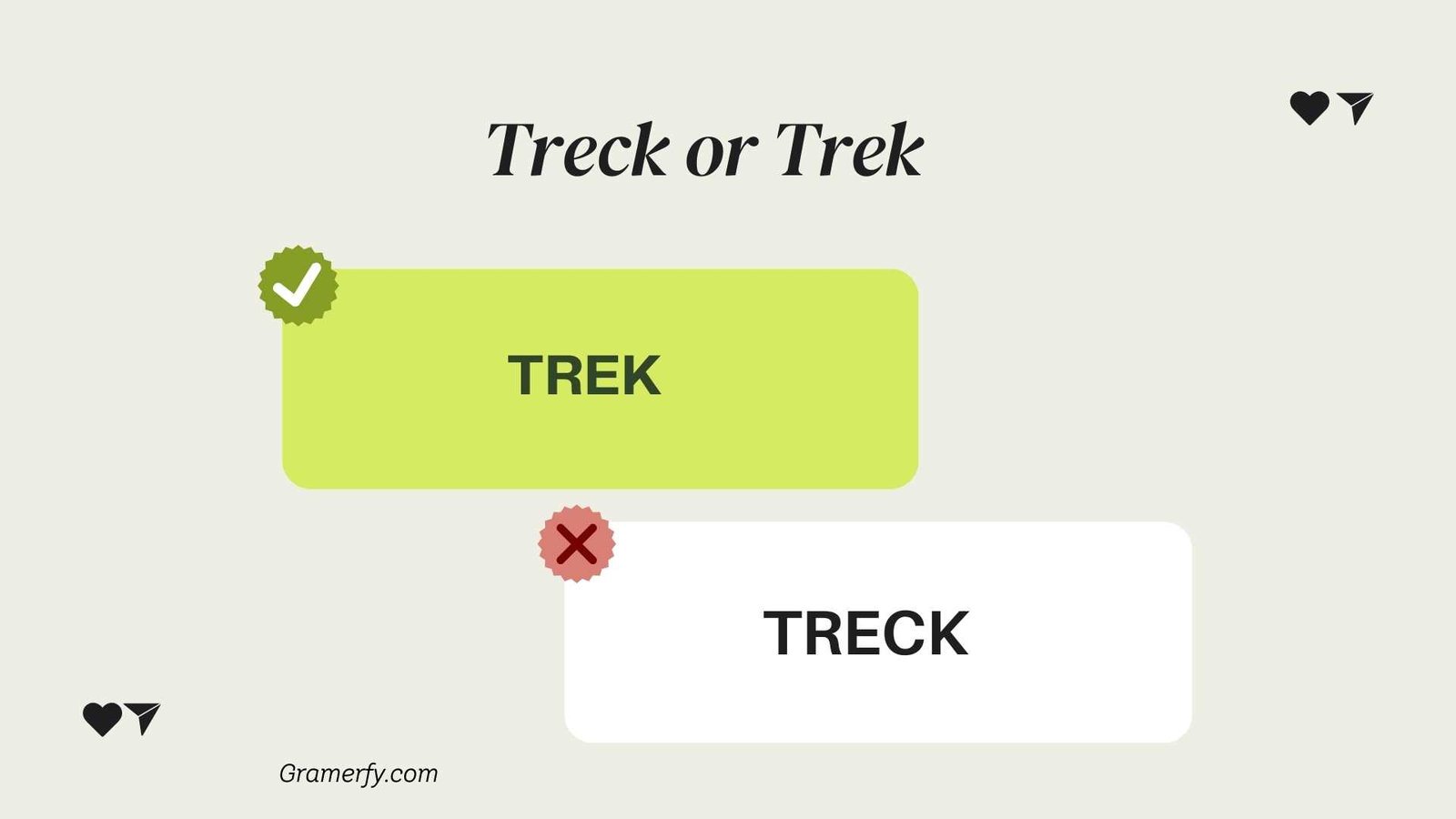
Treck is not a standard English word. It is often a misspelling of “trek.” You will rarely see “treck” in dictionaries or formal writing.
Common Usage
- Most instances of “treck” are typing errors.
- Using “treck” in professional writing or school assignments is considered incorrect.
Incorrect Example:
- We went on a treck through the forest. ❌
Corrected Version: - We went on a trek through the forest. ✅
Trek vs Treck: Comparison Table
| Feature | Trek | Treck |
| Meaning | A long, difficult journey or hike | Incorrect spelling of “trek” |
| Word Type | Noun & Verb | None (misspelling) |
| Usage | Standard, formal & informal English | Nonstandard, incorrect |
| Example (Noun) | The trek was tiring but rewarding. | The treck was tiring but rewarding. ❌ |
| Example (Verb) | We trekked through the forest. | We trecked through the forest. ❌ |
Correct Usage of “Trek”
As a Noun
- Travel context:
We enjoyed a trek in the Himalayas last summer. - Metaphorical context:
Completing the project felt like a trek through a challenging path.
As a Verb
- Present tense: We trek every weekend for fun and exercise.
- Past tense: Last month, they trekked across the desert.
- Future tense: We will trek to the top of the hill tomorrow.
Common Mistakes with “Trek”
- Spelling errors: Writing “treck” instead of “trek.”
- Incorrect: He went on a treck last weekend. ❌
- Correct: He went on a trek last weekend. ✅
- Incorrect: He went on a treck last weekend. ❌
- Using “trek” for short or easy walks:
- A casual walk in the park is not a trek.
- Trek implies distance, effort, or challenge.
- A casual walk in the park is not a trek.
- Verb confusion:
- Incorrect: We treck to the village. ❌
- Correct: We trekked to the village. ✅
- Incorrect: We treck to the village. ❌
Spelling Tips
- Remember the word comes from Afrikaans → one “c” is not needed.
- Always spell it as T-R-E-K for both noun and verb forms.
- When in doubt, ask: Am I talking about a long, challenging journey? If yes, use trek.
Examples in Sentences
Noun
- The trek to Everest Base Camp was life-changing.
- She completed a five-day trek across the national park.
Verb
- They trekked through dense forests and rivers.
- We will trek to the remote village next month.
Common Mistake Examples
- ❌ He went on a treck through the mountains.
- ✅ He went on a trek through the mountains.
FAQs (People Also Ask)
1. Is “treck” correct English?
No, treck is a misspelling. Always use trek in formal or informal writing.
2. Can “trek” be used for short walks?
Not usually. A trek implies a long, challenging journey. Short walks are just walks or strolls.
3. What is the past tense of trek?
The past tense of trek is trekked.
- Example: We trekked through the jungle last summer.
4. Can “trek” be used metaphorically?
Yes! Trek can describe any challenging process.
- Example: Completing the marathon was a trek in itself.
5. How do I remember the correct spelling?
Think of Trek like the Star Trek series—just TREK, never “treck.”
Tips for Using “Trek” Correctly
- Use trek for formal, informal, or creative writing.
- Avoid treck, as it is incorrect.
- Make sure the journey is long or challenging to justify using trek.
- Use trek both as a noun and verb confidently.
Conclusion
To sum it up, the only correct word in English is trek. Treck is a common spelling mistake. Remember: Using trek correctly will make your writing accurate, professional, and easier to read. Avoid treck in all contexts it is simply wrong.
Whether you’re writing a school assignment, travel blog, or a casual story, trek is your go-to word for describing journeys, hikes, and adventures.