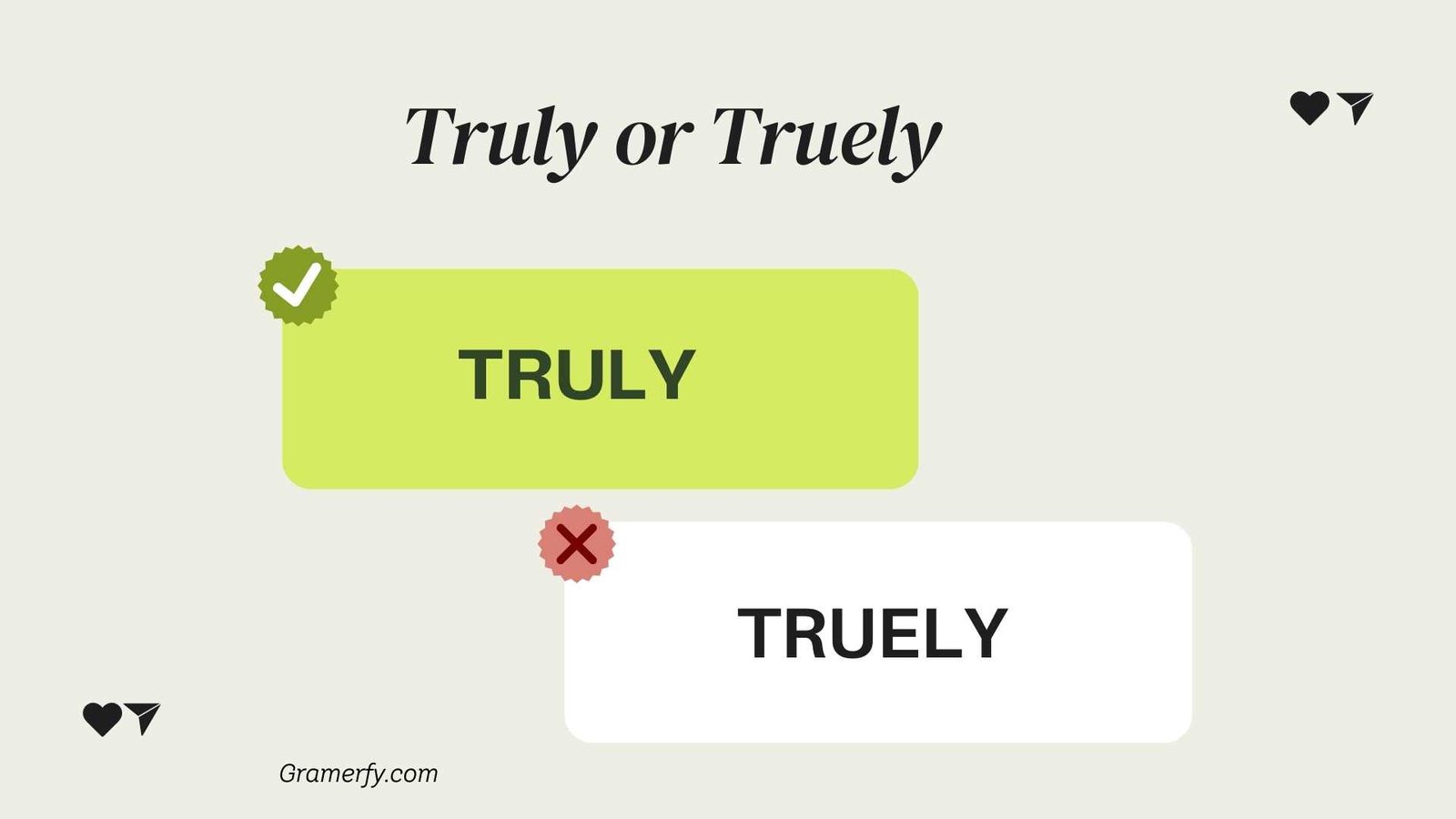
When it comes to spelling, clarity matters most, and understanding the difference between “truly” and “truely” is essential. People often get confused, but “truly” is the correct and widely accepted spelling in English.
Mistakes like “truely” can make writing appear careless or less professional. Writers and students should always double-check such words to maintain credibility.
In formal documents, using the correct spelling ensures that your message is taken seriously. Language evolves, yet standard spellings remain important for clear communication. .
Meaning and Correct Usage
Truly
Truly is an adverb that means:
- In a truthful or sincere way
- Really or genuinely
- Completely or absolutely
Examples:
- I truly appreciate your help.
- She is a truly talented singer.
- This is truly the best day of my life.
Key Points:
- Always spelled as truly.
- Can be used to emphasize sincerity, truth, or genuineness.
Truely
The word truely is incorrect in standard English.
- It is a common misspelling of truly.
- Avoid using it in formal writing, professional emails, essays, or publications.
Incorrect Examples:
- I truely love chocolate. ❌
- She is a truely amazing friend. ❌
Tip: Whenever you feel like writing “truely,” double-check and replace it with truly.
Truly vs Truely: Quick Comparison Table
| Aspect | Truly (✅ Correct) | Truely (❌ Incorrect) |
| Meaning | Really, sincerely, genuinely | None (misspelling of truly) |
| Usage | Formal and informal writing | Should be avoided entirely |
| Example Sentence | I truly care about you. | I truely care about you. ❌ |
| Accepted by Grammar | Yes | No |
Common Mistakes & Spelling Tips
Even native speakers sometimes write truely by mistake. Here’s how to avoid it:
1. Remember the Rule of “-ly”
- Many adverbs are formed by adding -ly to adjectives.
- The adjective true becomes the adverb truly.
- There is no “e” in the adverb form.
Mnemonic: “True + ly = truly, no extra e.”
2. Proofread Your Writing
- Use spell checkers.
- Read sentences aloud to spot mistakes.
3. Common Tricky Sentences
- Incorrect: I truely think he is honest. ❌
- Correct: I truly think he is honest. ✅
- Incorrect: She is truely happy with her work. ❌
- Correct: She is truly happy with her work. ✅
Multiple Examples of Correct Usage
Here are some real-life examples to help you remember:
- I truly admire your dedication.
- He spoke truly from the heart.
- This story is truly inspiring.
- We truly believe in your abilities.
- She is truly one of a kind.
Pro Tip: Replace “truely” with “truly” every time you see it in your writing.
Frequently Asked Questions (FAQs)
1. Is “truely” ever correct?
No. Truely is always incorrect in standard English. Always use truly.
2. Can I use “truly” in formal writing?
Yes. Truly is suitable for formal and informal writing. It emphasizes sincerity and truth.
3. What is the difference between “truly” and “really”?
- Truly emphasizes truth or sincerity.
- Really can mean “actually” or “very” in informal situations.
Example:
- I truly care about you. (Sincere)
- I am really tired. (Emphasis on feeling)
4. Are there any synonyms for “truly”?
Yes, some common synonyms include:
- Genuinely
- Honestly
- Sincerely
- Absolutely
5. How can I remember the correct spelling?
Think: “True + ly = truly”, no extra letters. This is the simplest and most reliable trick.
Conclusion
In English, truly is the only correct form. Truely is a common misspelling that should always be avoided. By remembering the simple rule “true + ly = truly”, you can write confidently in both formal and informal contexts.
Using truly correctly not only improves your writing but also makes your communication more professional, sincere, and understandable. With practice, spotting and correcting this mistake becomes second nature.