Choosing the right approach for tying or tieing can make a huge difference in everyday tasks, from securing packages to mastering intricate knots for crafts or outdoor adventures.
Many people get confused by the spelling, but understanding the correct usage can boost clarity in writing and communication.
Beyond language, the concept itself is surprisingly practical and versatile, touching everything from fashion and shoelaces to boating and climbing. Learning proper techniques saves time, prevents accidents, and even adds a touch of skill to simple chores.
Understanding the Base Word: “Tie”
Before we compare tying and tieing, it is important to understand the base word tie.
Meaning of “Tie”
The word tie can function as both a verb and a noun.
As a verb
Tie means:
- To fasten or secure something using a knot
- To attach things together
Examples:
- Please tie your shoes properly.
- He tied the rope around the box.
As a noun
Tie refers to:
- A knot or fastening
- A piece of clothing worn around the neck
- A situation where competitors have equal scores
Examples:
- He wore a blue tie to the meeting.
- The game ended in a tie.
What Does “Tying” Mean?
Definition of “Tying”
Tying is the present participle and gerund form of the verb tie.
It is used when talking about an action that is happening now or a general action.
Examples of “Tying” in Sentences
- She is tying her hair into a bun.
- He hurt his fingers while tying the knot.
- Tying shoelaces is easy once you learn.
In all these sentences, tying describes the ongoing action of securing or fastening something.
Is “Tieing” a Correct Word?
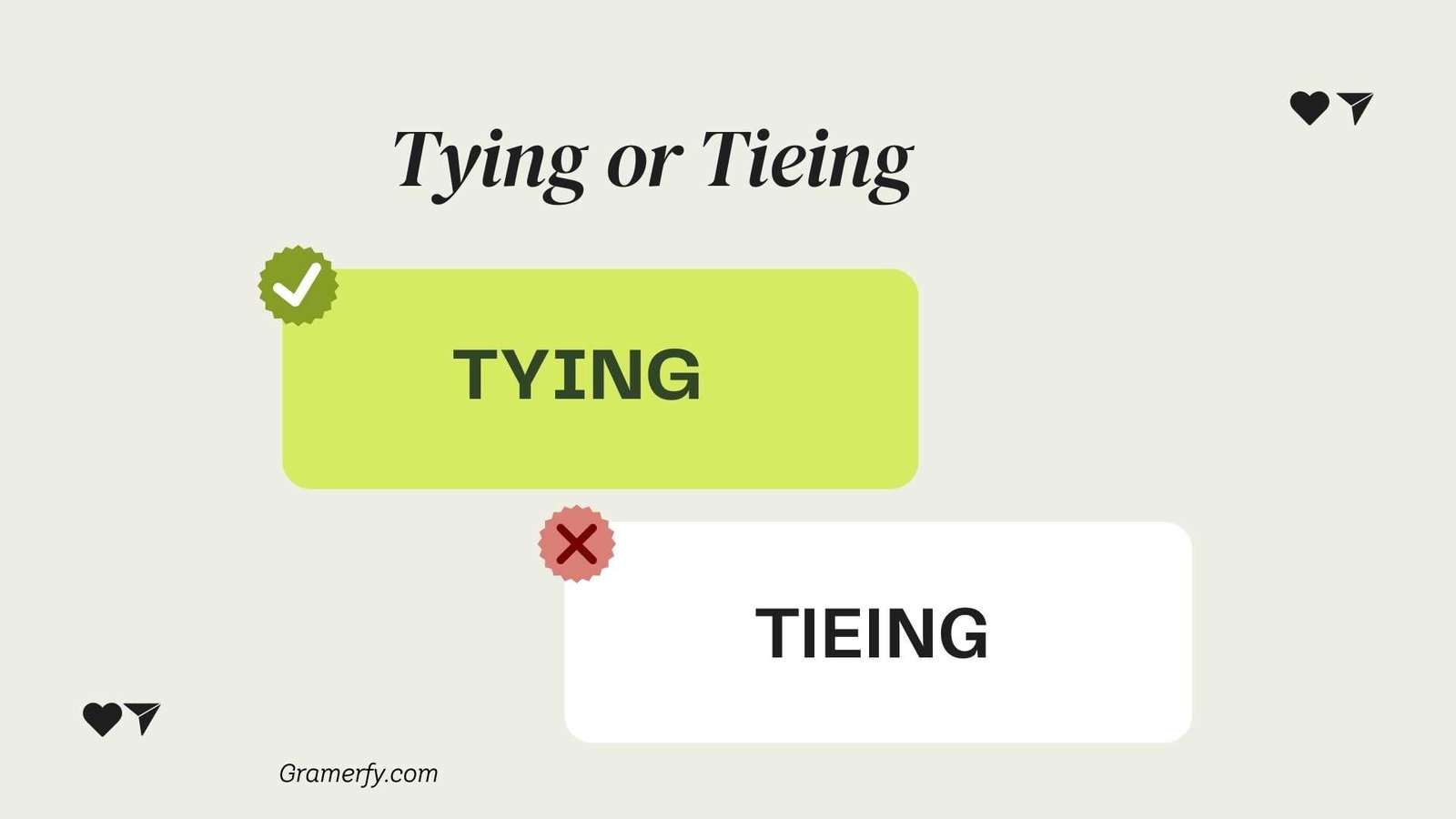
Short Answer: No
Tieing is incorrect.
It is not accepted in standard English grammar or dictionaries.
Even though tieing may look logical, English spelling rules do not allow it.
Why Do People Write “Tieing”?
People often write tieing because they:
- Add -ing directly to tie without changing spelling
- Do not know the silent E-dropping rule
- Assume all verbs simply add -ing
This is a very common learner mistake.
The Grammar Rule Behind “Tying”
The Silent “E” Rule
In English, when a verb ends in a silent E, and you add -ing, you drop the E.
Formula
Verb + silent E → drop E + ing
Examples of This Rule
- Make → Making
- Write → Writing
- Drive → Driving
- Use → Using
- Tie → Tying
This rule explains exactly why tying is correct and tieing is wrong.
Tying vs Tieing: A Clear Comparison
| Feature | Tying | Tieing |
| Correct spelling | ✅ Yes | ❌ No |
| Accepted in dictionaries | ✅ Yes | ❌ No |
| Follows grammar rules | ✅ Yes | ❌ No |
| Used in real English | ✅ Always | ❌ Never |
| Based on verb “tie” | ✅ Correct form | ❌ Incorrect form |
Conclusion from comparison:
👉 Always use tying.
Examples of “Tying” in Different Contexts
Everyday Life Examples
- I am tying my shoes before going out.
- She is tying the ribbon carefully.
Work and Professional Examples
- He is tying the documents together.
- The technician is tying the cables neatly.
Emotional or Figurative Use
- The story is tying all ideas together.
- This event is tying the community closer.
Sports and Games
- He is tying his opponent’s score.
- The referee discussed the rules for tying matches.
Common Mistakes People Make
Mistake 1: Writing “Tieing”
❌ She is tieing her shoes.
✅ She is tying her shoes.
Mistake 2: Overthinking the Spelling
Some writers hesitate because dying keeps the “Y,” so they think tie should keep the “E.”
But the rules are different.
- Die → Dying (change IE to Y)
- Tie → Tying (drop silent E)
Mistake 3: Spell-Check Dependence
Spell-check tools may not always catch errors in casual writing. Always learn the rule instead of relying fully on tools.
Tying vs Similar Verbs: Understanding Patterns
Learning patterns helps avoid mistakes.
Verbs Ending in Silent E
- Tie → Tying
- Make → Making
- Ride → Riding
- Hope → Hoping
Verbs Ending in IE
These verbs change IE to Y before adding -ing.
- Die → Dying
- Lie → Lying
- Vie → Vying
This is why tying looks similar to dying but follows a slightly different rule.
Easy Tips to Remember the Correct Spelling
Tip 1: Remember “Drop the E”
If the verb ends with a silent E, drop it before adding -ing.
Tip 2: Think of “Making”
If you can remember make → making, then tie → tying becomes easy.
Tip 3: Say It Aloud
You never pronounce an “E” sound in tying, which is another clue that tieing is wrong.
Is “Tying” a Noun or Verb?
Tying can act as both:
As a Verb (Present Participle)
- She is tying the rope.
As a Noun (Gerund)
- Tying knots requires practice.
Both uses are correct and common.
British vs American English: Any Difference?
No difference at all.
- American English: tying
- British English: tying
The spelling tieing is incorrect in all forms of English.
FAQs:
Is tying or tieing correct?
Tying is correct. Tieing is incorrect.
Why is tieing wrong?
Because English grammar requires dropping the silent “E” before adding -ing.
Is tieing ever acceptable?
No. It is not accepted in standard English.
What tense is “tying”?
It is the present participle or gerund form of tie.
Does tying follow the same rule as dying?
They look similar, but tie drops the silent E, while die changes IE to Y.
Can tying be used in formal writing?
Yes, it is perfectly correct in both formal and informal writing.
How do I stop spelling it wrong?
Remember: Drop the E, add ING.
Why Correct Spelling Matters
Using the wrong spelling like tieing can:
- Reduce writing quality
- Confuse readers
- Affect SEO and professionalism
- Make content look unpolished
Correct spelling builds trust and clarity.
Final Thoughts
In conclusion, understanding the correct spelling and usage of tying versus tieing is essential for clear and professional communication. The correct form, tying, is derived from the verb “to tie” and is widely accepted in modern English, while tieing is considered a common misspelling. Whether you are writing formally, crafting instructions, or even texting, using tying ensures your message is grammatically accurate and avoids confusion.
Beyond spelling, knowing how to apply tying in context whether referring to securing objects, forming knots, or metaphorically linking ideas adds clarity and precision to your writing. By paying attention to such subtle distinctions, writers can demonstrate attention to detail and linguistic competence.