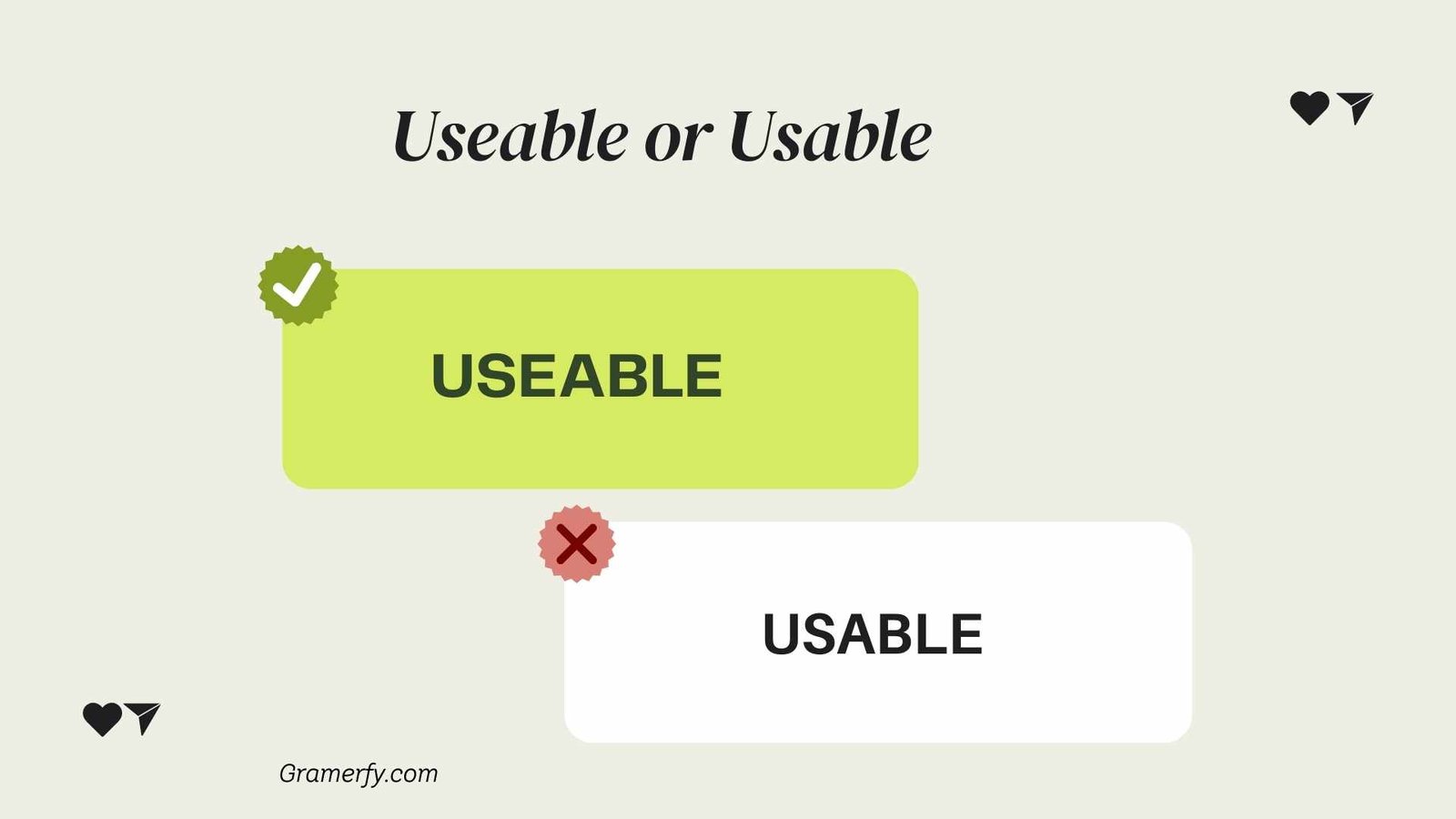
If you’ve ever paused mid-sentence wondering whether to write “useable” or “usable,” you’re not alone. This tiny spelling difference confuses students, bloggers, business owners, and even seasoned writers.
One extra letter can make you question your grammar skills. However, here’s the good news: the answer is simpler than you think.In today’s fast-moving digital world, correct spelling matters more than ever.
A single word can shape your credibility, boost your SEO rankings, and influence how professional your content looks. For example, choosing the wrong spelling in a blog post or website copy might quietly hurt your authority.
What Does “Usable” Mean?
Definition of Usable
Usable is an adjective that means:
Able to be used; fit or suitable for use.
If something is usable, it works properly and can be used for its intended purpose.
Simple Explanation
Think of usable as something that is not broken, not damaged, and practical enough to be used.
Examples of Usable in Sentences
- This phone is old, but it is still usable.
- The software is simple and usable for beginners.
- Only half of the data was usable.
- The classroom furniture is worn out but still usable.
- Make sure the document format is usable on mobile devices.
Common Contexts Where “Usable” Is Used
The word usable is very common in:
- Technology (usable design, usable interface)
- Education (usable resources, usable data)
- Everyday life (usable clothes, usable tools)
- Business and marketing (usable features, usable products)
What Does “Useable” Mean?
Definition of Useable
Useable also means:
Able to be used; suitable for use.
So, in meaning, useable and usable are the same.
Is “Useable” a Real Word?
Yes, useable is a real word and appears in some dictionaries. However, it is less common in modern English.
Why Does “Useable” Exist?
The word useable comes from:
- Use (verb) + -able (adjective suffix)
Some people feel that adding -able directly to use should result in useable, keeping the original spelling of the base word.
Examples of Useable in Sentences
- The equipment is still useable after repairs.
- Some parts of the old building are useable.
- The report contains useable information.
Even though these sentences are correct, most modern writers would choose usable instead.
Usable vs Useable: What Is the Difference?
Meaning Comparison
There is no difference in meaning between usable and useable. Both mean capable of being used.
Spelling Difference
The difference is only in spelling:
- Usable – more common, preferred spelling
- Useable – less common, older or alternative spelling
Usage Difference
While both spellings are correct, usable is:
- More widely accepted
- More common in modern English
- Preferred in professional, academic, and online writing
Usable vs Useable: Comparison Table
| Feature | Usable | Useable |
| Meaning | Able to be used | Able to be used |
| Part of speech | Adjective | Adjective |
| Spelling popularity | Very common | Less common |
| Modern usage | Preferred | Rare |
| Accepted in dictionaries | Yes | Yes |
| Recommended for writing | Yes | Not usually |
Which Spelling Should You Use?
The Short Answer
👉 Use “usable.”
Why “Usable” Is Preferred
- It is shorter and simpler
- It is used more frequently in modern English
- Most style guides recommend it
- It looks cleaner and more natural in writing
- It is standard in technology, UX, and academic fields
British vs American English
Good news: Both British and American English prefer “usable.”
There is no major regional difference here.
Why Is the “E” Dropped in “Usable”?
This is a common spelling rule in English.
Simple Rule
When a word ends in -e, the e is often dropped before adding -able.
Examples
- Use → Usable
- Move → Movable
- Love → Lovable
- Value → Valuable
Why Some Words Keep the “E”
Some words keep the e for clarity or pronunciation:
- Change → Changeable
- Notice → Noticeable
In the case of usable, dropping the e does not cause confusion in pronunciation, so usable became standard.
Common Mistakes With Usable and Useable
Mistake 1: Thinking One Is Incorrect
Many people believe useable is wrong.
It is not wrong, just less common.
Mistake 2: Mixing Spellings in the Same Text
Using usable in one paragraph and useable in another looks unprofessional.
✔ Choose one spelling and stick to it.
✔ The best choice is usable.
Mistake 3: Overthinking the Choice
Some writers waste time deciding between the two.
👉 Remember this simple rule:
When in doubt, use “usable.”
Spelling Tips to Remember the Correct Form
Easy Memory Trick
- Usable = Use + able (drop the “e” like lovable, movable)
Visual Tip
- Shorter spelling = more modern
- Longer spelling = older, less common
Writing Tip
If you are writing for:
- Blogs
- Websites
- SEO content
- Academic papers
- Business documents
👉 Always use usable.
Examples of “Usable” in Everyday Sentences
- This keyboard is still usable despite missing keys.
- The guide provides usable tips for beginners.
- Only a small portion of the data was usable.
- The app is usable even without internet access.
- These shoes are worn but still usable.
Examples of “Useable” in Everyday Sentences
- The machine is useable after maintenance.
- Some files were useable, others were not.
- The furniture remains useable.
These examples are correct, but again, usable would sound more natural to most readers.
Usable in Technical and Professional Writing
In Technology and UX Design
The word usable is extremely common in:
- User experience (UX)
- Web design
- Software development
Examples:
- A usable interface improves user satisfaction.
- The app is fast and usable.
- Designers focus on creating usable layouts.
In Academic Writing
Most academic style guides prefer usable.
Examples:
- The research produced usable results.
- Only usable data was included in the analysis.
FAQs: Useable or Usable (People Also Ask)
Is “useable” grammatically correct?
Yes, useable is grammatically correct, but it is less commonly used than usable.
Which spelling is more common: usable or useable?
Usable is far more common in modern English and is the preferred spelling.
Should I use “usable” in SEO writing?
Yes. Usable is better for SEO because it is searched more often and looks more natural to readers.
Is “usable” American or British English?
Usable is accepted and preferred in both American and British English.
Can I use “useable” in formal writing?
You can, but it is not recommended. Usable is safer and more professional.
Why do dictionaries list both spellings?
English evolves over time. Useable is an older or alternative spelling, while usable became standard through common usage.
Will spellcheck mark “useable” as wrong?
Some spellcheck tools may flag useable or suggest usable instead.
Final Verdict: Usable or Useable?
Let’s make it very clear:
- Both usable and useable are correct in meaning
- There is no difference in definition
- Usable is the preferred, modern, and professional spelling
- Useable is correct but rare and not recommended
Best Practice Rule
👉 Always use “usable” unless you have a very specific reason not to.
This choice will make your writing clearer, more natural, and more professional.
Conclusion
English spelling does not have to be confusing when you know the patterns behind it. The debate between useable vs usable is a perfect example of how English evolves over time. While both spellings are technically correct, modern English clearly favors usable.
If you want your writing to look polished, professional, and reader-friendly especially in academic, or business contexts usable is the best and safest choice. Remember the simple rule: drop the silent “e” and keep your writing clean and modern.