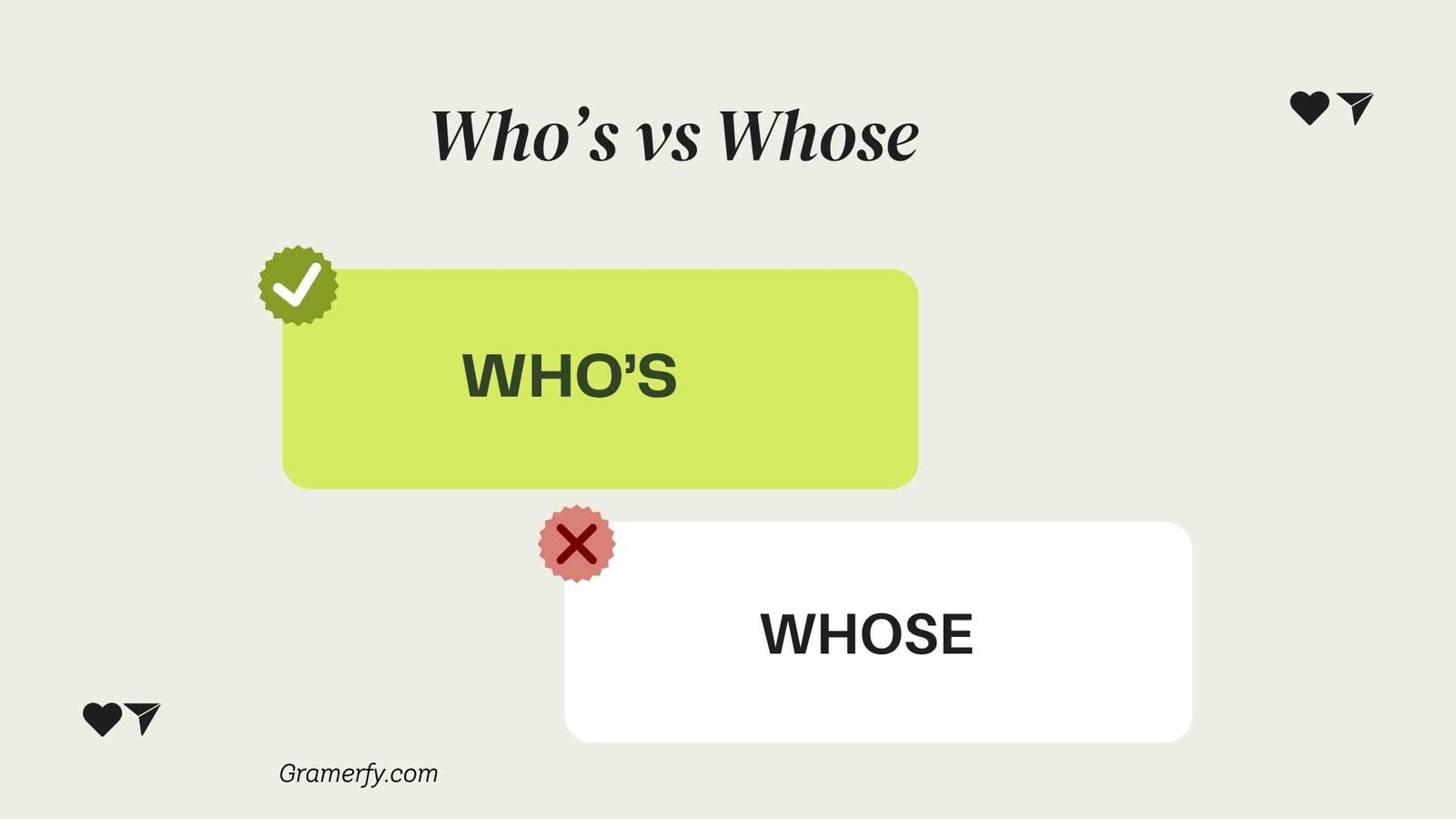
Confused between “Who’s” and “Whose”? You’re not alone! These two tiny words may look similar, but they carry completely different meanings and mixing them up can make even the simplest sentence feel awkward or unclear.
“Who’s” is a contraction for “who is” or “who has,” while “Whose” shows possession, telling us that something belongs to someone. Despite their small size, they pack a big punch in writing, texting, emails, and social media posts.
Getting them wrong isn’t just a grammar slip it can change the meaning of your sentence entirely, leaving your readers puzzled or misinformed.
What Does “Who’s” Mean?
“Who’s” is a contraction of “who is” or “who has.” Contractions are shortened forms of words combined with an apostrophe.
- Who is: Used to ask about someone or describe someone.
- Who has: Used to describe an action someone has done.
Examples of “Who’s”
- Who’s coming to the party tonight? (Who is coming)
- Do you know who’s responsible for this mistake? (Who is responsible)
- Who’s finished their homework? (Who has finished)
- I wonder who’s been calling me all day. (Who has been)
Tip: If you can replace who’s with who is or who has in your sentence and it still makes sense, then who’s is correct.
What Does “Whose” Mean?
“Whose” is a possessive pronoun. It shows that something belongs to someone.
Examples of “Whose”
- Whose book is this? (The book belongs to someone)
- I met a woman whose dog won a prize. (The dog belongs to the woman)
- Whose idea was it to organize the trip?
- Do you know whose car is parked outside?
Tip: If you are talking about ownership or possession, always use whose.
Quick Comparison: Who’s vs Whose
| Word | Meaning | Usage Example | Replacement Tip |
| Who’s | Contraction of who is / who has | Who’s coming to dinner? (Who is coming) | Try replacing with who is / who has |
| Whose | Possessive pronoun (ownership) | Whose jacket is this? | Replace with belonging to whom to check |
Common Mistakes and Spelling Tips
Even native speakers sometimes confuse who’s and whose. Here are some tips to avoid mistakes:
- Don’t forget the apostrophe in “who’s”
- Wrong: Whos coming to the party?
- Correct: Who’s coming to the party?
- Wrong: Whos coming to the party?
- Remember possession for “whose”
- Wrong: Who’s bag is this?
- Correct: Whose bag is this?
- Wrong: Who’s bag is this?
- Check by substitution
- Replace who’s with who is / who has. If it doesn’t make sense, use whose.
- Replace who’s with who is / who has. If it doesn’t make sense, use whose.
- Listen carefully
- Even though they sound the same, writing requires attention to meaning.
- Even though they sound the same, writing requires attention to meaning.
More Examples for Practice
Using “Who’s”
- Who’s ready to start the meeting?
- I wonder who’s going to win the competition.
- Who’s ever heard such a story?
- Can you tell me who’s knocking at the door?
Using “Whose”
- Whose shoes are these by the door?
- I found a letter whose sender is unknown.
- Whose turn is it to do the dishes?
- He is a student whose grades are excellent.
Easy Tricks to Remember the Difference
- Who’s = who is / who has → think action
- Whose = belonging to someone → think possession
- If you are unsure, try replacing it in your sentence. If it works as who is / who has, use who’s; otherwise, use whose.
FAQs (People Also Ask)
Q1: Can I use “whose” for objects?
Yes! Even though “whose” refers to possession, it can be used for objects:
- Example: I saw a house whose windows were broken.
Q2: Is “who’s” ever wrong?
“Who’s” is only wrong if you use it when you mean possession. Always check if who is or who has fits.
Q3: How do I know when to use “whose” or “who’s” in a question?
- Ask yourself: Am I asking about someone’s action → who’s
- Asking about ownership → whose
Q4: Can “whose” be used for animals?
Yes! Anything that “belongs” can be used with whose:
- Example: The cat whose owner is away is very lonely.
Q5: Are “who’s” and “whose” pronounced the same?
Yes, they sound identical in English, which is why spelling and context are very important.
Summary
Understanding the difference between who’s and whose is essential for clear and correct writing. Who’s is a contraction of “who is” or “who has,” while whose shows possession or ownership. Mixing them up can confuse readers and change the meaning of your sentences entirely.
By remembering that who’s always expands to a verb phrase and whose indicates something belongs to someone, you can write with confidence and precision. Regular practice and careful proofreading will make using these words second nature. Mastering this small distinction enhances both your grammar and overall communication skills.