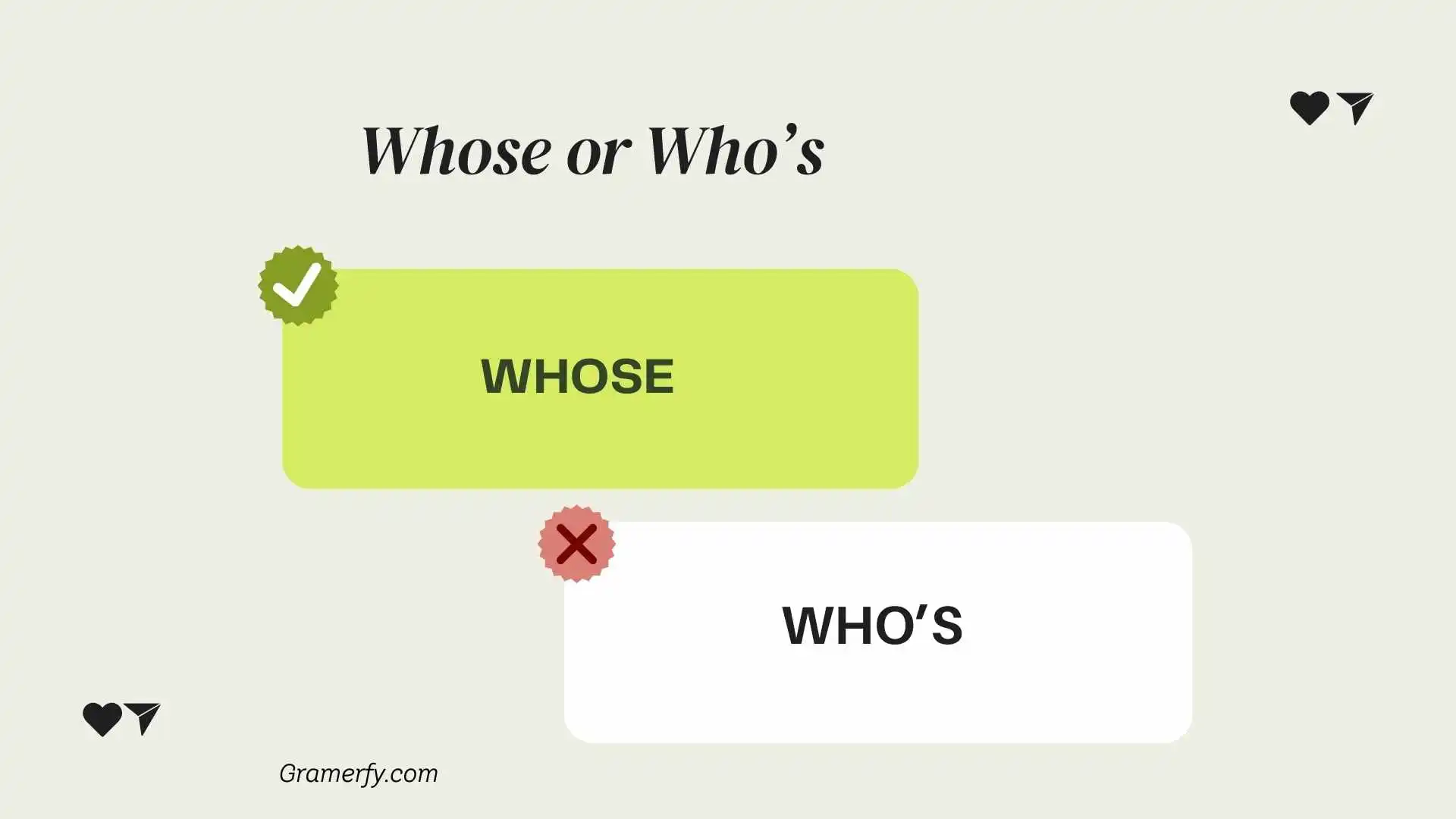
Have you ever paused while writing and wondered: Is it “whose” or “who’s”? 🤔 You’re not alone. This tiny pair of words confuses millions of English learners and even native speakers every day.
At first glance, they look almost identical, but their meanings and uses are completely different. One small apostrophe can change the entire meaning of a sentence!
Imagine writing an important email, a social media post, or an essay and suddenly getting stuck on this simple question. Should it be whose or who’s? Choosing the wrong one can make your writing look unprofessional or confusing.
What Does “Whose” Mean?
Whose is a possessive pronoun. It shows that something belongs to someone or something. Think of it as the possessive form of “who”.
- Examples:
- Whose book is this?
- I met a girl whose father is a doctor.
- Do you know whose keys are on the table?
- Whose book is this?
Key points about “whose”:
- It never uses an apostrophe.
- Always shows ownership or belonging.
- Can refer to people, animals, or things.
What Does “Who’s” Mean?
Who’s is a contraction of who is or who has. The apostrophe replaces the missing letters:
- Who is → Who’s
- Who has → Who’s
- Examples:
- Who’s coming to the party tonight? (Who is coming…)
- Who’s finished their homework? (Who has finished…)
- Can you tell me who’s responsible for this?
- Who’s coming to the party tonight? (Who is coming…)
Key points about “who’s”:
- Always has an apostrophe.
- Never shows possession.
- Common in informal writing and speech.
Whose vs Who’s: Easy Comparison
| Feature | Whose | Who’s |
| Meaning | Possessive (belonging to) | Contraction (who is/has) |
| Apostrophe | ❌ No | ✅ Yes |
| Example 1 | Whose coat is this? | Who’s coming with us? |
| Example 2 | I met a man whose car was stolen. | Who’s seen my phone? |
| Usage Tip | Use for ownership | Use for “is” or “has” |
Quick Tip: If you can replace the word with “who is” or “who has” and the sentence still makes sense, use who’s. Otherwise, it’s probably whose.
Common Mistakes with “Whose” and “Who’s”
Many learners make these mistakes:
- Using who’s for possession
- ❌ Who’s book is this?
- ✅ Whose book is this?
- ❌ Who’s book is this?
- Using whose instead of who’s
- ❌ Whose coming to dinner?
- ✅ Who’s coming to dinner?
- ❌ Whose coming to dinner?
- Confusing apostrophe placement
- Remember: whose = no apostrophe, who’s = has an apostrophe
- Remember: whose = no apostrophe, who’s = has an apostrophe
- Overthinking “whose” with things
- ✅ Whose idea was this? (Correct for objects or people)
- ❌ Who’s idea was this? (Incorrect if meaning possession)
- ✅ Whose idea was this? (Correct for objects or people)
Spelling and Pronunciation Tips
- Whose rhymes with “choose.”
- Who’s sounds the same but remember the apostrophe rule.
- When in doubt, test by expanding who’s → who is/has.
Examples of Correct Usage
Whose
- Whose turn is it to wash the dishes?
- I found a wallet whose owner had left it on the bus.
- She is the artist whose paintings were displayed in the gallery.
Who’s
- Who’s your favorite singer? (Who is…)
- Who’s been eating my snacks? (Who has…)
- Do you know who’s in charge here?
Fun Trick to Remember
Think of “whose” as “belonging to someone” and “who’s” as a short form of “who is/has”.
- Trick sentence:
- Whose shoes are these? → ownership
- Who’s wearing those shoes? → contraction
- Whose shoes are these? → ownership
FAQs (People Also Ask)
Q1: Can “whose” refer to things, not just people?
A: Yes! For example: “Whose idea was this invention?” It works for both people and objects.
Q2: Is “who’s” formal or informal?
A: It’s commonly informal but acceptable in most writing. For formal writing, you might use “who is” instead.
Q3: Can I use “whose” at the start of a sentence?
A: Absolutely! “Whose bag is on the table?” is perfectly correct.
Q4: How can I test if I should use “who’s”?
A: Replace it with “who is” or “who has.” If the sentence makes sense, use who’s.
Q5: Do native speakers confuse “whose” and “who’s”?
A: Sometimes, yes. Even experienced writers double-check because the words sound identical.
Tips for Avoiding Mistakes
- Always check for apostrophes: who’s = has/ is, whose = ownership
- Use replacement test: can you say “who is” or “who has”? If yes → who’s
- Read your sentence aloud; your ear will often catch errors.
- Remember common phrases: whose fault, whose idea, who’s going, who’s been.
Summary Table of Rules
| Rule | Example Correct Usage | Example Incorrect Usage |
| Possession → whose | Whose shoes are these? | Who’s shoes are these? |
| Contraction → who’s | Who’s ready for dinner? | Whose ready for dinner? |
| Test with “who is/has” | Who’s (who is) your teacher? | Whose (who is) your teacher? |
| Remember apostrophe | ✅ Who’s = who is/has | ❌ Whose = who is/has |
| Use for people & objects | Whose turn, whose bag, whose car | N/A |
Quick Practice Sentences
Fill in the blanks with whose or who’s:
- ________ jacket is lying on the chair?
- ________ going to the park this evening?
- She is the girl ________ brother won the contest.
- ________ finished the project before the deadline?
- I met a teacher ________ advice helped me a lot.
Answers:
- Whose
- Who’s
- Whose
- Who’s
- Whose
Conclusion
Mastering whose and who’s is simpler than it seems. Remember: whose = possession, who’s = who is/has. Use the replacement trick, double-check apostrophes, and practice with sentences daily.
With these tips, you’ll avoid common mistakes, write confidently, and make your English clear and polished. Practice, patience, and attention to detail are key, and soon you’ll never mix these two again!