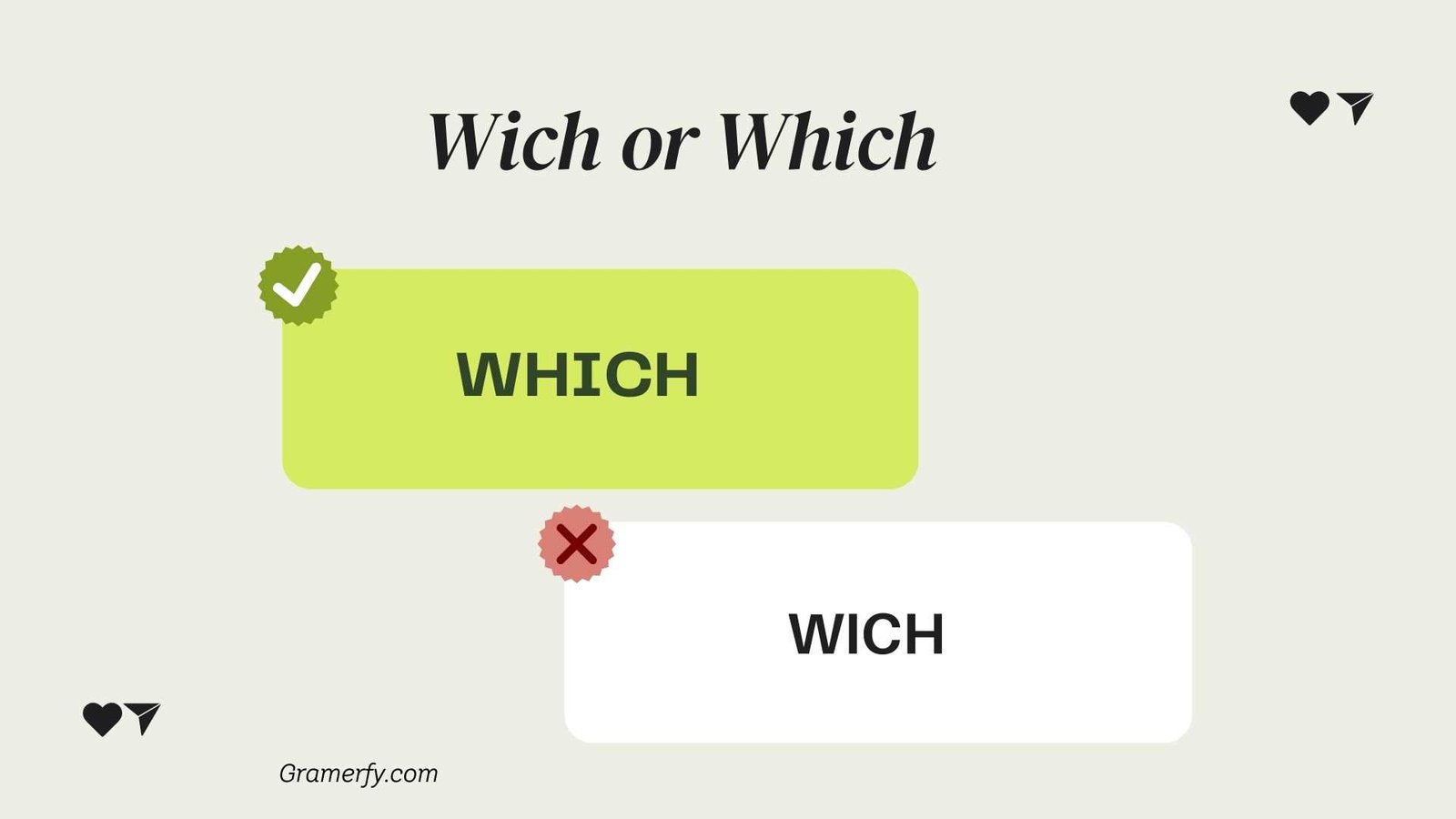
Confused between “wich” or “which”? You’re not alone. Every day, thousands of people type these two words into search bars, hoping to find a simple, clear answer.
A tiny spelling mistake can change the meaning of a sentence or make it look unprofessional. That’s why understanding the real difference between wich and which matters more than you might think.
Here’s the truth: one of these words is correct in standard English, and the other is usually a spelling error. But when you’re writing fast it’s a text message, social post, email, or school assignment it’s easy to mix them up. And once that habit forms, it sticks.
Meaning and Usage of “Which”
What Does “Which” Mean?
The word “which” is a pronoun and determiner used to ask questions or specify one or more items from a known set. It is one of the most common words in English.
- As a question word:
- “Which color do you prefer, red or blue?”
- “Which book did you read last week?”
- “Which color do you prefer, red or blue?”
- To introduce a clause:
- “I bought a new phone, which is very fast.”
- “She gave me a gift, which I really liked.”
- “I bought a new phone, which is very fast.”
Key points about “which”:
- It is always spelled w-h-i-c-h.
- It is used for choosing or specifying something.
- It is never used casually in place of “wich” (because “wich” is not standard English).
What About “Wich”?
Is “Wich” Correct?
The word “wich” is generally incorrect in modern English grammar when used in place of “which.” It is a common misspelling, often caused by typing errors or misunderstanding.
However, “wich” does exist in some contexts:
- In certain place names, like Greenwich or Sandwich.
- In some old texts or historical writing, “wich” was used in place of “which.”
Key point: If you are writing standard English, never use “wich” instead of “which.”
Wich vs Which: Comparison Table
Here’s a simple table to help you see the difference clearly:
| Feature | Which | Wich |
| Correct usage | ✅ Yes | ❌ No (except in proper nouns) |
| Function | Pronoun / Determiner | Not standard English |
| Example (question) | Which shirt should I wear? | Wich shirt should I wear? ❌ |
| Example (clause) | I read a book, which was fun. | I read a book, wich was fun ❌ |
| Common confusion | “wich” as a typo | Rarely correct |
| Appearance in names | Rare | ✅ Sandwich, Greenwich |
Common Mistakes With “Which”
Even native speakers make mistakes with which, especially in informal writing. Here are the most common ones:
- Using “wich” instead of “which”
- ❌ “Wich movie do you want to watch?”
- ✅ “Which movie do you want to watch?”
- ❌ “Wich movie do you want to watch?”
- Omitting “which” in clauses
- ❌ “I bought a car, is very fast.”
- ✅ “I bought a car, which is very fast.”
- ❌ “I bought a car, is very fast.”
- Using “which” when “that” is better
- “Which” is generally used in non-restrictive clauses (extra info).
- “That” is used in restrictive clauses (essential info).
- Example:
- ❌ “The book which I borrowed is great.” (acceptable but less natural)
- ✅ “The book that I borrowed is great.” (more natural for essential info)
- ❌ “The book which I borrowed is great.” (acceptable but less natural)
- “Which” is generally used in non-restrictive clauses (extra info).
Spelling Tips to Avoid Mistakes
Here are some tricks to remember that the correct spelling is “which”:
- Think of the “h”
- “Which” has an h after w, like whale, when, why. This can help you remember the correct spelling.
- “Which” has an h after w, like whale, when, why. This can help you remember the correct spelling.
- Check the context
- If you are asking a question or giving extra information, it’s almost always which, never wich.
- If you are asking a question or giving extra information, it’s almost always which, never wich.
- Use mnemonic phrases
- “Wonderful Helpers In Choosing Happily” = which.
- “Wonderful Helpers In Choosing Happily” = which.
Examples of Correct Usage
Here are multiple examples to make things crystal clear:
Questions Using “Which”
- “Which dress should I wear for the party?”
- “Which route will be faster to reach the airport?”
- “Which movie won the Oscar last year?”
Clauses Using “Which”
- “I visited the museum, which was very interesting.”
- “She bought a laptop, which has the latest features.”
- “He passed the exam, which made him very happy.”
Choosing Between Options
- “Which flavor of ice cream do you like?”
- “Which of these pens is yours?”
- “Which day works best for the meeting?”
Why People Confuse “Wich” and “Which”
The confusion usually arises because:
- Pronunciation is the same – both sound like /wɪtʃ/.
- Typing errors – the “h” is easy to miss on a keyboard.
- Lack of awareness – many learners do not know “wich” is almost never correct.
Remember: Whenever you write English, choose which, except for proper nouns like Greenwich.
FAQs (People Also Ask)
1. Can I use “wich” instead of “which”?
No. In standard English, “wich” is incorrect unless it is part of a proper noun. Always use which in grammar.
2. Is “which” used only for questions?
No. “Which” can also introduce extra information in sentences:
- “I bought a car, which is red.”
3. How do I remember “which”?
Focus on the h after w. Think of words like what, when, where, why to help you.
4. Is “wich” ever correct?
Only in names or historical texts. Examples:
- Sandwich (a place and food)
- Greenwich (a city in England)
5. What is the difference between “which” and “that”?
- Which → non-essential info: “I read a book, which was amazing.”
- That → essential info: “The book that I read was amazing.”
Tips to Practice Using “Which”
- Make your own sentences
- Write 5–10 questions using which.
- Write 5–10 questions using which.
- Check grammar apps
- Grammarly or Word can catch “wich” errors.
- Grammarly or Word can catch “wich” errors.
- Read English books and articles
- Notice how often which is used in questions and clauses.
- Notice how often which is used in questions and clauses.
- Speak out loud
- Say sentences with which to remember the pronunciation and spelling.
- Say sentences with which to remember the pronunciation and spelling.
Conclusion
By practicing and reviewing the examples in this guide, you will soon use which confidently and naturally in your writing and speaking.
Correct use of which not only improves your grammar but also makes your English sound professional and polished.