When it comes to expressing devotion, respect, or admiration, choosing the right spelling can make a surprising difference. Many English learners and even native speakers often get puzzled between “Worshiped” and “Worshipped”.
While both forms essentially convey the same meaning the act of showing reverence or adoration they follow different spelling conventions depending on whether you’re using American or British English.
Imagine writing a heartfelt essay, a historical piece, or a religious reflection, only to stumble over this tiny yet impactful detail. Understanding which form fits your context not only sharpens your writing but also boosts your credibility.
Meaning of Worship
Before we dive into the past tense forms, let’s understand the word “worship” itself.
- Worship (verb): To show great respect, love, or devotion to a deity, person, or thing.
- Worship (noun): The act of showing reverence or adoration, usually in a religious context.
Examples:
- People worship their gods in different ways.
- Sunday is a day of worship for many religions.
Worshiped vs Worshipped: Correct Usage
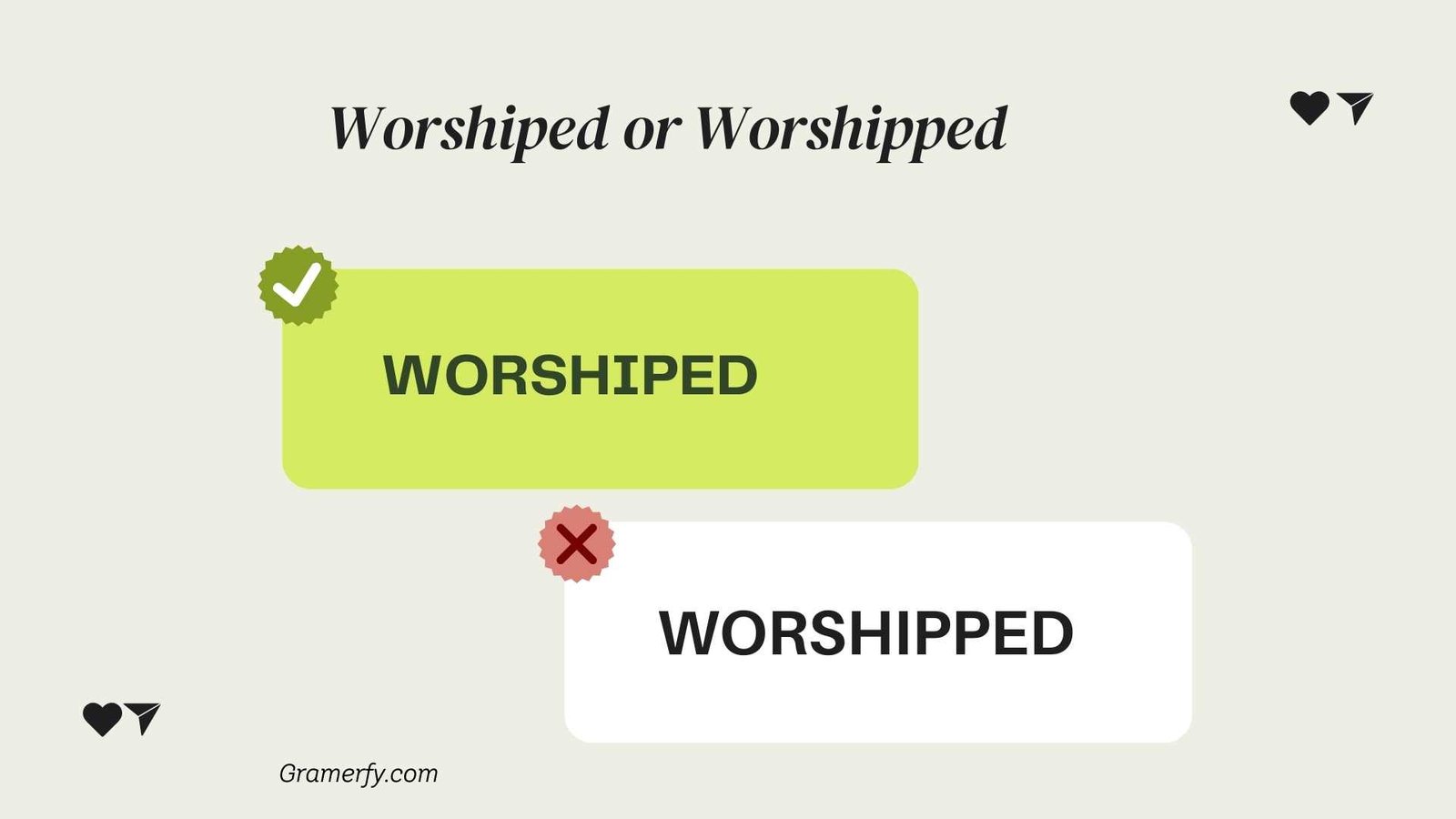
The difference between worshiped and worshipped lies mainly in spelling conventions, not meaning. Both forms are correct, but their usage depends on whether you follow American English or British English rules.
| Word | Usage | Example Sentence |
| Worshiped | American English | He worshiped the saints at the church. |
| Worshipped | British English | She worshipped her grandmother like a queen. |
Key Points:
- American English: Typically uses a single “p” – worshiped.
- British English: Doubles the consonant “p” – worshipped.
- Meaning: Both words mean exactly the same thing; the difference is only in regional spelling.
Rules for Forming the Past Tense
English verbs follow certain rules when changing to the past tense. The difference between worshiped and worshipped is a classic example of a consonant doubling rule.
Consonant Doubling Rule:
- If a verb ends in a single consonant preceded by a single vowel, and the stress is on the last syllable, double the consonant before adding -ed.
- Example: admit → admitted
- If the stress is not on the last syllable (as in worship), American English usually does not double the consonant.
- American English: worship → worshiped
- British English: worship → worshipped
Common Mistakes and Spelling Tips
Even native speakers sometimes get confused. Here are the most common mistakes and tips:
- Mistake: Using the wrong version for your audience.
Tip: Use worshiped for American readers and worshipped for British readers. - Mistake: Forgetting the double consonant in British English.
Tip: Remember: British English often doubles the final consonant for verbs ending in a single vowel + consonant. - Mistake: Confusing worship with similar verbs.
Tip: Compare with words like travel → traveled (US), travelled (UK). The pattern is the same. - Mistake: Spelling the base word incorrectly before adding -ed.
Tip: Always check the base word: worship is spelled with one p before adding endings in American English.
Examples in Sentences
Here are multiple examples showing worshiped and worshipped in context:
American English (Worshiped)
- They worshiped at the temple every weekend.
- I worshiped my teachers when I was a child.
- Many people worshiped the ancient gods in ceremonies.
British English (Worshipped)
- She worshipped her parents for their guidance.
- The villagers worshipped the local deity during the festival.
- He worshipped the singer like she was a superstar.
Tip: Both forms can appear in literature, newspapers, or online, so understanding your audience is key.
Worshiped vs Worshipped: Quick Comparison Table
| Feature | Worshiped (US) | Worshipped (UK) |
| Spelling | Single “p” | Double “p” |
| Region | United States | United Kingdom |
| Pronunciation | Same | Same |
| Meaning | Same | Same |
| Past Tense Usage Example | He worshiped the saint. | She worshipped her grandmother. |
FAQs (People Also Ask)
Q1: Is it wrong to write worshiped?
A: No, it is correct in American English. British English prefers worshipped.
Q2: Can I use worshipped in the US?
A: Yes, it will still be understood, but it may look unusual to American readers.
Q3: How do you pronounce worshiped and worshipped?
A: Both are pronounced the same way: /ˈwɜr.ʃɪpt/.
Q4: What is the present tense of worshiped/worshipped?
A: The present tense is worship.
Example: I worship at the temple every week.
Q5: Are there other verbs like worship that have double consonant variations?
A: Yes! Examples include:
- travel → traveled/travelled
- cancel → canceled/cancelled
- label → labeled/labelled
Tips for Remembering the Difference
- Think about your audience: US → worshiped, UK → worshipped.
- Look at the pattern: Words ending in a single vowel + consonant often double in British English.
- Practice with examples: Write sentences in both versions to get comfortable.
Conclusion
With this guide, you can confidently write sentences using worshiped or worshipped, knowing exactly which form is appropriate.
Now, whether you are writing an essay, a blog, or a story, you’ll never be unsure about this word again!