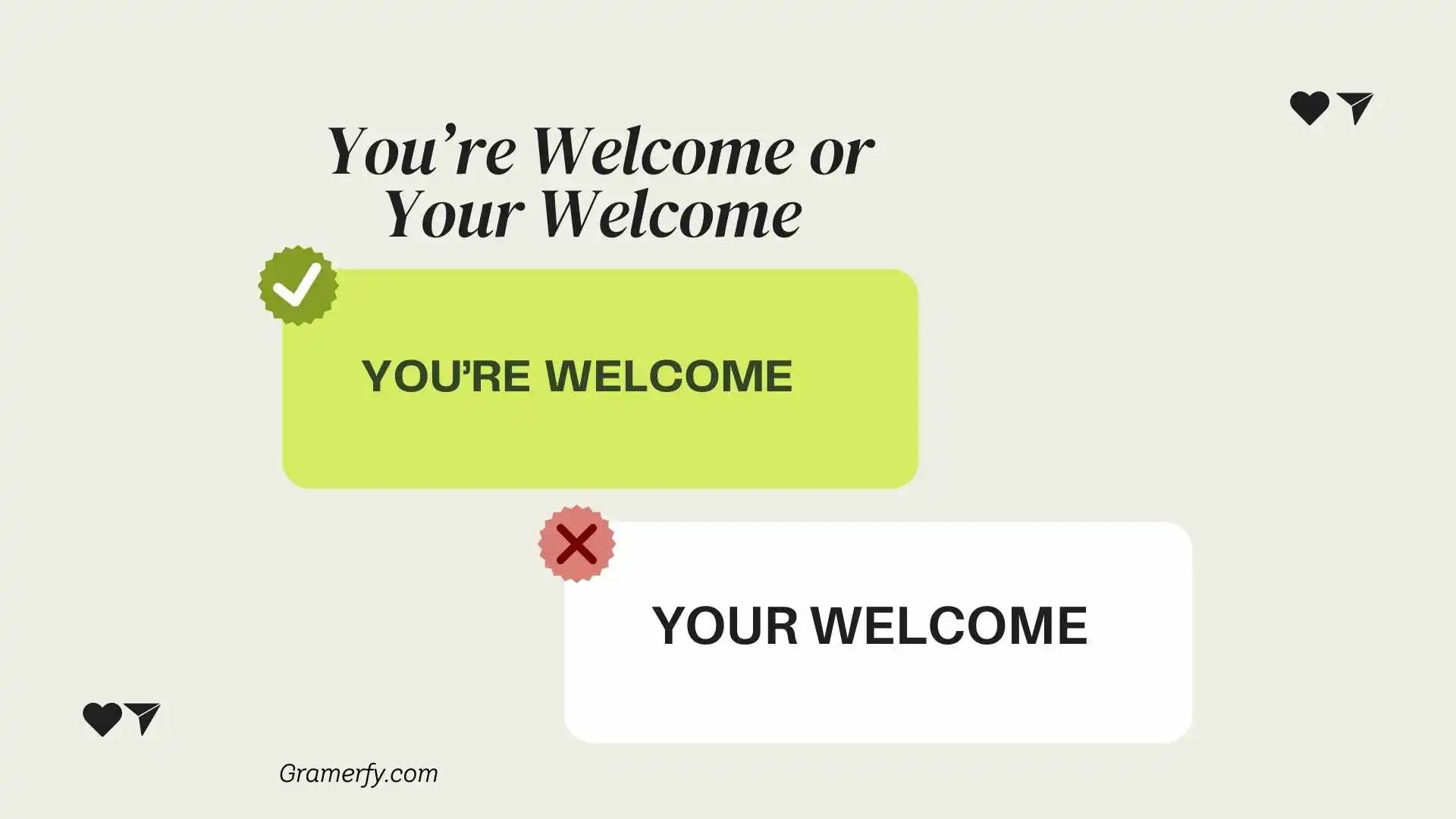
Have you ever paused for a moment and wondered whether you should write “You’re welcome” or “Your welcome” after someone says thank you? You’re not alone.
This tiny difference confuses thousands of people every day, especially in texts, emails, and social media comments. At first glance, both phrases look almost identical. However, only one of them is grammatically correct in standard English.
Understanding the difference between “You’re welcome” and “Your welcome” can instantly improve your writing and help you avoid a common mistake many people make online.
What Does “You’re Welcome” Mean?
“You’re welcome” is a contraction of “you are welcome.” It is the correct response when someone thanks you. It shows politeness and acknowledgment.
Key Points:
- Contraction of you are.
- Used after thank you.
- Polite and friendly.
Examples:
- “Thank you for helping me with my homework.”
Response: “You’re welcome!” - “I appreciate your advice.”
Response: “You’re welcome.” - “Thanks for the gift.”
Response: “You’re welcome, I’m glad you liked it.”
What Does “Your Welcome” Mean?
“Your welcome” is grammatically incorrect in the context of responding to thanks.
- “Your” is a possessive pronoun, showing ownership (e.g., your book, your bag).
- Saying “your welcome” is like claiming that the welcome belongs to someone, which usually makes no sense.
Examples (Incorrect):
- “Thanks for helping me.”
Wrong Response: “Your welcome.” - “I really liked your work.”
Wrong Response: “Your welcome.”
Tip: If you are responding to “thank you,” always use you’re welcome.
You’re Welcome vs Your Welcome: Quick Comparison Table
| Feature | You’re Welcome | Your Welcome |
| Meaning | You are welcome (correct reply) | Possessive, usually incorrect |
| Grammar | Contraction of “you are” | Possessive pronoun “your” |
| Usage | Response to “thank you” | Rarely correct in this context |
| Correct? | ✅ Correct | ❌ Incorrect |
| Example | “You’re welcome for your help.” | “Your welcome mat is at the door.” |
Common Mistakes and How to Avoid Them
Even native speakers sometimes confuse you’re and your, but it’s easy to avoid with a few tips.
Mistake 1: Using “your welcome” after thanks
- ❌ “Thank you for helping me.” → “Your welcome.”
- ✅ Correct: “You’re welcome.”
Mistake 2: Forgetting the apostrophe
- ❌ “Youre welcome.”
- ✅ Correct: “You’re welcome.”
Tip: Remember that you’re = you are. If you can replace it with “you are” in your sentence and it still makes sense, use you’re.
Mistake 3: Confusing possessive and contraction
- ❌ “Your welcome to the party.” (meant as reply to thanks)
- ✅ Correct: “You’re welcome to the party.”
How to Remember the Difference
- Think of the apostrophe – it often signals a contraction: you’re = you are.
- Check if it makes sense to say “you are”. If yes, use you’re.
- “Your” shows ownership. Only use it when something belongs to someone.
Memory Tip:
- When someone thanks you, imagine replying: “You are welcome.” → Always you’re.
More Examples of Correct Usage
Best In Daily Conversation
- “Thanks for picking me up.” → “You’re welcome!”
- “I really appreciate your help.” → “You’re welcome.”
In Texts and Messages
- “Thanks for the birthday gift 🎁” → “You’re welcome!”
- “Thanks a lot for your advice.” → “You’re welcome, happy to help.”
In Emails or Formal Writing
- “Thank you for your prompt response.” → “You’re welcome. Please let me know if you need further assistance.”
FAQs (People Also Ask)
1. Is it “you’re welcome” or “your welcome”?
Answer: The correct phrase is “you’re welcome”, as it means “you are welcome.”
2. Can I write “your welcome” in any situation?
Answer: Only if you literally mean something belongs to someone (e.g., “your welcome mat”), not as a reply to thanks.
3. Do native speakers make this mistake?
Yes, it’s common in informal writing, especially in texts, but it’s considered incorrect.
4. How do I remember which one is correct?
Replace you’re with you are. If the sentence makes sense, you’re good. If not, it’s probably your.
5. Is “youre welcome” correct without the apostrophe?
No, the apostrophe is necessary in formal writing. Informal texts may omit it, but it’s always better to use you’re.
Spelling Tips for Beginners
- Always include the apostrophe in you’re.
- Double-check if you can replace it with “you are.”
- Remember “your” = ownership. Think: “your phone, your book.”
Fun Examples to Remember
- “Thanks for helping me study.” → “You’re welcome, genius!”
- “Thanks for the advice.” → “You’re welcome. I’ve been there before.”
- “Thank you for inviting me.” → “You’re welcome. It’s always fun to have you around.”
Incorrect:
- “Thank you for inviting me.” → “Your welcome.” ❌
Conclusion
Mixing up you’re welcome and your welcome is one of the most common English mistakes, but it’s also one of the easiest to fix. Remember, you’re welcome is a contraction of you are welcome and is the correct reply to “thank you.” On the other hand, your welcome refers to ownership and rarely fits the context of gratitude.
By using simple checks like replacing “you’re” with “you are” and keeping the apostrophe in mind, you can write with confidence and avoid embarrassment. With practice, responding politely with you’re welcome will become automatic in your writing and speech. Mastering this small but crucial detail will make your English sound polished, friendly, and correct.